

The Tools #
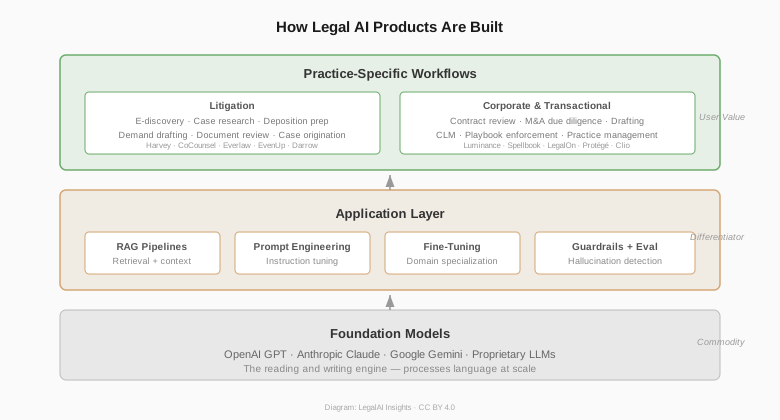
Every legal AI vendor says “proprietary AI.” Most of them run on the same handful of foundation models. The difference between a tool that saves your team ten hours a week and one that collects dust after the pilot isn’t the model underneath — it’s the application layer on top: the retrieval pipeline, the prompt engineering, the legal-specific training data, the workflow design, and the guardrails against hallucination. Two products built on the same foundation model can produce wildly different results.
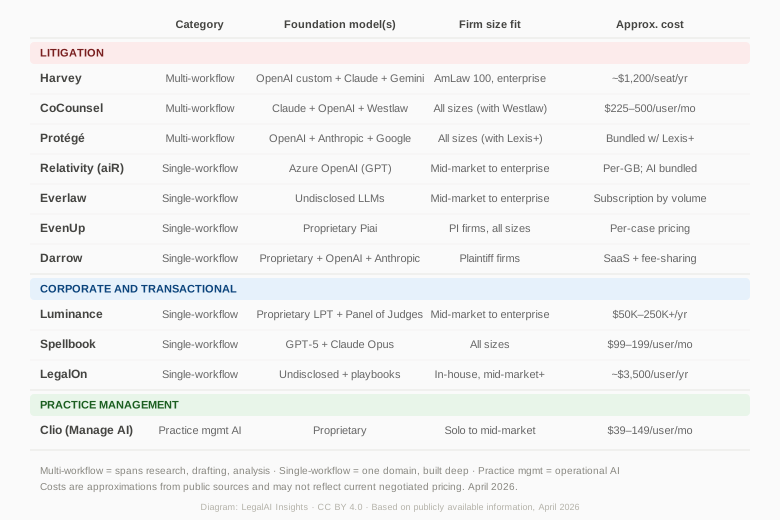
This post profiles eleven tools — seven for litigation, three for corporate and transactional work, and one for practice management. For each: what it does, why it is special, what it runs on (including how it addresses hallucination), what it costs, and the trade-off. Pricing in legal AI is deliberately opaque — most vendors negotiate individually. Where we’ve found numbers, we cite sources. Where we haven’t, we say so.
Litigation #
Harvey #
Harvey is the most-funded legal AI startup in the market, valued at $11 billion after a $200 million round in March 2026 co-led by GIC and Sequoia. Founded in 2022 by Winston Weinberg (former O’Melveny & Myers litigator) and Gabe Pereyra (former DeepMind research scientist), Harvey is used by over 100,000 lawyers across 1,300 organizations.
What it does. Harvey is a multi-workflow legal AI platform spanning research, drafting, document analysis, and workflow automation. Its core products include an AI assistant for question-answering and drafting, a document management system called Vault for bulk analysis, a research module that handles case law and regulatory questions, and a workflow engine for building custom AI pipelines. In 2026, Harvey launched AI Agents — autonomous tools that execute multi-step legal tasks end-to-end, from research through drafting.
Why it is special. Scale of investment and talent. Harvey has raised over $860 million total, hired lawyers from Wachtell, Latham, Skadden, and Paul Weiss, and built a custom case law model with OpenAI that no competitor can replicate without a similar partnership. The multi-model architecture means Harvey isn’t locked to any single provider’s roadmap.
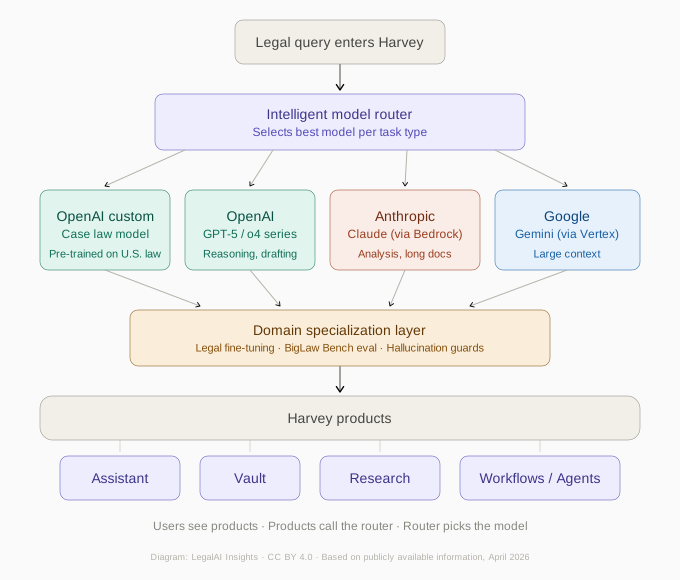
Claude and Google’s Gemini alongside OpenAI’s models. The platform auto-routes queries to the best model for the task, including selecting models with lower hallucination rates for specific task types. Harvey uses agentic workflows with real-time self-review — AI agents that perform their own verification, conduct deeper research when confidence is low, and escalate to human review when needed.
What it costs. Harvey uses annual per-seat subscriptions with custom enterprise quotes. Roughly 42% of AmLaw 100 firms use the platform, including A&O Shearman and HSBC. Estimates vary: earlier reports suggested $500 per lawyer annually, while more recent sources cite ~$1,200 per seat per year with 20-seat minimums. A structured two-week pilot is typically required.
The trade-off. Harvey’s breadth means it may not go as deep as single-workflow tools on any specific task. Enterprise-only pricing puts it out of reach for mid-market and small firms.
CoCounsel (Thomson Reuters) #
CoCounsel is Thomson Reuters’ AI assistant, born from its $650 million acquisition of Casetext in 2023. It reached one million users across 107 countries by February 2026. CoCounsel integrates directly with Westlaw, which gives it a structural advantage no standalone startup can match: when CoCounsel cites a case, it pulls from Westlaw’s verified database, not from a language model’s training data.
What it does. CoCounsel handles legal research with verified citations, document review, contract analysis, deposition preparation, and timeline creation. The next-generation CoCounsel Legal platform, announced in April 2026, is a unified agentic system that plans, selects tools, and adapts mid-workflow — built using Anthropic’s Claude Agent SDK. Thomson Reuters describes it as “fiduciary-grade AI” that works like a senior associate rather than a first-year waiting for instructions.
Why it is special. Westlaw’s database. Thomson Reuters has spent decades building the most comprehensive collection of verified U.S. case law, statutes, and secondary sources. No startup can replicate this corpus — it’s the product of 50+ years of editorial curation. When CoCounsel cites a case, it’s pulling from that database, not generating from training data. The KeyCite citation verification system has no equivalent outside Thomson Reuters and LexisNexis.
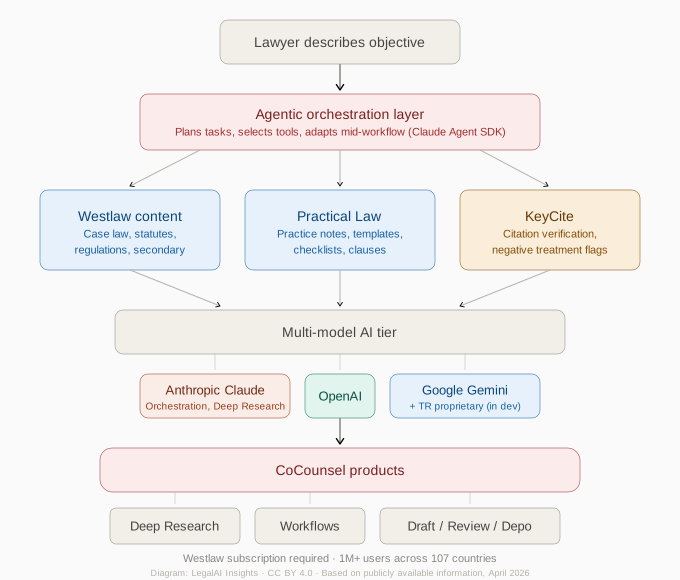
GPT-4. The next-generation version uses Anthropic’s Claude Agent SDK for its agentic capabilities, integrated with Westlaw’s proprietary legal database, Practical Law content, and the KeyCite citation verification system — which checks every cited case for negative treatment post-generation. Deep Research uses specialized agents for different document types (case law, statutes, secondary sources), each tuned to reduce errors in its domain. The UK launch integrates Microsoft 365 and document management systems. Thomson Reuters has also disclosed it is developing a proprietary LLM for legal, tax, and compliance use cases.
What it costs. CoCounsel is an add-on to Westlaw, not a standalone product. Tiers include CoCounsel Core at $225/user/month and All Access at $500/user/month. But CoCounsel requires a Westlaw subscription, pushing total Thomson Reuters spend to $300–600/user/month.
The trade-off. CoCounsel’s Westlaw integration is simultaneously its greatest asset and its deepest lock-in. It dramatically reduces hallucination risk on citations, but ties you further into the Thomson Reuters ecosystem. Its capabilities outside research — drafting, client communications — are narrower than multi-workflow platforms like Harvey.
Lexis+ with Protégé (LexisNexis) #
Lexis+ with Protégé is LexisNexis’s answer to CoCounsel — an AI platform that leverages the second-largest legal database in the world. Launched in February 2026 as the replacement for Lexis+ AI, it represents LexisNexis’s bet that the future of legal AI is integrated workflows, not standalone chat.
What it does. Protégé combines conversational legal research, document drafting, summarization, and analysis in a single prompt box backed by LexisNexis’s content library. It ships with hundreds of pre-built workflows — including litigation workflows for drafting motions and generating discovery documents, transactional workflows for contract redlining and risk assessment, and a custom workflow builder. Every output is grounded in Shepard’s Citations for verification, and the platform supports AI personalization by role, jurisdiction, and practice area. Protégé integrates with Microsoft 365, document management systems, and iManage/SharePoint.
Why it is special. Where CoCounsel’s moat is KeyCite and Practical Law, Protégé’s is Shepard’s Citations and secondary source depth. Protégé adds a GraphRAG architecture that retrieves entire subgraphs of citation relationships rather than individual documents. LexisNexis posted the lowest independently measured hallucination rate among legal AI tools in Stanford’s testing.
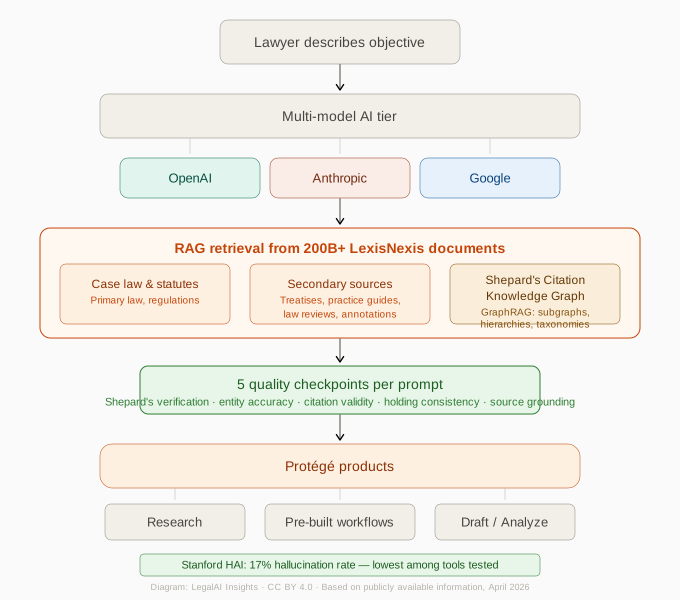
What it runs on. Protégé uses foundation models from OpenAI, Anthropic, and Google, integrated within LexisNexis’s secure environment. Customer inputs are not used to train any external models. RAG retrieval draws from 200 billion LexisNexis documents. Stanford’s independent testing found Lexis+ AI hallucinated 17% of the time — the best rate among tools tested.
What it costs. Like CoCounsel, Lexis+ with Protégé is bundled with the LexisNexis subscription ecosystem. Pricing is negotiated individually. Industry comparisons suggest Lexis has been pricing aggressively to compete with CoCounsel, with lower total cost in many cases for firms comparing the two publishers’ AI offerings.
The trade-off. The CoCounsel vs. Protégé choice is the defining procurement decision for many litigation teams. Protégé has broader secondary source coverage and Shepard’s citations; CoCounsel has KeyCite and Practical Law. If your firm already pays for one publisher’s ecosystem, the AI add-on from that publisher will almost always win on total cost and workflow integration.
Relativity (aiR) #
Relativity is the incumbent e-discovery platform — used by 198 of the Am Law 200, the U.S. Department of Justice, and over 300,000 users in approximately 40 countries. Founded in 2001 (originally as kCura), the company filed confidentially for an IPO in March 2026 at a ~$4 billion valuation. Relativity is layering generative AI onto the platform that already processes more litigation data than any other tool on earth — an incumbent strategy built on installed base rather than AI-native architecture.
What it does. Relativity aiR is a suite of generative AI products embedded in the RelativityOne cloud platform. aiR for Review performs first-pass document review. aiR for Privilege identifies privileged documents and flags disclosure risks. aiR for Case Strategy — generally available since January 2026 — auto-extracts key facts, visualizes chronologies, summarizes transcripts, and streamlines deposition preparation. aiR Assist is a natural-language search tool that answers questions across document sets with citations. Over 250 customers use the aiR suite, with 240 million+ review predictions made across thousands of matters.
Why it is special. Installed base and ecosystem. No e-discovery platform comes close to Relativity’s market penetration — 198 of the Am Law 200 means virtually every major litigation team already has Relativity workflows, trained reviewers, and institutional muscle memory built around the platform. The Relativity App Hub extends the platform with hundreds of third-party integrations, creating switching costs that no competitor can easily overcome. When Relativity bundles AI into standard pricing, 300,000 users get access overnight without a procurement conversation.
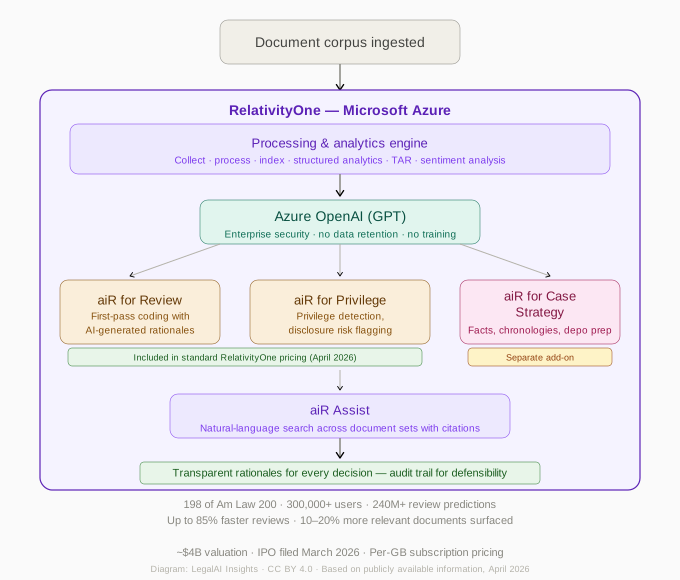
What it runs on. Relativity aiR is built in partnership with Microsoft Azure OpenAI, using OpenAI’s models within Azure’s enterprise security environment. Customer data stays within RelativityOne and is never retained by Relativity or Microsoft for training. Each aiR product generates transparent rationales — for every review decision, the AI explains why it coded a document a particular way, creating an audit trail for defensibility. Customers report up to 85% faster reviews and 10–20% more relevant documents surfaced compared to linear or TAR-only alternatives.
What it costs. RelativityOne uses subscription pricing based on data volume (per-GB tiers), not per-seat. Starting in April 2026, aiR for Review and aiR for Privilege are included in standard RelativityOne pricing at no additional charge — a move that eliminated the AI upcharge friction across the entire installed base. aiR for Case Strategy remains a separate add-on. Specific per-GB pricing is not publicly disclosed and varies by commitment level.
The trade-off. Relativity is an e-discovery and litigation platform, not a research or drafting tool. It doesn’t compete with CoCounsel or Protégé on legal research, and it doesn’t handle contract review or transactional work. The platform’s complexity — built over two decades for large-scale litigation — can overwhelm small teams with simple discovery needs. And while aiR for Review and Privilege are now bundled, aiR for Case Strategy’s separate pricing means the full AI suite still requires additional investment.
Everlaw #
Everlaw is the leading AI-native e-discovery platform, purpose-built for litigation teams managing large document sets. Used by 91 of the Am Law 200, all 50 state attorneys general, and Fortune 100 corporate counsel, Everlaw attacks the problem from the documents up — where Harvey and CoCounsel approach litigation from research and drafting.
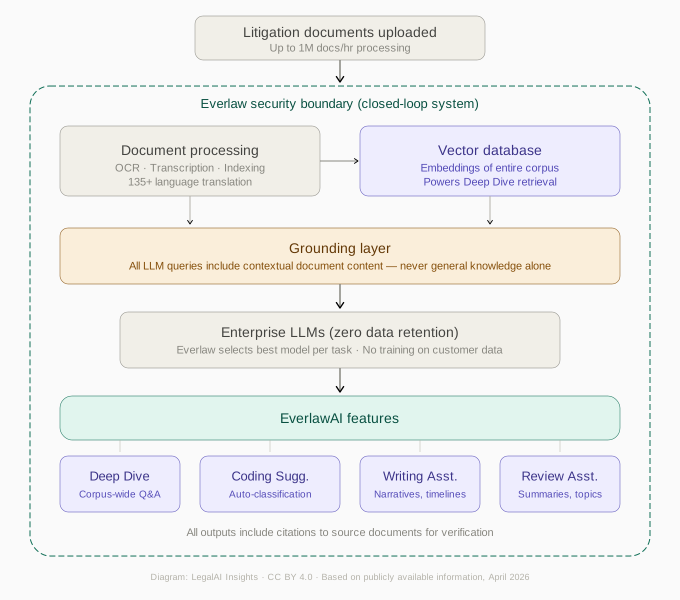
What it does. EverlawAI embeds generative AI directly into the e-discovery workflow through four key features. Deep Dive lets users ask natural-language questions across millions of documents and get answers with direct citations. Coding Suggestions auto-classifies documents for relevance, privilege, and case issues at accuracy levels that match or exceed human review. Writing Assistant synthesizes reviewed evidence into case narratives, timelines, and deposition questions. The platform processes up to one million documents per hour.
Why it is special. Workflow integration. Everlaw doesn’t bolt AI onto a separate interface — it embeds Deep Dive, Coding Suggestions, and Writing Assistant directly into the review workflow where attorneys already spend their time. A reviewer can ask a question about the corpus, get a cited answer, code the document, and build a case narrative without leaving the platform. The closed-loop architecture also means no client data leaves Everlaw’s security boundary.
What it costs. Subscription pricing varies by data volume and user count, with AI capabilities bundled into base tiers rather than charged as add-ons. Specific per-seat pricing is not publicly available.
The trade-off. No legal research, no brief drafting, no contract review, no transactional support. Everlaw does e-discovery — and if your need is outside that boundary, you’ll need a second tool.
EvenUp #
EvenUp is the category leader in AI for personal injury law, valued at over $2 billion after a $150 million Series E in October 2025. Over 2,000 firms — including 20% of the top 100 U.S. personal injury firms — use the platform, processing over 10,000 cases per week.
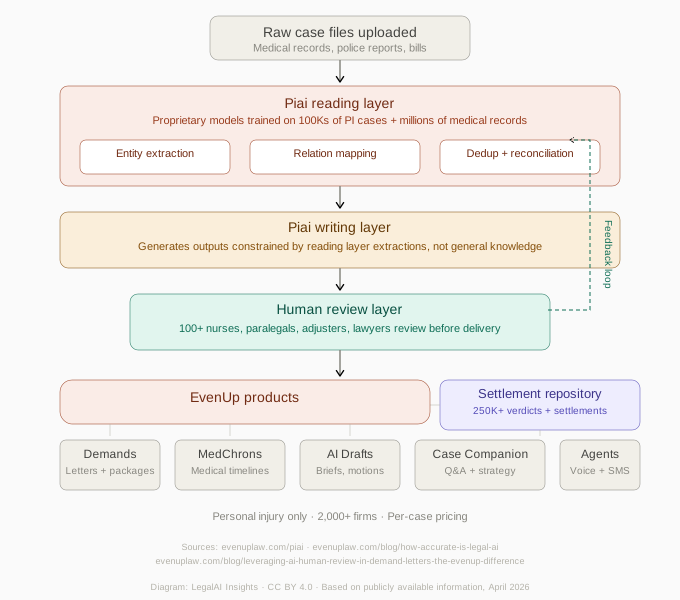
What it does. EvenUp’s Claims Intelligence Platform handles the entire PI case lifecycle. It generates demand letters and medical chronologies from raw medical records, structures settlement data for negotiation, monitors treatment gaps across active caseloads, and automates client communication through AI agents. One Houston firm reported a 30% increase in monthly demand output and a 300% increase in settlement offers on certain case types after deployment.
Why it is special. Proprietary data flywheel. EvenUp has processed over 200,000 cases and millions of medical records, and every case processed makes the model more precise. No competitor can replicate this dataset without processing a comparable volume of PI cases. The combination of domain-specific AI with human review creates an accuracy floor that general-purpose tools can’t match on medical record extraction.
What it costs. EvenUp does not publish pricing. Subscription is tied to case volume, with per-case pricing and no feature tiers. The ROI case is unusually concrete: firms can measure increased demand output and settlement results directly against subscription costs.
The trade-off. EvenUp is built for personal injury law and nothing else. If you practice PI, it’s likely the most impactful AI tool available. If you don’t, it’s irrelevant.
Darrow #
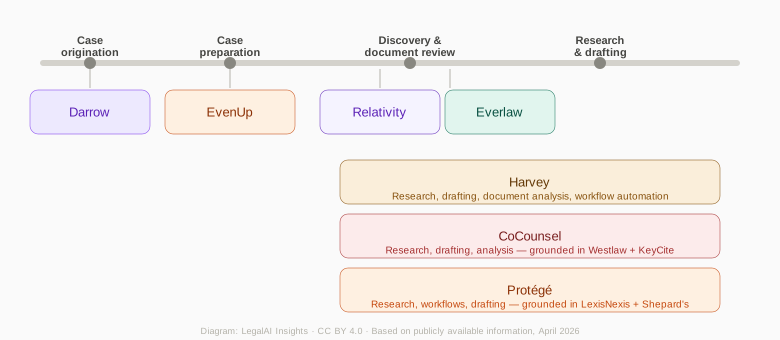
Darrow occupies a unique position in legal AI: it works upstream of litigation, identifying potential legal violations before cases are filed. While every other tool on this list helps you with work you’ve already decided to do, Darrow helps you decide what work is worth doing. The platform serves approximately 80 law firms with 3,000 active lawyers and has facilitated over $15 billion in active litigation value.
What it does. Darrow’s Legal Exposure Management platform scans billions of public data points — regulatory filings, SEC disclosures, consumer complaints, environmental reports, court dockets, and social media — to detect patterns that indicate corporate legal violations. Its Snippets feature delivers anonymized, litigation-ready case previews to plaintiff firms, while its predictive underwriting tools assess case merit and likely outcomes using AI, legal reasoning, and financial modeling.
Why it is special. It occupies a category no other tool on this list competes in: case origination. Darrow doesn’t help you do legal work faster — it finds work worth doing. The proprietary Legal Intelligence Assets scanning regulatory filings, consumer complaints, and SEC disclosures represent years of domain-specific data pipeline engineering that a general-purpose AI tool can’t replicate.
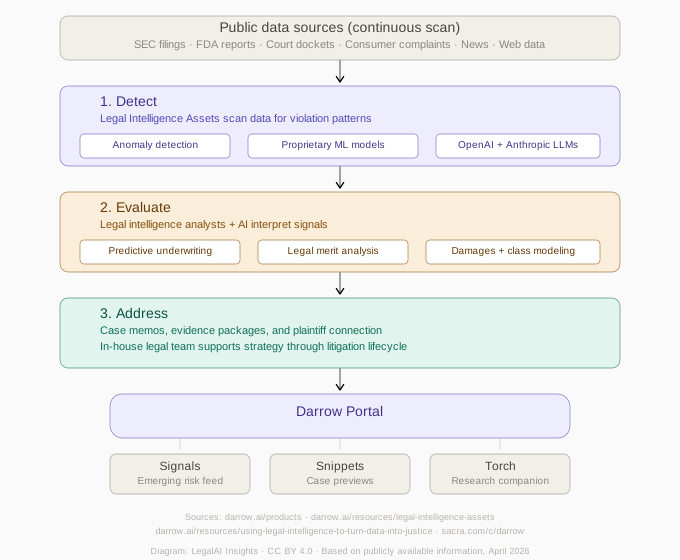
What it runs on. Darrow integrates proprietary machine learning models with foundation models from OpenAI and Anthropic. Its system follows a three-stage intelligence pipeline: detect (proprietary Legal Intelligence Assets scan public data using anomaly detection algorithms), evaluate (legal intelligence analysts and attorneys assess merit, damages, and class size), and address (case memos and evidence packages delivered to plaintiff firms). Human analysts review every AI-detected signal before it reaches a client — and because Darrow identifies violations from structured public data rather than generating legal prose, its hallucination risk profile is lower than research or drafting tools. The company was founded in 2020, spun out of Y Combinator, and has raised approximately $60 million including a $35 million Series B led by Georgian.
The trade-off. Darrow is a business development and case origination tool for plaintiff-side litigation — fundamentally different from tools that help you do legal work. If you’re a defense firm or an in-house team, it doesn’t serve your workflow.
Corporate and Transactional #
Luminance #
Luminance is the most technically differentiated contract platform on the market, used by over 1,000 organizations across 70+ countries including all four Big Four firms. Built by machine learning researchers from the University of Cambridge, Luminance is one of the few legal AI companies that built its own foundation model rather than layering on top of OpenAI or Anthropic.
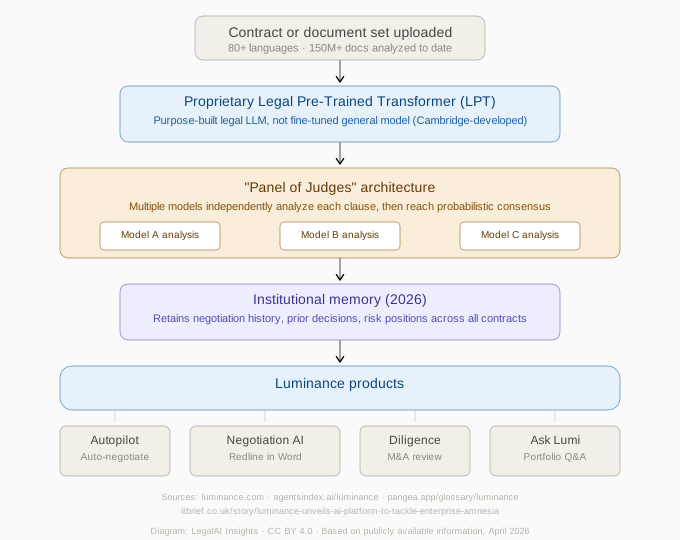
What it does. Luminance handles the full contract lifecycle: generation, negotiation, review, and portfolio management. Its standout feature is Autopilot, an autonomous agent that can negotiate NDAs end-to-end without human intervention — not “suggest edits for a lawyer to review,” but actually negotiate, redline, and close. In January 2026, Luminance launched a major platform upgrade introducing institutional memory, an architecture that retains negotiation history and decision-making context across the organization’s entire contract portfolio. Ask Lumi is a conversational assistant that answers questions with citations from the full contract portfolio. In April 2026, Luminance announced a strategic alliance with LexisNexis to embed Protégé’s citation-backed legal research directly into the Luminance workflow.
Why it is special. It built its own model. Luminance’s proprietary Legal Pre-Trained Transformer is purpose-built for contract language, not adapted from a general-purpose model. Combined with the institutional memory architecture launched in 2026, which retains negotiation history across the entire contract portfolio, Luminance can align new terms with what the organization has already agreed to — something no tool that treats each document as a fresh context window can do.
What it costs. Luminance does not publish pricing. Industry estimates suggest annual contracts starting at $50,000–$100,000 for mid-market deployments, with enterprise implementations potentially exceeding $250,000 annually. Cloud and on-premise deployment options are available.
The trade-off. Luminance does not offer litigation support or legal research. Implementation takes weeks to months, and enterprise pricing puts it outside the reach of small firms.
Spellbook #
Spellbook made a strategic bet that the other contract platforms missed: lawyers draft in Microsoft Word, so AI contract tools should live there too. Used by over 4,000 legal teams in 80+ countries, Spellbook embeds directly as a Word add-in rather than building a separate platform that requires workflow migration.
What it does. Spellbook suggests clause language as lawyers type, flags risks in counterparty drafts, generates redlines, and benchmarks contract terms against 2,300+ contract types. Its newest feature, Spellbook Associate, is an AI agent that handles multi-document workflows — updating terms across deal bundles, managing disclosure schedules, and understanding deal structure. The platform integrates with Thomson Reuters’ Practical Law to ground suggestions in precedent rather than generated text.
Why it is special. Zero adoption friction. Spellbook lives inside Microsoft Word — the tool lawyers already use. No platform migration, no workflow redesign, no training on a new interface. Edits appear under the lawyer’s name, so redlined documents can be forwarded to clients without revealing the AI. For transactional lawyers who draft and redline daily, this means value on day one without changing how they work.
What it runs on. Spellbook is powered by OpenAI’s GPT-5 and Anthropic’s Claude Opus, fine-tuned on legal contract databases. Integration with Thomson Reuters’ Practical Law grounds suggestions in precedent rather than generated text, and benchmarking against 2,300+ contract types provides a factual reference layer for clause suggestions. The platform maintains zero data retention agreements with its model providers, meaning client documents are not used for training.
What it costs. Spellbook offers tiered pricing: Starter at $99/user/month, Professional at $149/user/month, and Enterprise at $199/user/month (minimum 10 seats), all billed annually. A 14-day free trial is available on Starter and Professional plans. This makes Spellbook one of the most accessible contract AI tools for small and mid-size firms — a meaningful distinction in a market where most competitors require enterprise sales conversations.
The trade-off. Spellbook is a drafting and review tool, not a contract lifecycle management platform. It doesn’t handle post-signature obligations, compliance tracking, or contract repository management.
LegalOn #
LegalOn takes a different approach to the “AI review problem” than Spellbook or Luminance. Used by over 6,000 customers globally, LegalOn builds what amounts to an AI-powered second set of eyes — anchored in attorney-written playbooks rather than autonomous AI negotiation.
What it does. LegalOn’s AI reviews and redlines contracts against 50+ pre-built playbooks created by its in-house legal team, flagging risks by severity and providing attorney-curated guidance. It recently launched five AI Agents for in-house legal teams that handle specific tasks from intake through drafting. The platform includes an AI assistant for ad-hoc questions, matter management for tracking legal requests, and a Knowledge Core that unifies an organization’s contracts, templates, and playbooks. LegalOn recently launched jurisdiction-specific review for UK contracts.
Why it is special. Ready-made legal expertise. LegalOn’s 50+ attorney-built playbooks encode years of contract review knowledge into AI guardrails that work on Day 1. Competitors that require firms to build their own playbooks (Luminance, Ironclad) need weeks of configuration before delivering value. For in-house teams reviewing high volumes of standard commercial agreements, LegalOn’s pre-built standards eliminate the cold-start problem.
What it runs on. LegalOn uses large language models (the company does not disclose which foundation models), combined with its proprietary attorney-authored legal content layer. AI outputs are constrained to curated playbooks rather than the model’s general knowledge — the AI flags deviations from defined standards rather than generating open-ended legal analysis. Inline citations link each finding to its source for verification.
What it costs. LegalOn uses modular per-seat pricing. Estimates suggest individual licenses start at approximately $3,500/user annually, with a five-user enterprise license at about $40,000/year. The company was founded in 2017 in Japan and has raised over $130 million from Goldman Sachs, Sequoia, and SoftBank.
The trade-off. LegalOn’s playbook-driven model is both its strength and its constraint. The 50+ pre-built playbooks deliver value on Day 1 without configuration, but the AI reviews against defined standards rather than reasoning independently about novel risks.
Practice Management #
Clio (Manage AI) #
Clio is not a frontier AI tool — it’s the most widely used legal practice management platform in the world (over 150,000 legal professionals in 100+ countries) that has embedded AI into the operational software lawyers already use.
What it does. Manage AI (formerly Clio Duo) turns practice management data into actions. It extracts deadlines from court documents and creates calendar events automatically, drafts client communications from case data, generates invoices, summarizes matters, and surfaces insights across a firm’s practice data. The company also launched Clio Work, a separate AI research platform powered by Clio Library — a database of over one billion legal documents from 100+ countries — with Cert, a proprietary citator for verifying authority.
Why it is special. Installed base. 150,000+ legal professionals already use Clio Manage for practice management. Adding AI is a toggle, not a migration. Clio also solves the problem no other tool on this list touches: the administrative 50% of legal work — scheduling, billing, client updates, deadline tracking — that consumes hours every week but doesn’t involve legal reasoning. At $39/month for the AI add-on, the cost-per-hour-saved ratio is the best on this list.
What it runs on. Clio uses proprietary generative AI integrated into its Manage platform, without publicly disclosing foundation model partners. Manage AI operates primarily on the firm’s own structured practice data (calendar entries, billing records, matter notes) rather than generating legal analysis from general knowledge — a lower-risk hallucination profile than research or drafting tools. Clio Work (the separate research product) is powered by the Vincent AI engine and the Clio Library legal database, with authority verified through Cert, its proprietary citator.
What it costs. Clio Manage starts at $39/user/month (billed annually) for basic practice management. Manage AI (the AI add-on) costs $39/user/month on top. The full-featured Complete plan with AI runs $149/user/month. Clio Work (the research platform) is priced separately with introductory offers.
The trade-off. Clio’s AI won’t match Harvey for complex legal reasoning or Everlaw for deep document analysis. It’s built for the operational layer — and for solo practitioners and small firms, that’s where the hours go.
What the Market Tells You #
These eleven tools fall into three categories by scope.
Multi-workflow platforms (Harvey, CoCounsel, Protégé) span research, drafting, document analysis, and more. Their breadth makes them harder to evaluate — “it does everything” means no single workflow is the obvious entry point — but they serve as a firm’s primary AI infrastructure.
Single-workflow tools (Everlaw, Relativity, EvenUp, Darrow, Luminance, Spellbook, LegalOn) each chose a narrow domain and built deeply into it. EvenUp does personal injury and nothing else. Everlaw and Relativity do e-discovery. Luminance does contract lifecycle management. These tools deliver the clearest impact because they’re optimized for one job.
Practice management AI (Clio) is a different category entirely — AI embedded in the operational software lawyers already use for scheduling, billing, and client communications, not in the legal reasoning layer.
The publisher lock-in is real. If your firm already pays for Westlaw or Lexis+, the AI add-on from that publisher will almost always win on total cost — making the CoCounsel vs. Protégé choice as much about existing contracts as product quality.
Pricing opacity is a feature, not a bug. Most vendors negotiate individually because they can. The lack of transparent pricing benefits larger firms with more negotiating leverage. Clio and Spellbook are notable exceptions, with published pricing that lets you evaluate cost before engaging a sales team.
The question isn’t “which tool is best?” It’s “which workflow costs me the most time, and which tool is purpose-built for that specific workflow?”
Further Reading #
- Harvey Platform Overview. Product details and use cases.
- CoCounsel by Thomson Reuters. Product page with feature details.
- EverlawAI. AI features for e-discovery.
- Relativity aiR. Generative AI suite for e-discovery and case strategy.
- aiR in Motion: Building on Breakthroughs. Relativity’s technical deep dive on aiR architecture and results.
- EvenUp Claims Intelligence Platform. Personal injury AI platform details.
- Darrow Legal Intelligence. Case origination and violation detection.
- Luminance Legal-Grade AI. Contract lifecycle management.
- Spellbook AI Contract Review. Word-integrated contract drafting.
- LegalOn Technologies. Playbook-driven contract review.
- Lexis+ with Protégé. LexisNexis AI workflow platform.
- Clio Manage AI. Practice management AI.
- legalbenchmarks.ai Evaluation Framework. Open-access legal AI evaluation toolkit.
This post is part of the Legal AI Landscape series on LegalAI Insights. It is intended for informational and educational purposes only and does not constitute legal advice. Product capabilities, pricing, and availability described here reflect publicly available information as of the publication date and are subject to rapid change. Vendor claims have not been independently verified. Laws governing AI use vary by jurisdiction.