TL;DR
- The same vendors show up in both launches, in different roles. Some are connectors in Claude and plugins in ChatGPT. Harvey and Legora are also API customers of Astra, and Free Law Project supplies data to both.
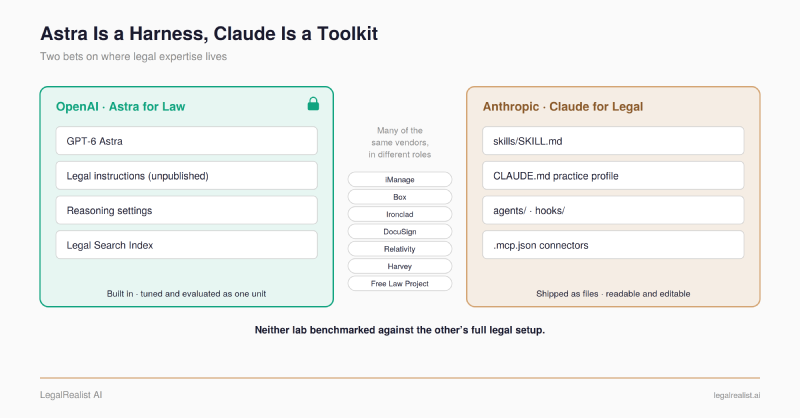
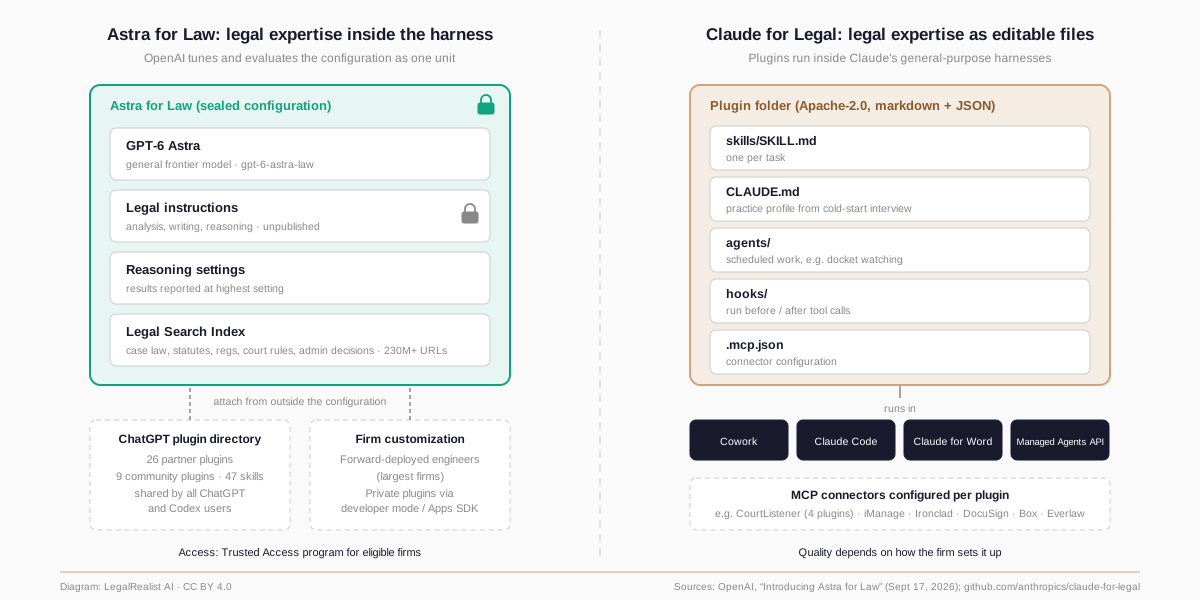
- Astra for Law is a sealed configuration. GPT-6 Astra, unpublished legal instructions, reasoning settings, and a legal search index, tuned and evaluated as one unit.
- Claude for Legal ships editable parts, not a legal harness. Apache-2.0 skills, practice profiles, agents, and connector configs that run inside Claude’s general-purpose harnesses.
- The index and the connector solve the same retrieval problem in different ways. Both draw on Free Law Project case law, but the corpus, ranking, and integration differ, and no matched test compares them.
- Neither lab benchmarked against the setup lawyers actually buy. OpenAI compared Astra with its own base model and with a Claude model whose configuration it didn’t disclose.
- Test the configurations, not the models. Run closed matters through each vendor’s full setup before signing anything.
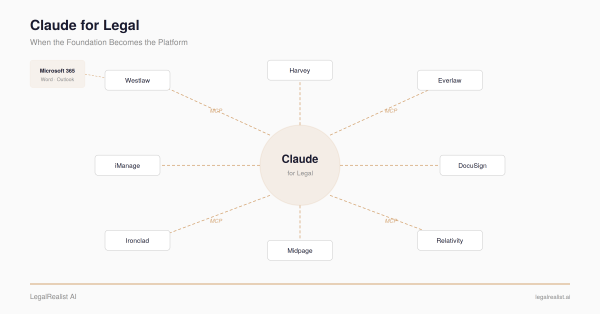
On May 12, Anthropic launched Claude for Legal with 12 practice-area plugins and more than 20 connectors. On September 17, OpenAI launched Astra for Law with 26 partner-built plugins and a legal research index.
Many of the same legal tech companies appear in both announcements. Some of them play the same role in each; others don’t. The more useful difference is where each company decided the legal expertise should live.
Same Vendors, Different Roles#
The overlap is real, but the roles aren’t equivalent. A connector in Claude, a plugin in ChatGPT, an API customer, a testimonial, and a data source are different relationships:
| Company | Claude for Legal (May) | Astra for Law (September) |
|---|---|---|
| Box, iManage, NetDocuments, Ironclad, DocuSign, Relativity | MCP connector | Partner plugin |
| Harvey | MCP connector | Partner plugin; API customer |
| Legora | Partner testimonial | Partner plugin; API customer |
| Thomson Reuters | MCP connector; CoCounsel Legal plugin in the repo | HighQ plugin; CoCounsel Legal connector previewed |
| Free Law Project (CourtListener) | MCP connector in four plugins | Data partner for the Legal Search Index; CourtListener plugin |
Sources: Anthropic launch post, Claude for Legal repository, OpenAI announcement, Artificial Lawyer’s plugin list, LawSites. As of September 18, 2026.
The document, contract, and e-discovery vendors connect to both labs the same way: they expose their systems to whichever AI surface a lawyer opens. The legal AI companies have a more complicated relationship with OpenAI. Harvey and Legora each ship a plugin in ChatGPT, and OpenAI names both as API customers for Astra, which makes them partners, customers, and potential competitors at the same time.
When the document and contract connectors overlap this much, they stop being the main difference. The real product decision sits one layer up: who writes the legal instructions, whether a firm can read and change them, and who evaluates the result.
Astra Is a Harness#
A harness is everything wrapped around a model that shapes how it behaves on a task: the system instructions, the tools it can call, the reasoning settings, the retrieval sources. Astra for Law is a harness sold as a product. OpenAI describes it as three pieces:
- GPT-6 Astra, OpenAI’s general frontier model, exposed in ChatGPT as
GPT-6 Astra Lawand slated for the API asgpt-6-astra-law - Custom legal instructions for analysis, writing, and reasoning, which OpenAI has not published
- A Legal Search Index covering U.S. case law, statutes, regulations, court rules, and administrative decisions across more than 230 million URLs
As MLQ put it, Astra for Law “is a product configuration and workflow foundation, not a separately trained base model.” OpenAI tuned and evaluated those pieces as one unit, and it reports its results “at the highest reasoning setting.”
The 26 partner plugins, plus nine community plugins and 47 skills from groups like LegalQuants and Skills.law, sit alongside Astra rather than inside it. They live in ChatGPT’s shared plugin directory, which serves every ChatGPT and Codex user. Firms that want deeper customization get it in two ways. The largest firms get OpenAI’s forward-deployed engineers; LawSites reports that Sullivan & Cromwell, Ropes & Gray, and Cooley already have them. Everyone else can build private plugins through developer mode and the Apps SDK.
Access runs through OpenAI’s Trusted Access program for eligible law firms. OpenAI has not announced pricing or a general API release date.
Claude for Legal Is a Toolkit#
Claude for Legal does not ship a dedicated legal harness. It ships editable legal skills, profiles, agents, and connector configurations that run inside Claude’s general-purpose harnesses. The open-source repository contains 12 first-party plugins (commercial, corporate, employment, privacy, product, regulatory, AI governance, IP, litigation, law student, legal clinic, and a Legal Builder Hub) plus an external CoCounsel Legal plugin maintained by Thomson Reuters.
Each plugin is a folder of plain files:
skills/, one markdownSKILL.mdper taskhooks/that run before or after tool callsagents/for scheduled or event-driven work, such as docket watching.mcp.json, which configures the MCP connectorsCLAUDE.md, a practice profile written by a cold-start interview that reads your playbooks and signed agreements
Everything is markdown or JSON under an Apache-2.0 license. The same folder runs in four surfaces: Cowork, Claude Code, Claude for Word, and the Managed Agents API. A partner can open the contract-review skill, see what it tells the model to check, and change it. That shows the instructions. It doesn’t show the model’s reasoning or explain why a research tool ranked one authority above another.
Community skills installed through the Legal Builder Hub pass a trust gate that scans for hidden content and prompt injection, checks licenses, and re-scans on every update. The gate screens what goes through that workflow; it doesn’t certify community skills in general. (We covered why that matters in The Connector Is the Attack Surface.)
The trade-off follows from the design. How well Claude for Legal works depends on how well the firm sets it up. The repository’s README warns that skipping the cold-start interview is “the single most common reason a skill produces generic output.”
The Legal Index Solves the Same Retrieval Problem#
Astra’s most distinctive component is its Legal Search Index, and its case law comes largely from the same place as one of Claude’s research connectors. OpenAI says its partnership with Free Law Project supplies “more than 99.9% of published U.S. precedential case law.” On Claude’s side, the CourtListener connector draws on the same Free Law Project data. It comes preconfigured in four plugins: litigation, IP, legal clinic, and law student. It works without an account, and an optional API key unlocks more features.
Both approaches get authorities into the model’s context so it can cite them, but they’re different kinds of things. MCP is an interface protocol: a standard way for a model to call an outside tool. OpenAI’s index is a corpus, a retrieval system, and a ranking layer that it built into the harness and tuned the model to use. Claude’s connector calls CourtListener’s own search as an outside tool, so its results depend on CourtListener’s ranking, not a legal-specific layer tuned for Claude.
Breadth differs too. Astra’s index goes beyond opinions to statutes, regulations, court rules, and administrative decisions, updated daily. CourtListener focuses on opinions, dockets, and oral arguments. To get statutes and secondary sources in Claude, a firm adds a subscription connector such as Thomson Reuters’ CoCounsel Legal (Westlaw and Practical Law), Descrybe, or Trellis for state trial courts.
OpenAI reports that Astra retrieved “up to 54% more relevant passages from the correct court opinions” than its base model using web search. That’s a ranking claim measured against OpenAI’s own model. Sharing a source doesn’t mean the two systems have the same coverage, ranking, citation treatment, or performance, and no matched evaluation has tested them against each other.
The Comparisons OpenAI Didn’t Make#
OpenAI’s headline numbers come from its own evaluation, which used a private validation set of 200 questions from Vals AI’s Legal Research Bench. Astra for Law passed the overall correctness check on 54.0% of questions, compared with 38.7% for GPT-6 Astra using web search alone. Vals hasn’t published these as independent leaderboard results. More telling than the numbers is the choice of opponents.
The formal evaluation compared Astra against its own base model. The announcement’s worked example compared it against Claude Fable 5.1. OpenAI reports that in its litigation example, “Claude Fable 5.1 returned a holding that had been reversed on appeal,” while Astra found Oliver Wyman, Inc. v. Eielson, 282 F. Supp. 3d 684 (S.D.N.Y. 2017). OpenAI doesn’t say what reasoning setting, plugins, connectors, or tools Claude had.
Three comparisons are missing:
- Claude with its legal plugins and research connectors, the setup Anthropic actually ships
- Thomson Reuters’ CoCounsel, which has Westlaw behind it
- Harvey and Legora, the category leaders
All three of those vendors have plugins in ChatGPT, and Harvey and Legora are also API customers, so benchmarking against them would be awkward. MLQ noted that the results “compare Astra for Law with another OpenAI system, rather than with Westlaw, Lexis+ or another commercial legal platform.”
Anthropic did the same thing in May. Its launch cited Harvey’s BigLaw Bench score for Claude Opus 4.7, framed as “the highest of any Claude model,” which is a comparison against itself. Neither lab has published a head-to-head against the other’s full legal setup.
The Vendors Are Adding Their Own Models#
The vendors neither lab benchmarked against are a moving target, because some of them now run their own models alongside frontier ones.
On August 24, Thomson Reuters launched Thomson, its first in-house model, built “from a strong open-source foundation.” The Batch reports that the large version starts from Alibaba’s Qwen3.5-397B-A17B, mid-trained on a curated 200-billion-token dataset and then post-trained. Thomson’s first deployment is one feature, Tabular Analysis in CoCounsel Legal. Thomson Reuters says CoCounsel remains multi-model, using Thomson “where it delivers the clearest advantage and other leading models elsewhere,” and The Next Web reports that CoCounsel “still relies mostly on Claude.”
Four days earlier, Harvey announced Tenet, a model post-trained from Moonshot AI’s open-weight Kimi K3. Harvey calls it a research preview. It isn’t a production migration, and Harvey’s product still runs on frontier models.
One feature and one research preview don’t show a wholesale shift away from frontier labs. They do mean a buyer comparing “CoCounsel” or “Harvey” may be comparing a mix of models that changes by feature. [Low confidence] More legal AI vendors will deploy their own post-trained open-weight models for specific, high-volume features (two vendors disclosed such models within a week, but only one has put one into production). For buyers, that raises a question a DPA doesn’t answer: which base model is behind each feature, and where did it come from? (BERI’s provenance analysis covers why that matters.)
What This Means for Firms#
Choosing between the two launches means choosing where you want the legal expertise to live.
- A harness gives you tuned defaults with instructions you can’t read. Astra’s instructions are unpublished, OpenAI controls updates, and access is limited to firms in Trusted Access. You get a system OpenAI tuned and evaluated as one unit.
- A toolkit lets you read and edit the instructions, and makes setup your job. You can see what each Claude for Legal skill tells the model, but not the model’s reasoning or a connector’s ranking. Quality depends on your cold-start profiles and the connectors you pay for.
- Expect portability with adaptation, not drop-in portability. MCP connectors can move between vendors at the protocol level. Skills, tool names, profile formats, permissions, and runtime behavior are still vendor-specific. A tuned harness doesn’t move at all.
- Run the comparison the vendors skipped. Take three matters you’ve already closed. Run them through Astra, through Claude with its legal plugin and research connectors, and through whatever your firm already licenses. Compare the citations as well as the prose.
Further Reading#
- Introducing Astra for Law. OpenAI’s announcement, with its evaluation methodology and worked examples.
- Claude for Legal on GitHub. Plugin source, the connector matrix, and the Legal Builder Hub trust layer.
- Claude for the Legal Industry. Anthropic’s May 12 launch post.
- Skills and Plugins in ChatGPT and Codex. OpenAI’s documentation on the shared plugin directory.
- OpenAI Releases Astra for Law. Bob Ambrogi’s breakdown on LawSites.
- Astra for Law’s 26 Legal Tech Plugins. Artificial Lawyer on the plugin list and the “centrality” argument.
- Astra for Law Is a Legal Configuration of GPT-6 Astra. MLQ on what is and isn’t new.
- Harvey Tenet. Harvey’s own description of its research-preview model.
- Claude for Legal: When the Foundation Becomes the Platform. Our May analysis of the Claude launch.
This post is part of the Legal AI Arms Race series on LegalRealist AI. It is intended for informational and educational purposes only and does not constitute legal advice. Product features, benchmark results, and partnerships described here reflect publicly available information as of September 18, 2026, and are vendor-reported unless otherwise noted.