TL;DR
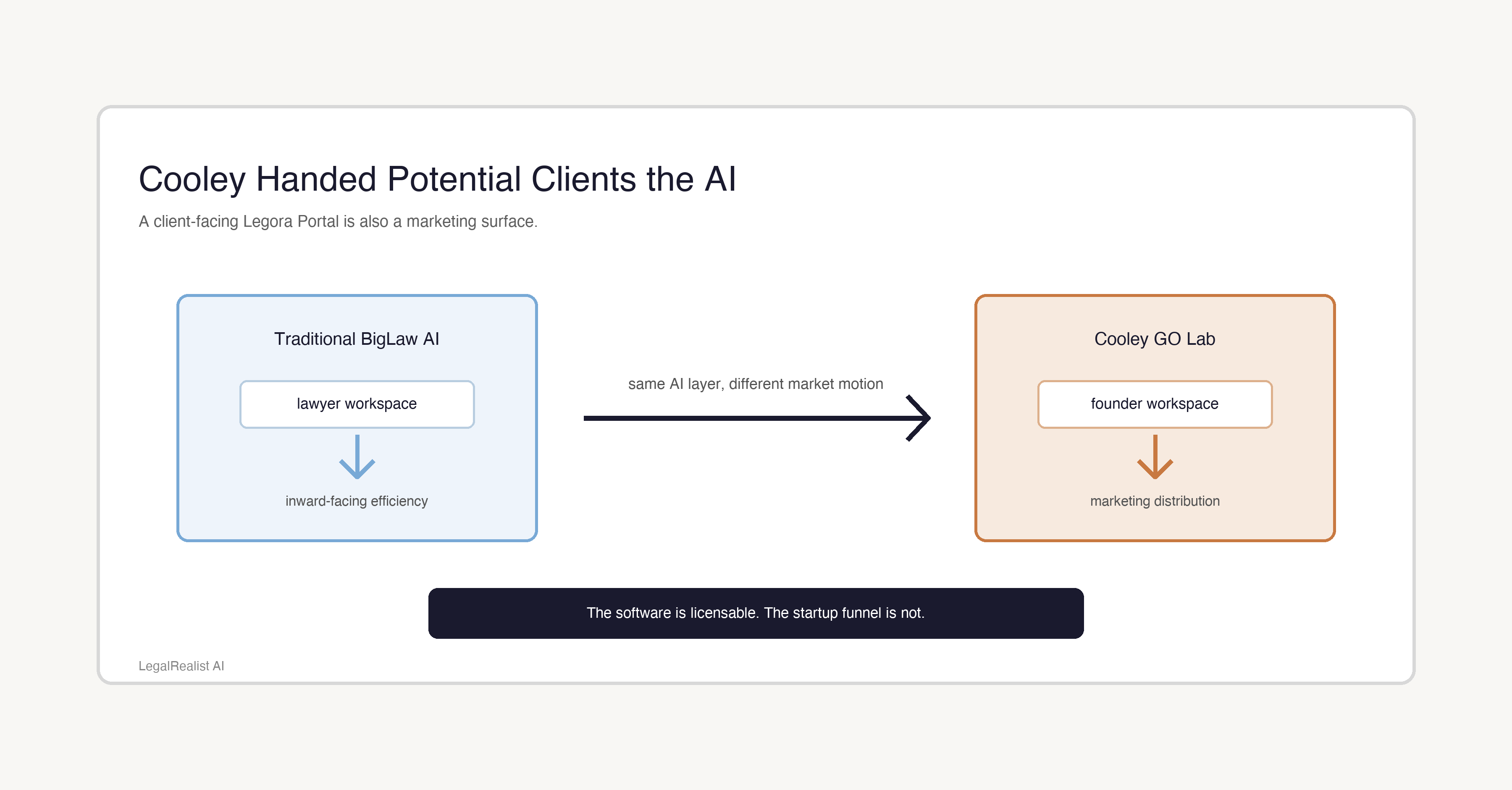
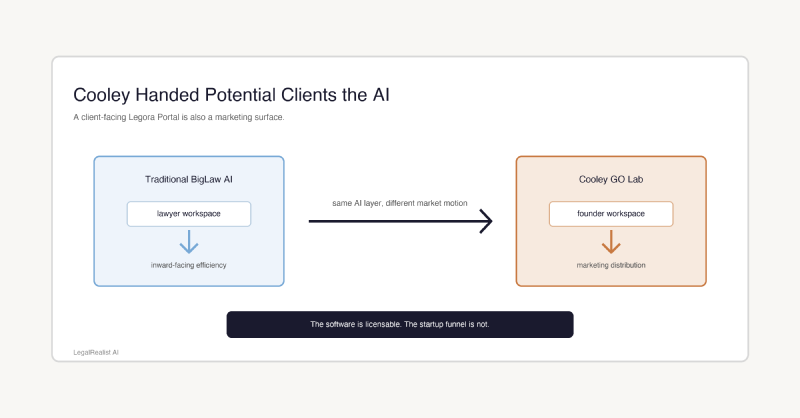
- Cooley aimed its AI at potential clients, not lawyers. Every firm this series has covered built or bought AI to make its own attorneys faster. Cooley gave founders a marketing tool that happens to do the routine work associates used to bill.
- The mechanics: a white-labeled product seeded into the YC batch. Cooley GO Lab is Legora’s Portal product with a Cooley skin, debuting exclusively with Y Combinator’s summer 2026 cohort.
- It’s an extension of Cooley’s franchise, not a departure. Cooley has given startups free legal tech for a decade. This is that playbook, AI-accelerated – market by helping founders early, keep them through Series B and IPO.
- Most firms can’t run this play. It only works if you already own a startup funnel. The tech is licensable; the batch of future unicorns to aim it at is not.
- The non-privileged disclaimer is the tell. Cooley GO Lab carries no attorney-client privilege. That’s honest – it marks the tool as an early taste, not legal advice.
On June 23, Cooley gave the founders in Y Combinator’s summer 2026 batch – many of them potential future clients, not current ones – an AI tool that reviews their NDAs and contractor agreements, flags terms that fall outside market practice, and answers questions about their own documents. It’s called Cooley GO Lab, it’s built on technology from the legal AI company Legora, and it comes with a clear warning: using it creates no attorney-client relationship and carries no privilege.
The first two posts in this series looked at firms arming their own lawyers – Cleary acquiring an AI company, A&O Shearman co-developing with Harvey, Latham subscribing and building on top, and Kirkland building a Palantir-powered knowledge moat. All of it pointed inward. Cooley pointed the same kind of technology at the potential client, as a marketing surface.
What Cooley Shipped#
Cooley GO Lab is built on Legora Portal, a white-labeled workspace Legora announced in November 2025 for firms that want to deliver AI workflows and legal knowledge to their own clients. Cooley supplied the content – startup-specific templates and guidance drawn from Cooley GO, the free resource library the firm has run for years – and Legora supplied the application layer. The result is a founder-facing tool that analyzes documents like nondisclosure and contractor agreements and evaluates them against how those deals actually get done.
The legal substance is Cooley’s. According to the firm, its lawyers shape and refine the underlying content, drawing on patterns across company formation, equity, and governance. The agentic layer that reads the founder’s document and produces the analysis is Legora’s.
What it is not is legal advice. Cooley is explicit that Cooley GO Lab does not create an attorney-client relationship, and the company warns that exchanges are not protected by privilege. That single design choice tells you most of what the tool is for, a point worth returning to.
“We’re entering a new era in how legal insights are delivered and applied,” said Matthew Bartus, the partner and global co-chair of Cooley’s emerging companies and venture capital practice. The framing is deliberate: this is about delivery of insight to potential clients, not internal efficiency.
AI Pointed Outward#
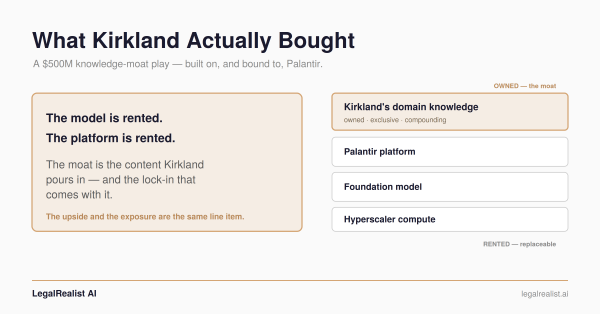
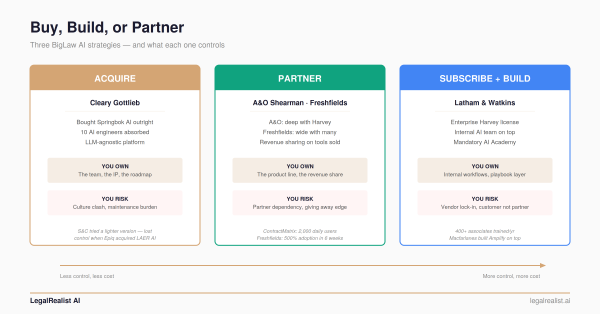
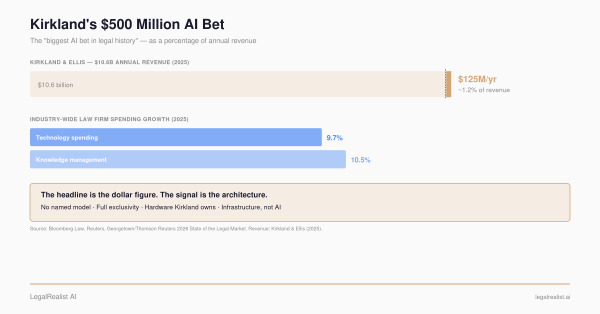
The strategies this series has tracked so far differ in approach but share a direction. Cleary acquired Springbok AI to build in-house. A&O Shearman co-develops agentic tools with Harvey and licenses them. Latham runs an enterprise Harvey subscription with an internal build team on top. Kirkland is spending $500 million on a slate of custom builds, its flagship a Palantir-powered fund formation engine – it owns the firm-specific code and data, but the stack is built on and bound to Palantir. Every one of these is a bet on making the firm’s own lawyers produce more, faster.
Cooley’s bet runs on a different axis. The AI isn’t sitting beside an associate reviewing a credit agreement; it’s sitting in front of a founder reviewing their own NDA. The work it does – first-pass document review against market norms – is exactly the kind of routine task a junior lawyer would have billed for, or that a founder would have skipped entirely. Cooley is giving it away as marketing.
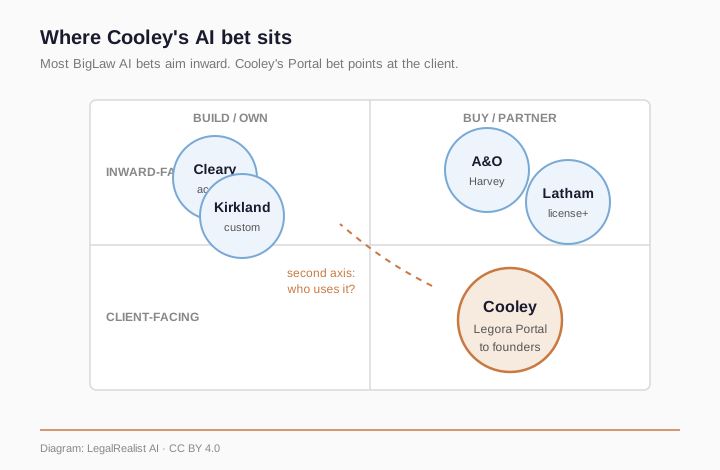
That’s not a contradiction of the build-versus-buy question – it’s a second question stacked on top of it. A firm decides whether to build or buy its AI, and separately decides whether to aim it at its lawyers or its market. The first four firms in this series all answered the second question the same way without appearing to treat it as a question at all. Cooley answered it differently.
The Funnel Was Always the Point#
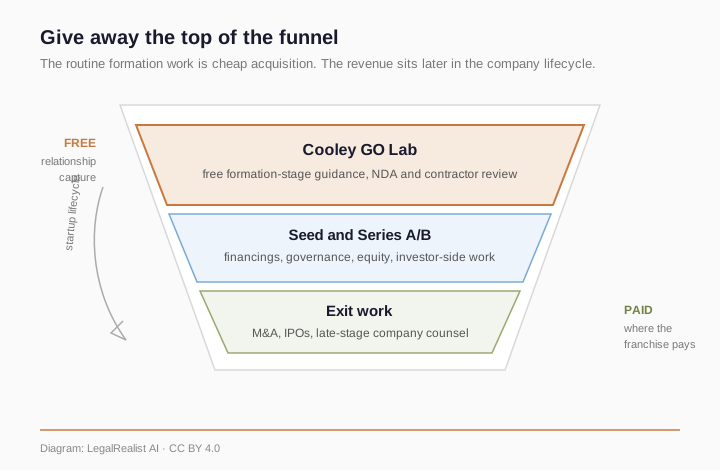
The instinct is to read “law firm gives away legal work” as cannibalization. It isn’t, and the reason is that the work Cooley is giving away was never the profitable part.
Cooley is the dominant firm for venture-backed startups – ranked #1 in the US and globally for representing companies in VC financings by PitchBook every year since 2020, and counsel to more than 7,000 high-growth private companies. Formation-stage work – reviewing a founder’s contractor agreement, checking an NDA – is a loss leader in that model. The money is in the financings, the M&A, and the IPOs that come later, where Cooley leads. Catching a botched liability clause at formation isn’t revenue; it’s how you stay the firm of record when the revenue arrives.
Founders are also already doing this work with AI, just badly. Legora’s own CEO, Max Junestrand, has told the story of using an early version of ChatGPT to rewrite a contract and ending up with an unlimited liability clause his general counsel had to catch. Business Insider framed the launch around exactly this: founders self-serve legal work to avoid outside-counsel hourly rates, and Cooley GO Lab is built to catch the common early-stage mistakes that result. The choice for the founder was never “Cooley or nothing.” It was “Cooley’s guardrails or a raw consumer chatbot.” Cooley is meeting the founder where they already are.
And this is continuous with how Cooley already operates. The firm built Cooley GO as a free content library, runs a “GObot” Q&A assistant, and gave its fund-formation clients a compliance tool called Vanilla at no charge. As Cooley’s chief innovation officer has put it, every company today is a software company. Cooley GO Lab is the same give-it-away-early strategy, now running on an LLM instead of a static template. One investor reading the launch called it a clean way for Cooley and Legora to land the whole batch as early customers. That’s the move: productized marketing with enough utility to be worth using.
Who Can Actually Run This Play#
Here’s the limit that keeps the move from being a template for the industry: it only works if you already own a funnel.
The strategies in the first post were, to varying degrees, copyable. Any firm with the budget can subscribe to Harvey and build on top, the way Latham did. Cooley’s play has a prerequisite that money can’t buy quickly – a captive pipeline of high-growth companies worth keeping. Give a founder-facing AI tool to a firm with no startup practice and it has nowhere to point it.
A handful of firms have the same prerequisite. Wilson Sonsini has been productizing legal work for startups for years through its SixFifty subsidiary. Goodwin, Gunderson Dettmer, and Fenwick all anchor deep emerging-companies practices. Orrick already runs the Orrick AI Law Center and a “Tech Studio” stocked with form generators. Each of these firms could plausibly white-label the same kind of client-facing tool and aim it at a client base that justifies the effort.
The wildcard is the Big Four. Firms like PwC – already a Harvey deployment – reach far more early-stage companies through their accounting and advisory arms than any law firm does, and they have fewer billable-hour incentives to protect. If “give potential clients the AI” becomes a real competitive front, the most dangerous entrants may not be law firms at all.
For everyone else, the lesson isn’t “build a founder-facing AI tool.” It’s that a client-facing AI product is a moat-widener for firms that already have a moat, and not much use to firms that don’t.
The Catches#
Three things temper the story.
First, the technology isn’t a differentiator. Legora Portal is a product, and Cooley is one of several firms using it – Legora’s own design partners for the Portal include Linklaters, Goodwin, and Cleary Gottlieb, the last of which appeared in this series as an acquirer of AI. If the edge were the software, it would evaporate the moment a competitor signed the same contract. The edge is Cooley’s brand, its Y Combinator relationship, and its content. The Portal is just the marketing and delivery mechanism.
Second, the stack has a recursive risk. Cooley’s client-facing tool rides on an application layer (Legora) that in turn rides on underlying foundation models. Legora is well capitalized – a $5.6 billion valuation and past $100 million in recurring revenue – but every firm building on the application layer is building on ground the model makers also stand on.
Third, the non-privileged design is the honest tell. A tool that produced privileged legal advice would be a very different, far riskier product; a tool that explicitly disclaims privilege is a marketing and relationship instrument. That’s the right call, and it tracks the privilege concerns this publication has covered before – consumer-tier AI exchanges are exactly the kind of third-party disclosure that defeats protection. Founders and their counsel should still read the fine print: how the underlying platform handles data retention, whether inputs train future models, and where the hallucinations that any LLM-based tool can produce get caught before a founder relies on them. Legora states the Portal uses zero-retention inference and holds SOC 2 and ISO certifications, but those terms are worth confirming for any specific deployment.
The interesting question isn’t whether Cooley’s bet pays off. It almost certainly deepens relationships it already had and starts relationships earlier with companies it wants to represent later. The question is whether “give potential clients the AI” becomes the standard incumbent defense – the way funnel-owning firms respond to AI-native challengers and consumer chatbots circling the same routine work. A few things to watch:
- Do other funnel-owners follow? If Wilson Sonsini, Goodwin, or Orrick ship comparable tools within the year, the play is real and the race is on for the same client bases.
- Does Cooley ever charge? Free is a customer-acquisition cost. A paid tier would signal Cooley sees the tool itself as a product, not just a funnel.
- Do the data terms get published? The gap between “not privileged” and “safe to paste your cap table into” is exactly where founders will get burned, and where firms can differentiate by being specific.
Further Reading#
- Cooley Launches Cooley GO Lab, Powered by Legora. The launch announcement.
- Legora Hits $5.6B Valuation. TechCrunch on the funding and the Harvey rivalry.
- Legora Crosses $100M in ARR. Legora’s growth and the shift to agentic workflows.
- Legora Acquires Qura. ABA Journal on Legora’s move into legal research.
- Cooley’s Emerging Companies Practice. The franchise the tool plugs into.
- Orrick AI Law Center. A comparable firm’s client-facing tech effort.
- Buy, Build, or Partner: BigLaw Bets on AI. Part 1 of this series.
- What Kirkland Actually Bought. Part 2 of this series.
- Kirkland’s $500 Million Bet. The original announcement that Part 2 revisits.
This post is part of the Law Firm AI Positioning series on LegalRealist AI. It is intended for informational and educational purposes only and does not constitute legal advice. AI capabilities, strategies, and market conditions described here reflect publicly available information as of the publication date and are subject to rapid change. Laws governing AI use vary by jurisdiction.