TL;DR
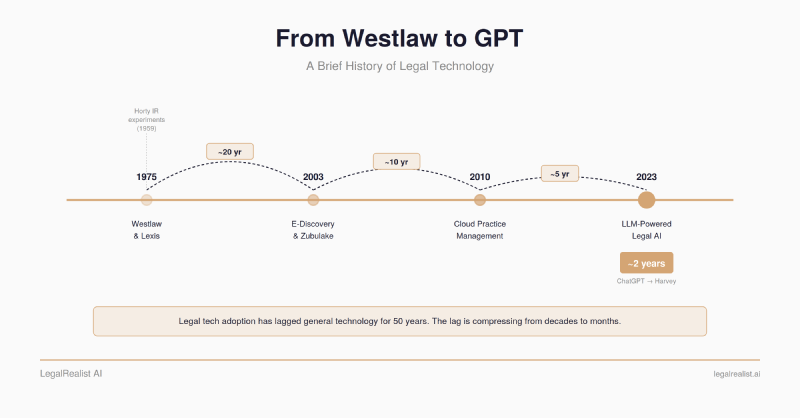
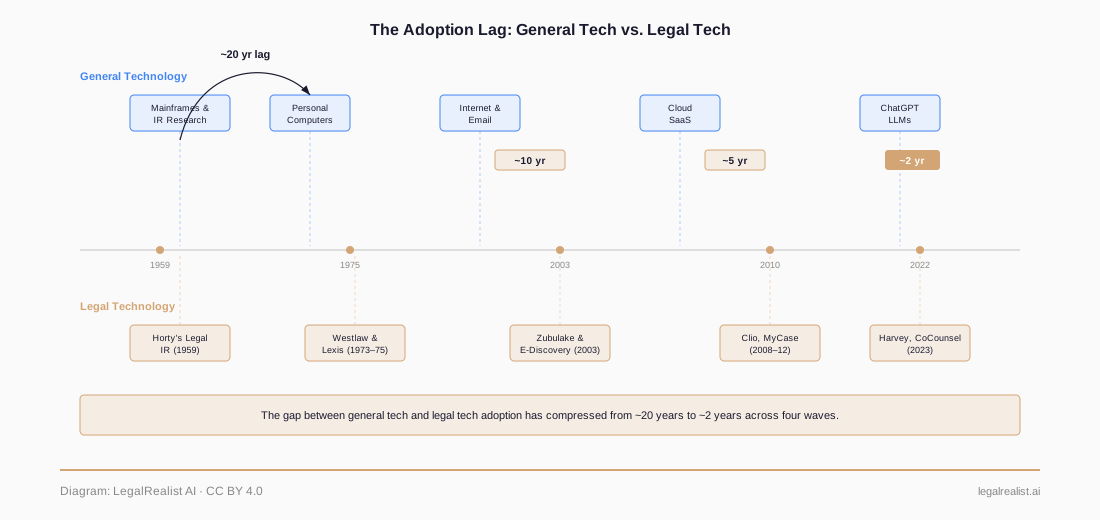
- The lag is the pattern. Legal tech has followed general technology on a 10–20 year delay for half a century — Westlaw arrived two decades after the first legal information retrieval experiments, e-discovery platforms a decade after businesses went digital.
- The economics drove adoption; the courts get the credit. Zubulake, Da Silva Moore, and Mata v. Avianca are the datable markers, but firms were already moving — the rulings ratified and accelerated a shift that changing economics had already made inevitable. The durable trigger is when not adopting costs more than adopting.
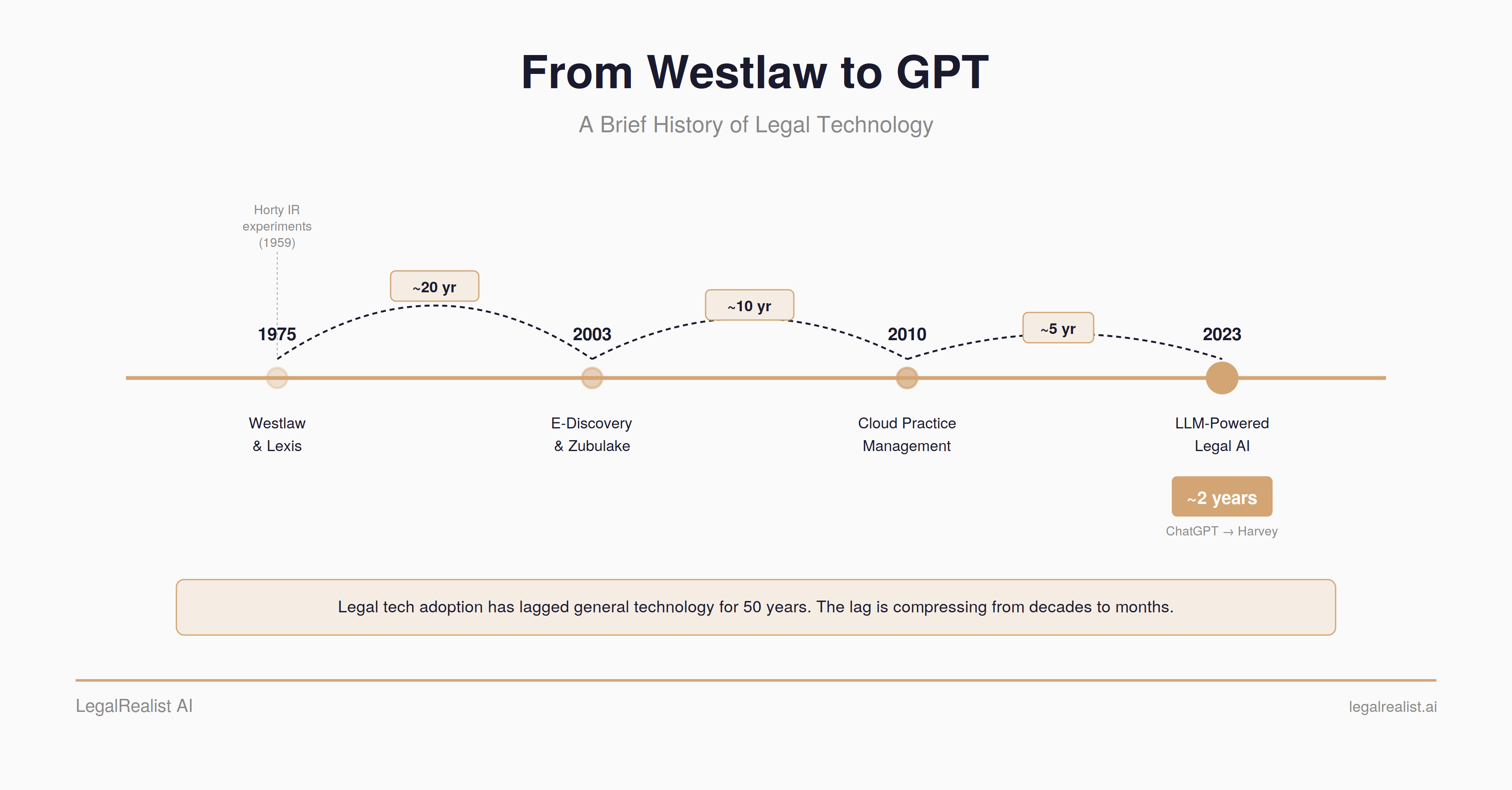
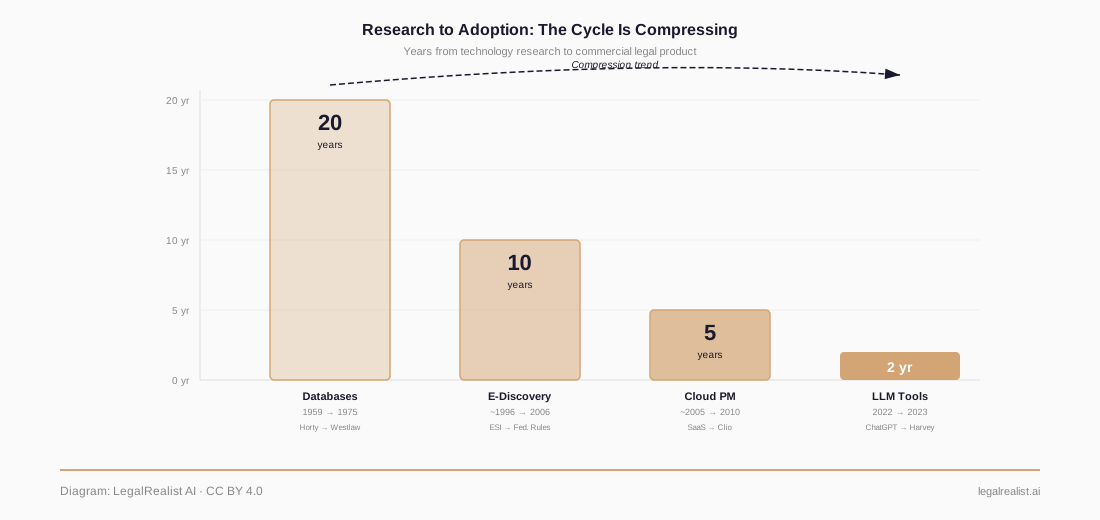
- The cycle is compressing from decades to months. The database revolution took ~20 years from research to product. E-discovery took ~10. Cloud and SaaS took ~5. LLM-powered legal tools took ~2. The next wave won’t wait for a six-month vendor evaluation.
- Today’s AI debates are yesterday’s e-discovery debates. Data security, accuracy, vendor lock-in, and professional responsibility — the legal profession has worked through every one of these concerns before, with the same initial resistance and the same eventual accommodation.
Corrections & Updates
- June 22, 2026: Updated the AI Use Spectrum for agentic developments — added Level 2, agentic office harnesses such as Claude Cowork that run reusable skills on a matter’s files, reframing the leap beyond chat that has emerged since publication.
- June 18, 2026: Corrected the Relativity launch date from 2001 to 2006; 2001 was the founding year of its maker (kCura), not the platform’s release. Adjusted “dominant by 2010” to “market-leading by the late 2010s.”
- June 18, 2026: Clarified the John Horty timeline — work began in 1959 and the keyword-search system became operational in the early 1960s, rather than being built and demonstrated in 1959.
In 1975, the year West Publishing launched Westlaw, you could also buy an Altair 8800 — the first commercially successful personal computer. In 2004, as courts debated whether companies had to preserve electronic documents, Google went public. In November 2022, when OpenAI released ChatGPT, most law firms were still debating whether to allow Microsoft Teams.
Legal technology doesn’t just follow general technology. It follows it on a remarkably consistent delay — and that delay has been shrinking with each wave.
The Research Era (1950s–1970s)#
The idea that computers could help lawyers find law predates the personal computer by two decades. Starting in 1959, John Horty at the University of Pittsburgh built one of the first legal information retrieval systems; by the early 1960s it could search Pennsylvania statutes by keyword — hours of manual index work, done in seconds. By the mid-1960s the Ohio State Bar had partnered with Data Corporation on a full-text search system for Ohio case law, the project that became Lexis.
These were research projects, not products: the hardware filled rooms, the databases covered single states, and the query languages needed training no practicing lawyer had. The insight was sound — computers could search legal text faster than humans browsing indexes — but it took another fifteen to twenty years to reach a lawyer’s desk. Drafting lagged the same way: to see how a contract had changed, a lawyer set two drafts side by side and marked every difference by hand in red pen — the literal “redline.”
The Database Revolution (1973–1995)#
Lexis launched commercially in 1973. Westlaw followed in 1975. For the first time, lawyers could search case law electronically instead of pulling reporters off shelves and flipping through West’s printed digest system.
The resistance was immediate. Senior partners said you couldn’t trust a computer to find what a trained associate with a digest system would. Terminals were expensive and per-search charges were hard to pass to clients. Many lawyers refused to learn the systems at all, leaving searches to associates and librarians.
The objections are the same ones firms raise about every new technology, including AI. The profession adapted anyway. By the late 1980s Westlaw and Lexis were essential infrastructure, law schools taught electronic research, and an associate who couldn’t run a competent search was at a disadvantage. The shift happened not because firms liked it but because maintaining physical libraries and the staff to run them became economically irrational once the technology was reliable.
The database revolution also established the vendor lock-in that still defines legal tech. Westlaw and Lexis built proprietary editorial layers — West’s Key Number System, Lexis’s Shepard’s Citations — that made switching costly, and both still dominate legal research fifty years later. When Thomson Reuters dropped 16% after Anthropic released a legal plugin in February 2026, the market was betting the lock-in might finally break. It hasn’t — yet.
Document comparison made the same jump from hand to machine. CompareRite, a DOS-era utility, could generate a redline between two drafts in seconds, and by the 1990s it was the standard comparison tool in firms.
Research to adoption: ~20 years. Horty’s 1959 experiments to Westlaw’s 1975 commercial launch.
E-Discovery and the Compliance Era (2000–2015)#
By the late 1990s businesses ran on email and litigation was drowning in it — a single case could involve millions of electronic documents. The rules for document production, written for paper, had no framework for electronically stored information (ESI).
The inflection point was Zubulake v. UBS Warburg (S.D.N.Y. 2003–2004), where Judge Shira Scheindlin held that parties must preserve relevant electronic documents once litigation is reasonably anticipated, on pain of adverse-inference instructions and sanctions. It created no new law — it applied existing preservation obligations to electronic records — but it pushed every large organization to build ESI systems and catalyzed the e-discovery industry that followed.
The 2006 Federal Rules of Civil Procedure amendments codified ESI obligations: meet-and-confer requirements, rules for the form of production, and a safe harbor for routine document destruction. The 2015 amendments tightened spoliation sanctions and made proportionality a constraint on discovery scope.
Between Zubulake and the 2015 amendments, an ecosystem emerged. Relativity (platform launched 2006, market-leading by the late 2010s) became the standard review platform; Everlaw and DISCO offered cloud alternatives. Predictive coding went from controversial to court-approved in Da Silva Moore v. Publicis Groupe (S.D.N.Y. 2012), where Judge Andrew Peck held technology-assisted review an acceptable alternative to manual review. The profession’s reaction — suspicion, demands for proof it matched human reviewers — previewed how it would respond to LLMs a decade later.
The pattern is usually told as courts forcing adoption, but that overstates their role. Firms were already moving — discovery at email scale couldn’t be done by hand at any price a client would pay. The courts added a floor: once mishandling ESI became sanctionable, opting out stopped being an option. The rulings get the attention because they’re datable, but the economics were the engine.
Redlining moved on economics alone over the same years. Workshare’s DeltaView (1999) displaced CompareRite as the default blackline tool — adopted by no court order but because no deal lawyer wanted to miss a change buried in a sixty-page redraft.
Research to adoption: ~10 years. ESI problems emerged in the late 1990s; the 2006 Federal Rules amendments made e-discovery compliance mandatory.
Cloud and SaaS (2010–2020)#
While large firms built e-discovery infrastructure, a parallel wave reshaped how smaller firms operated. Cloud practice-management platforms — Clio (2008), MyCase (2010), PracticePanther (2012) — moved calendaring, billing, document management, and client communication to the browser. A solo with a laptop and a Clio subscription could run a practice that once required a secretary, a filing system, and an office.
Those platforms served small firms. Large firms ran heavier machinery — Thomson Reuters Elite’s 3E, the financial and practice-management system that dominates the AmLaw 200, plus document platforms like iManage. The closest analog to Salesforce — a vertical cloud platform for professional-services firms, and a public company in its own right — is Intapp, which went public in 2021. But these enterprise systems reached the cloud years after the small-firm tools: the bigger the firm, the longer the lag.
The shift was as much business model as technology. Software moved from a licensed product you installed to a subscription you rented — billed monthly, updated continuously, hosted by the vendor — which stripped out servers, IT staff, and perpetual-license fees. LegalZoom (2001) and Rocket Lawyer (2008) took the same model direct to consumers with standardized documents, which the bar fought as unauthorized practice of law before largely accommodating.
No court forced this wave — it was pure economics. Firms on the cloud ran leaner than those that weren’t, and the advantage compounded until staying on-premises stopped making sense. Redlining moved to the cloud alongside everything else: Litera absorbed Workshare in 2019 and folded document comparison into the cloud document stack.
Research to adoption: ~5 years. Salesforce proved the SaaS model by the mid-2000s; legal-specific cloud platforms were mainstream by 2010–2012.
The LLM Moment (2022–Present)#
OpenAI released ChatGPT on November 30, 2022. Within two months it had 100 million users — the fastest a consumer application had ever reached that mark, against roughly nine months for TikTok and two and a half years for Instagram. Within a year, every major legal tech vendor had either integrated a LLM into their product or announced plans to do so.
Harvey — founded in late 2022 on OpenAI’s models — secured an exclusive partnership with Allen & Overy by February 2023 and raised over $200 million by early 2025. Thomson Reuters launched CoCounsel — built by Casetext, which it acquired for $650 million in 2023 — alongside Spellbook, EvenUp, and dozens of startups that raised hundreds of millions for legal AI. Redlining shows the shift: the task CompareRite automated in the 1990s is now something Spellbook does generatively, proposing edits rather than flagging differences.
The profession’s Zubulake moment arrived in June 2023, when a federal judge in Mata v. Avianca sanctioned two attorneys $5,000 for a brief with six fabricated, ChatGPT-generated citations and made them notify the judges named on the fake opinions. Like Zubulake, it created no new law — it applied existing competence obligations to a new technology. But it forced every lawyer using AI to confront the failure mode: LLMs hallucinate, and the consequences fall on the attorney, not the tool.
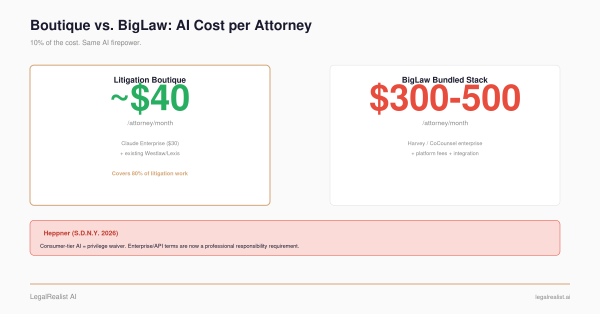
ABA Formal Opinion 512 (July 2024) established that lawyers using AI must understand the technology, supervise its output, and protect client confidentiality with third-party services. In February 2026, United States v. Heppner held that a defendant’s conversations with consumer-tier Claude were not privileged — extending the reckoning from competence to confidentiality. (The privilege and work-product questions are mapped in Privilege, Work Product, and AI: A 2026 Doctrinal Map.)
Adoption in this wave spreads along a spectrum: individual chat (Level 1); agentic office harnesses like Claude Cowork that run reusable skills on a matter’s files (Level 2); vibe-coded ad hoc applications (Level 3); and firm-built or bought platforms (Levels 4–5). It’s also the first wave where the technology writes its own tools — a quarter of Y Combinator’s Winter 2025 startups had codebases written almost entirely by AI — and the levels hardest to govern, 1 through 3, are where most adoption happens.
This wave also breaks the market structure of the earlier ones. The database, e-discovery, and cloud platforms were built by legal specialists — West, Mead, kCura, Clio. The LLM layer is built by general-purpose frontier labs that sell into every industry, and they have begun reaching past their legal-tech customers to the firms — and the clients — directly.
That February 2026 sell-off carried a meaning beyond lock-in. Anthropic, a model supplier, had shipped a legal plugin for Claude, and the market read it as the supplier turning into the competitor.
Both leading labs are now staffing the bet. Anthropic expanded that plugin in May 2026 into a branded Claude for Legal line, with Mark Pike — an associate general counsel — serving as its product lead for the legal industry. OpenAI hired Ironclad co-founder Jason Boehmig in June 2026 to build a legal vertical, having long supplied the models under tools like Harvey.
The labs also reach end users directly — the lawyer in Mata and the defendant in Heppner were using consumer ChatGPT and Claude. The pressure comes from both ends, and the legal-tech middle is what’s exposed.
[Medium confidence] Legal is the vertical the frontier labs target next, because coding showed them the playbook — and Anthropic has already shipped a direct legal product.
Code is what LLMs do best: training data is abundant and outputs are cheaply verifiable — a compiler or test suite confirms in seconds whether an answer works. That feedback loop pushed coding into agentic tools and an ecosystem of MCP connectors (the Model Context Protocol, now a cross-vendor standard) that let models act inside real systems.
[Low confidence] Legal AI may rhyme with that arc — multi-step agents, connectors into research databases and document systems — but how much of the playbook transfers is unknown. Code has clearer ground truth than law: a failing test is obvious; a subtly wrong indemnification clause or a hallucinated citation is not, and a silent error lands on a client and an attorney’s license, not a CI pipeline. Those differences could slow the transfer, reshape it, or matter less than they look — the coding analogy is the best available map, not the territory.
Research to adoption: ~2 years. LLMs became commercially capable with GPT-3 in 2020, and legal-specific AI tools arrived within months of ChatGPT’s November 2022 launch.
What the Pattern Means Now#
Every wave has followed the same arc: resistance on grounds of reliability, cost, and professional responsibility → shifting economics that make the old way untenable, with courts weighing in along the way — sometimes warning, sometimes sanctioning, always stretching existing doctrine to cover the new technology → grudging adoption → normalization. The rulings draw outsized attention, but they ratify a shift the economics already set in motion: Zubulake didn’t invent the duty to preserve, Mata didn’t invent the duty of competence — the doctrine expanded to fit, ESI then AI, rather than courts forcing a profession that was standing still. A self-regulating profession is assumed not to change on its own, so observers reach for an external shock instead of the quieter pressure of cost. The arguments against Westlaw in 1975 (too expensive, can’t trust the results, lawyers shouldn’t need computers) are identical to those against AI in 2024 (too expensive at scale, can’t trust the output, lawyers shouldn’t rely on machines for judgment).
The difference now is clock speed: each wave gave firms less time to adapt, and the LLM window — about two years — has already closed. Firms still running six-month AI evaluations are working on an e-discovery-era timeline in an LLM-era cycle. The Thomson Reuters 2025 Future of Professionals Report found individual professionals adopting AI faster than their organizations — the same gap that preceded every prior wave, now closing in months rather than years.
The firms that navigated each prior wave weren’t the ones that adopted first. They were the ones that understood what the technology actually did, matched it to the right problems, and built governance around reality rather than aspiration. That’s as true for LLMs as it was for Westlaw.
Further Reading#
- Attention Is All You Need. Vaswani et al. (2017), the Transformer paper behind modern LLMs.
- Zubulake v. UBS Warburg. The e-discovery landmark.
- Da Silva Moore v. Publicis Groupe. The predictive-coding approval.
- Mata v. Avianca. The AI Hallucination sanctions case.
- ABA Formal Opinion 512. Lawyers’ duties when using AI.
- United States v. Heppner. The AI privilege ruling.
- Privilege, Work Product, and AI: A 2026 Doctrinal Map. How the doctrine is adapting to AI.
- Thomson Reuters 2025 Future of Professionals Report. Professional AI adoption data.
- LegalTech: SaaSpocalypse Now. Market reaction to Anthropic’s legal plugin.
This post is part of the History of Legal Tech series on LegalRealist AI. It is intended for informational and educational purposes only and does not constitute legal advice. AI capabilities, features, and regulatory developments described here reflect publicly available information as of the publication date and are subject to rapid change. Laws and ethics rules governing AI use in legal practice vary by jurisdiction.