TL;DR
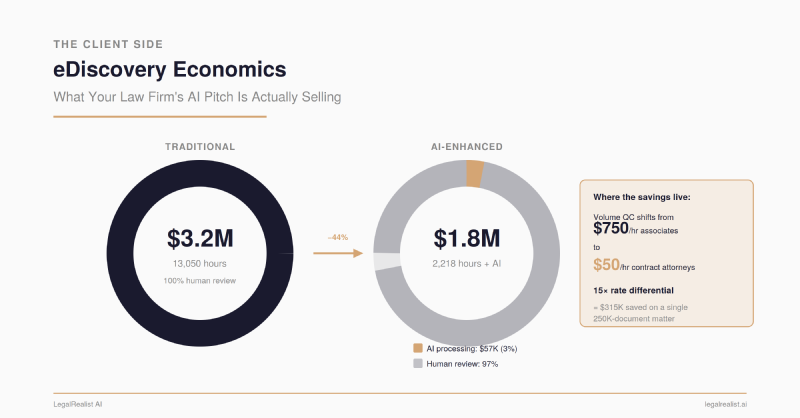
- AI processing is ~3% of total AI-enhanced eDiscovery cost. The platform fee on a 250,000-document matter runs about $57,000. The other 97% is still human time billed at human rates.
- The real savings come from leverage restructuring, not automation. Shifting volume QC from $750/hr associates to $50/hr contract attorneys – because AI pre-screening makes that work routine enough for managed review – is where the $1.4M difference lives.
- Risk profile determines cost more than technology choice. The same 250,000 documents cost 3–4x more in high-defensibility adversarial litigation than in standard compliance work. The AI is identical; the governance isn’t.
- Firms may not pass the savings through. The model assumes leverage restructuring benefits the client. In practice, firms can widen per-hour margins while reducing total hours – and a privilege waiver from downshifted QC is a tail risk the model doesn’t price.
- The calculator models what your firm’s pitch deck won’t. Adjust document volume, risk profile, and staffing assumptions yourself – and see exactly which numbers are driving the total.
A 250,000-document regulatory production. Traditional workflow: approximately $3.2 million, 13,050 billable hours across contract attorneys, associates, and partners. The same matter with AI-enhanced review: approximately $1.8 million, 2,218 attorney hours plus AI processing. That’s a $1.4 million difference – 44% – on the same documents, the same legal issues, the same defensibility requirements (modeled here as a standard regulatory production).
The $1.4 million didn’t come from replacing reviewers with software. AI processing on that matter costs about $57,000 – about 3% of the AI-enhanced total. The savings came from restructuring who does what: which tasks stay with $750/hr associates, which shift to $50/hr contract attorneys, and which get handled by AI at $0.15–$0.50 per document. Every firm pitching AI-enhanced eDiscovery is selling a leverage restructuring. The AI is the justification. The billing math is the product.
The numbers above come from the eDiscovery Cost Calculator, an open-source cost model. Every figure in this post can be reproduced, adjusted, and stress-tested against your own matter parameters. (Source code on GitHub.)
The Billing Rate Is the Cost Driver#
eDiscovery cost is a throughput problem. A reviewer processes documents at rates that vary by document type and complexity – industry benchmarks from the RAND Institute for Civil Justice and the ComplexDiscovery pricing surveys center on roughly 50 documents per hour for initial review, 20 per hour for privilege review, 5 per hour for privilege log entries, 10 per hour for key document identification. Simple email sets run faster; complex technical documents slower. The calculator uses these defaults but lets you adjust them. Multiply 250,000 documents by those rates and you get the first-level hours. Then apply a QC ratio – what percentage of first-level work gets second-level review by more senior attorneys – and you get the full hour count.
The rates come from Am Law 2025–2026 billing surveys (Thomson Reuters, Valeo Partners) for associate and partner tiers, and managed review market pricing (EDRM) for contract attorneys:
| Role | Rate |
|---|---|
| Contract Attorney | $50/hr |
| Junior Associate | $750/hr |
| Senior Associate | $1,000/hr |
| Partner | $1,500/hr |
That 15x spread between contract attorneys and junior associates is where the economics live. In a traditional workflow, junior associates handle the volume QC – reviewing the contract attorneys’ first-pass work, checking privilege calls, validating coding decisions. That QC work is necessary but largely mechanical: did the reviewer apply the right designation? Does the privilege call match the document’s content? Are the extracted metadata fields correct?
When 30% of initial review output goes through junior associate QC at $750/hr, the QC layer alone costs more than the entire first-level review. A 250,000-document matter with a standard QC ratio generates roughly 1,500 junior associate hours on initial review QC – over $1.1 million in billing for work that consists primarily of checking boxes a contract attorney already checked.
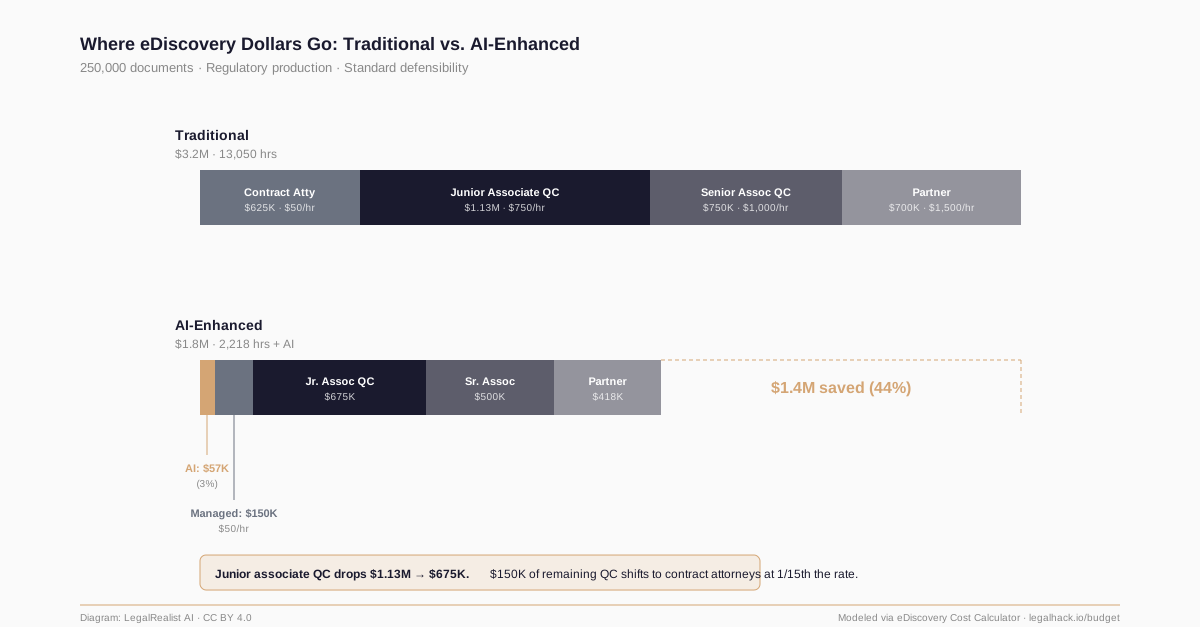
This is BigLaw leverage working as designed. The associate tier exists to review the work of cheaper labor and to be reviewed by more expensive labor. It’s a profitable structure for the firm. It’s an expensive structure for the client. And it’s the structure that AI-enhanced review disrupts – not by eliminating the review, but by changing who’s qualified to do it.
What AI Actually Changes#
In an AI-enhanced workflow, the AI handles four processing tasks: initial document review, privilege screening, privilege log drafting, and key document identification. The per-document costs are fixed:
| Task | Per-Document Rate |
|---|---|
| Initial review | $0.15 |
| Privilege review | $0.35 |
| Privilege log | $0.50 |
| Key document identification | $0.50 |
Source: ComplexDiscovery Winter 2026 eDiscovery Pricing Survey. Relativity and Everlaw began bundling some AI review features into standard platform pricing in early 2026 – the rates above reflect standalone or third-party AI review services, not bundled platform features.
On 250,000 documents, that totals roughly $57,000 in AI processing – about 3% of the AI-enhanced workflow’s total cost. The platform fee is a rounding error. If your firm’s AI pitch leads with the technology cost, they’re burying the number that actually matters.
The savings come from what AI processing enables downstream. When AI pre-screens documents – flagging likely privileged materials, tagging responsiveness, extracting key terms – the QC task changes character. An associate reviewing AI-tagged documents isn’t making first-pass judgment calls. They’re validating a machine classification against the document content. That’s a narrower, more routine task, and it’s one that trained contract attorneys at $50/hr can handle for most of the volume.
The calculator exposes two levers the client controls. AI efficiency gain (adjustable from 0–40%) represents how much AI pre-screening reduces human QC hours overall – the feedback loop where attorney corrections during QC improve the AI’s accuracy through the review, not just after it. Volume QC to managed review (0–60%, default 30%) represents the share of junior associate QC work that shifts to contract attorneys. At 30%, you’re moving roughly 450 associate hours to managed review. At $700/hr in rate differential, that’s $315,000 on a single matter.
The human-AI feedback loop is the quality argument firms should be making – and usually aren’t. The mechanism differs by platform. TAR-based systems using continuous active learning literally retrain the classifier on each attorney correction. LLM-based systems typically update through prompt refinement – adding corrected examples to the prompt context or adjusting classification rules – rather than retraining the model itself. Either way, the system’s accuracy on the remaining corpus should improve as the review progresses. This is a different claim than “our AI is 95% accurate” (accurate compared to what baseline? measured by whom? on which document types?). It’s a claim about the trajectory of accuracy within a single matter, and it’s verifiable: the error rate on documents reviewed in week three should be measurably lower than week one.
Firms already using technology-assisted review ( TAR) can push these gains further by combining TAR’s corpus-level ranking with LLM-based semantic review – an approach that’s cheaper than either technology alone.1
Risk Profiles Set the Floor#
The calculator models nine risk profiles across four matter types – adversarial litigation, regulatory production, internal investigation, and compliance/breach response – each at multiple defensibility levels. The profiles bundle four parameters that scale together: QC ratios, junior/senior associate allocation, partner involvement, and AI efficiency assumptions.
The contrast between profiles matters more than the technology choice. An adversarial litigation matter at high defensibility sets a 30% QC ratio on initial review, allocates QC hours 70/30 between junior and senior associates, doubles partner involvement in key document review, and assumes 0% AI efficiency gain – because opposing counsel will challenge every methodology decision and the court hasn’t blessed AI-assisted review under Rule 26(f). A standard compliance review on the same 250,000 documents sets a 10% QC ratio, allocates 90/10 junior/senior, halves partner involvement, and assumes 20% AI efficiency gain – because the production target is a regulator with known expectations, not an adversary looking for disqualification leverage.
Same documents. Same AI. The adversarial:high matter costs 3–4x the compliance:standard matter because the governance parameters – who reviews, how much gets reviewed, and how much senior time each document demands – are fundamentally different.
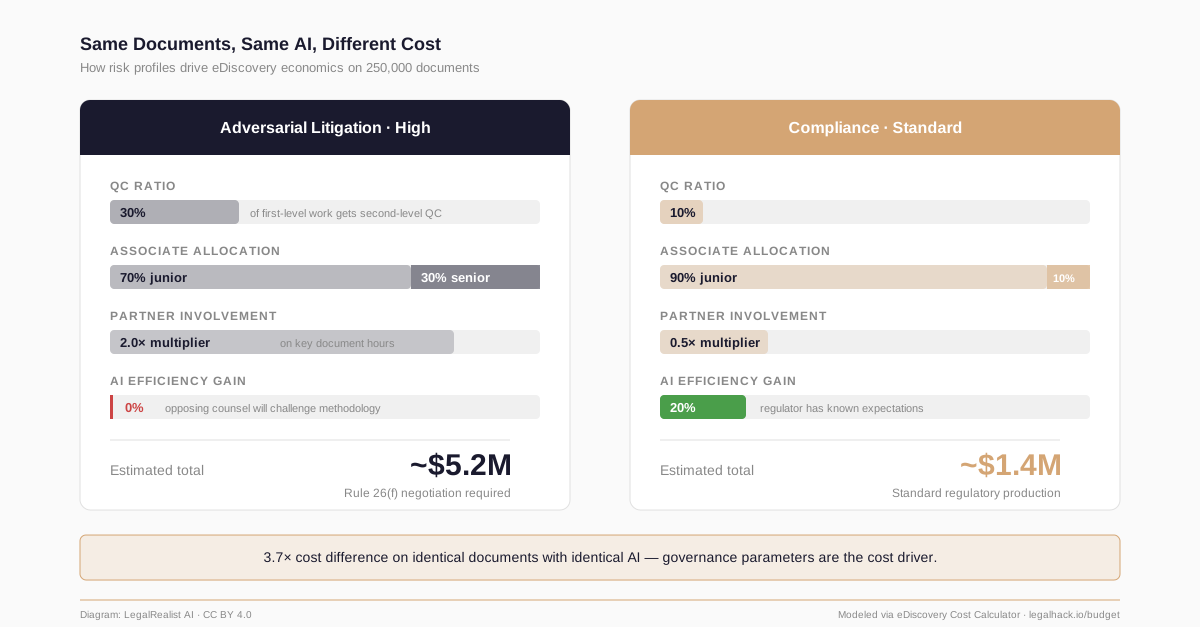
For adversarial litigation specifically: AI-assisted review is not yet judicially blessed as a standard methodology. Unlike TAR, which has a decade of case law supporting its defensibility (starting with Da Silva Moore v. Publicis Groupe in 2012; see the Sedona Conference TAR Case Law Primer for a comprehensive survey), LLM-based review hasn’t been through the same judicial vetting. If you’re using AI-enhanced review in adversarial litigation, the methodology needs to be negotiated with opposing counsel at the Rule 26(f) conference or addressed in a discovery plan – not deployed unilaterally and disclosed after the fact.
What the Model Doesn’t Cover#
The calculator covers the review phase – initial review, privilege review, privilege log drafting, and key document identification. That’s roughly 70–80% of total eDiscovery spend on most matters. It excludes collection, processing, expert witness fees, deposition preparation, trial graphics, motion practice, and appellate work.
The billing rates are client-facing rates, not the firm’s staffing cost. A junior associate billed at $750/hr costs the firm substantially less in salary, benefits, and overhead. The difference is the firm’s margin, and it’s not modeled here because the client’s question is “what am I paying?” – not “what does it cost my firm to provide this?”
The model also doesn’t compare specific vendor platforms. The per-document AI processing rates ($0.15–$0.50) represent current market pricing for LLM-based review services, not any single provider’s fee schedule. Actual pricing varies by volume, contract terms, and whether the firm is using a managed service or running the AI pipeline in-house.
The Best Argument Against This#
The model assumes firms pass leverage savings through to clients. Many won’t. A firm that shifts QC from a $750/hr associate to a $50/hr contract attorney can bill the same line item at something closer to the associate rate – “AI-enhanced review” as a premium service rather than a cost reduction. The client sees a lower total because fewer hours are billed, but the per-hour margin widens. Nothing in the model captures that markup.
There’s also an error propagation problem. If AI pre-screening miscategorizes a privileged document as non-privileged, and a contract attorney – less experienced with the client’s privilege landscape than the associate who would have caught it – validates the AI’s call, the document gets produced. Privilege waiver in adversarial litigation is difficult to undo and easy to litigate. The cost savings from shifting QC downstream need to be weighed against the tail risk of a privilege waiver that wouldn’t have happened under the traditional workflow.
Finally, the throughput rates in this model are averages. A 250,000-document set of short emails reviews faster than 250,000 documents that include lengthy contracts, regulatory filings, and technical reports. The model doesn’t adjust for document complexity, and on a complex corpus, the actual savings could be substantially smaller than what the calculator projects.
Questions to Bring to Your Firm#
The numbers you want before signing off on an AI-enhanced eDiscovery engagement:
Cost and implementation. What’s the per-document AI processing cost, broken down by task? What’s the projected total, and how does it compare to a traditional staffing model for this matter’s document volume and risk profile? What happens to the cost if document volume doubles after a supplemental production?
Quality and feedback loop. How do attorney corrections during QC feed back into the AI’s classification? What’s the error rate trajectory – is the system measurably more accurate at the end of the review than the beginning? Who handles the edge cases the AI flags but can’t resolve?
Staffing transparency. Which tasks shift from associates to contract attorneys? What’s the hourly rate for each tier? If AI pre-screening makes volume QC manageable for contract attorneys at $50/hr, is the firm passing that savings through or billing the same associate rate for less complex work?
Course correction. What happens when new custodians are added mid-review? When a supplemental production arrives? When the AI model needs to be re-trained on a new document type? What does the clawback protocol look like, and who bears the cost if AI-processed documents need to be recalled?
Run your matter’s parameters through the eDiscovery Cost Calculator before the pitch meeting. Adjust the risk profile to match your matter type. Move the sliders. See where the numbers are sensitive and where they’re stable. When the firm presents their estimate, you’ll know which assumptions are driving the total – and which ones to push on.
Further Reading#
- eDiscovery Cost Calculator. Interactive cost modeling tool. Source code on GitHub.
- EDRM Framework. The Electronic Discovery Reference Model – the standard process framework for eDiscovery.
- Da Silva Moore v. Publicis Groupe. The 2012 decision endorsing TAR as a defensible review methodology.
- Technology-Assisted Review Glossary. Grossman & Cormack’s reference on TAR terminology.
- Evaluation of Machine-Learning Protocols for TAR in eDiscovery. Cormack & Grossman’s foundational paper on continuous active learning ( TAR 2.0).
- Am Law Billing Survey 2025–2026. Thomson Reuters data on associate and partner billing rates.
- ABA Formal Opinion 512. The ABA’s 2024 guidance on lawyers’ duties when using AI tools.
- Rule 26(f) Conference – Federal Rules of Civil Procedure. The discovery planning rule governing methodology agreements.
- RAND Institute for Civil Justice – Where the Money Goes. The foundational study on eDiscovery cost distribution and review throughput benchmarks.
- ComplexDiscovery Winter 2026 eDiscovery Pricing Survey. Current per-document AI review pricing and market trends.
- Sedona Conference TAR Case Law Primer, Second Edition. Comprehensive survey of TAR case law from Da Silva Moore through continuous active learning.
- Sedona Conference TAR Reference Model: Unifying Traditional and GenAI Approaches. Framework for integrating LLM-based review with traditional TAR workflows.
- Sedona Conference Primer on AI and the Practice of Law. Ethical and practical framework for lawyers using AI tools.
This post is part of The Client Side series on LegalRealist AI. It is intended for informational and educational purposes only and does not constitute legal advice. The cost estimates and billing rates in this post are modeled figures based on publicly available industry surveys and are not specific to any law firm or vendor. Actual costs depend on matter complexity, jurisdiction, staffing decisions, and contract terms. AI capabilities and pricing are subject to rapid change. Laws governing eDiscovery and AI use vary by jurisdiction.
TAR + LLM: the dual-pass approach. TAR classifiers score documents on commodity hardware for fractions of a cent – orders of magnitude cheaper than LLM review at $0.15–$0.50 per document. What’s always been expensive is the training: senior attorneys coding seed sets at $1,000/hr. LLMs compress that bottleneck by pre-screening and summarizing documents so attorneys validate rather than read cold – cutting seed-set coding time in half. TAR then ranks the full corpus at near-zero cost; the LLM handles semantic review on the prioritized subset. Most platforms (Everlaw, Reveal) are building native integration, but for now the combination favors firms with in-house technical capability. A future post will cover this in depth. ↩︎