The Billable Hour Problem#
TL;DR
- The billable hour is a productivity tax. In every other professional service, doing better work faster earns more. In law, it earns less. AI makes that contradiction unsustainable.
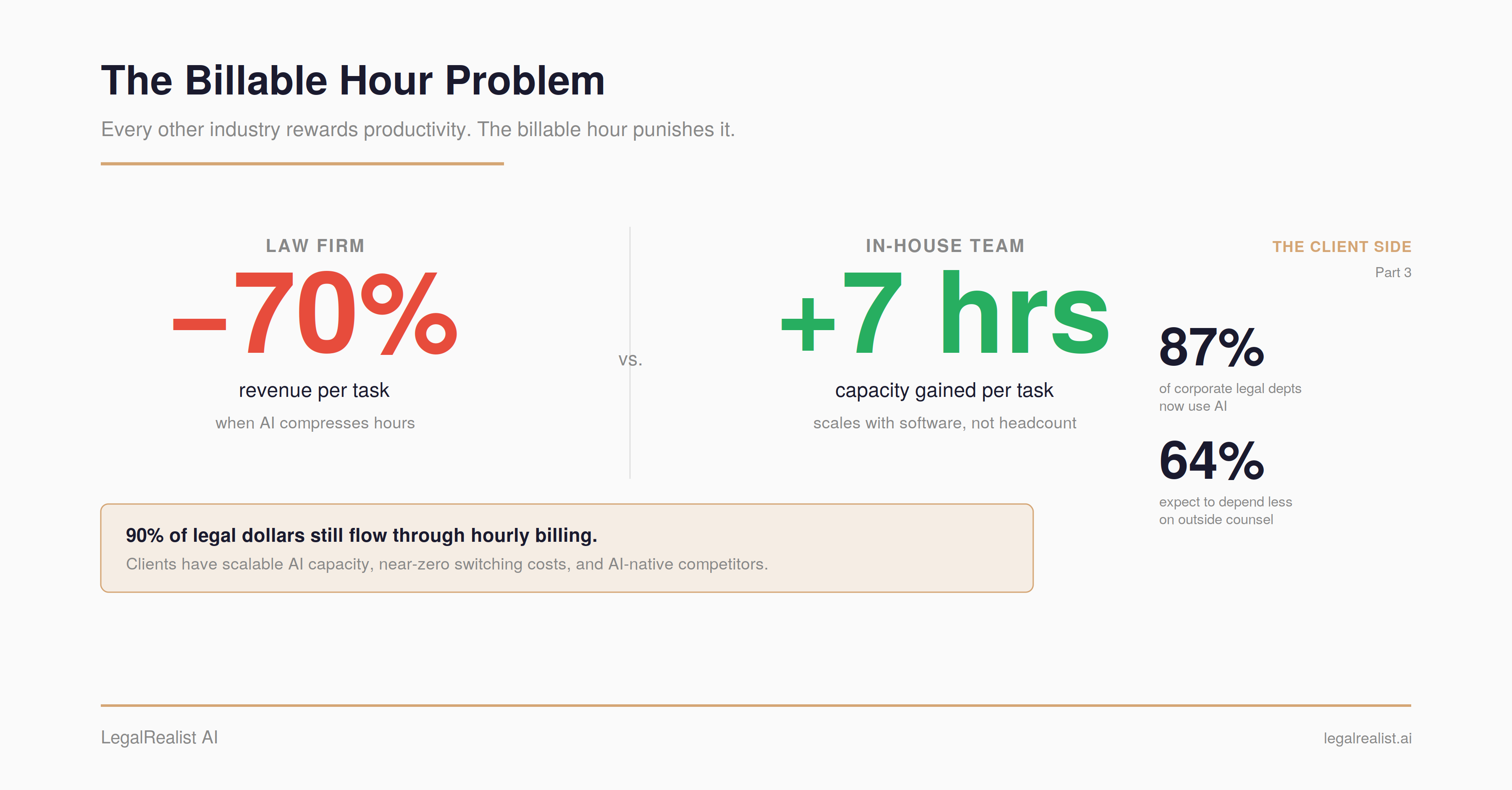
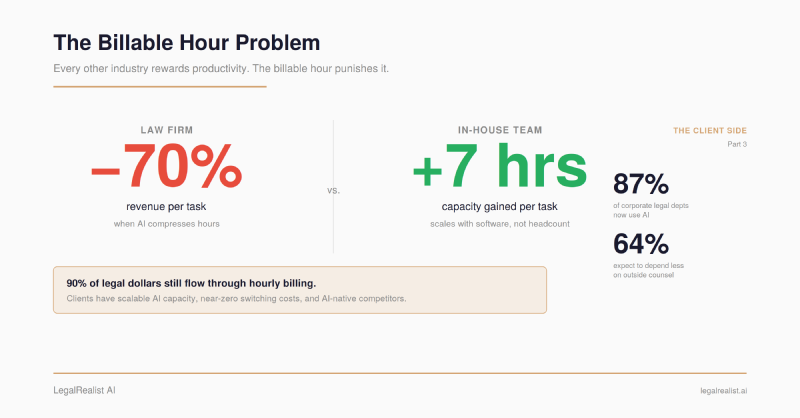
- The same AI creates opposite incentives – and makes internal capacity scalable. A firm loses 70% of its revenue when AI compresses a task. An in-house team gains 7 hours of capacity that scales with software, not headcount. The variable-cost advantage that justified sending commodity work to outside counsel disappears.
- AI destroys the lock-in that kept commodity work at firms. Institutional knowledge used to live in the partner’s head. Now it lives in a structured playbook any AI-augmented provider can read. For fungible work, switching costs drop to near zero.
- Clients are codifying the repricing – or just quietly stopping the work. Zscaler’s published guidelines refuse payment for AI-generated work product. Most of the shift is quieter: GCs stop sending work that AI now handles in-house, and the firm never gets a breakup call.
- The market is splitting into three layers. Fixed fees for commodity work. Value-based pricing for judgment work. AI handling production in between. Firms that bill hourly for fungible services are competing against market forces that don’t require anyone’s permission.
The Productivity Tax#
In software, a developer who ships a feature in a day instead of a sprint gets promoted. In medicine, a surgeon whose technique cuts procedure time by half operates on more patients and earns more revenue. In nearly every professional service, efficiency is rewarded – the same outcome delivered faster means more capacity, more clients, more profit.
A law firm that uses AI to complete a research memo in 3 hours instead of 10 bills for 3 hours instead of 10. Revenue drops 70%. The work is better. The client is happier. The firm made less money.
A fair objection: the firm’s margin on those 3 hours may be higher, because AI’s marginal cost is near zero while associate time carries salary, benefits, and overhead. That’s true per task. But law firm economics don’t run on per-task margin – they run on total revenue, which drives associate salaries, partner compensation, and the leverage model that makes BigLaw profitable. A firm that earns better margins on 30% of the revenue has a math problem no efficiency gain solves by itself.
This is the structural problem at the center of legal economics in 2026. The billable hour doesn’t just fail to reward productivity – it actively punishes it. Every efficiency gain a firm achieves through AI shows up as lost revenue on the income statement, unless the firm raises rates fast enough to offset the compression. The 2026 Report on the State of the US Legal Market, published by Thomson Reuters and Georgetown Law, calls this “an almost absurd tension that sees firms deploying technology that can accomplish in minutes what once took hours, then trying to bill for it by the hour.”
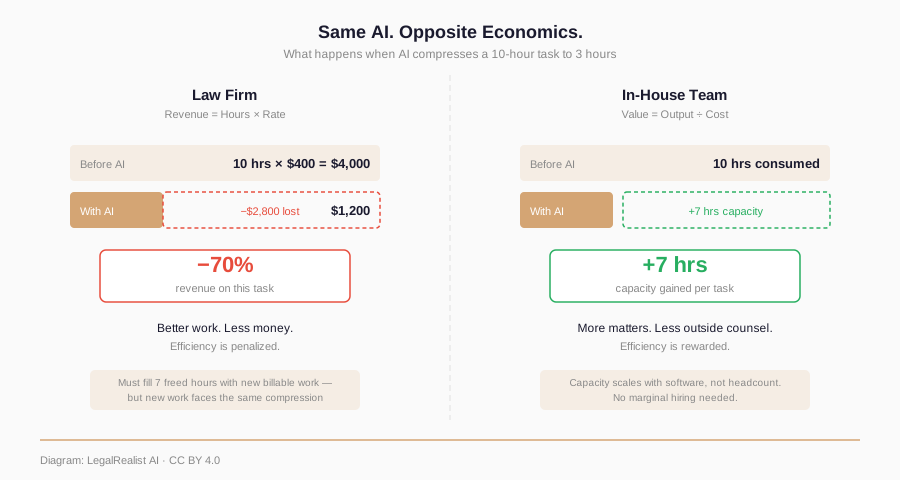
The arithmetic is straightforward. An associate bills $400/hour. A research task takes 10 hours without AI, 3 hours with it. Under hourly billing:
- Without AI: 10 hours × $400 = $4,000
- With AI: 3 hours × $400 = $1,200
- Revenue lost: $2,800 (70%)
To hold revenue flat, the associate would need to bill roughly $1,333/hour – a rate no client will accept for work that took 3 hours. The alternative is to fill those 7 freed-up hours with new billable work, but if that new work is also subject to AI compression, the firm is running faster on a treadmill that keeps accelerating.
Law firm technology spending grew 9.7% in 2025 – likely the fastest growth the industry has ever seen. Knowledge management tools grew 10.5%. Profits grew 13%. But 90% of all legal dollars still flow through hourly billing. Firms are investing heavily in tools that make their primary revenue model work worse.
Opposite Incentives#
The productivity tax doesn’t apply equally. Law firms and their clients face the same AI and arrive at opposite economic conclusions – not because they’ve made different strategic choices, but because their incentive structures point in opposite directions.
For a law firm, revenue = hours × rate. AI compresses hours. Revenue falls. The firm benefits only if it can immediately backfill the freed hours with new billable work – and even then, the new work is subject to the same compression. As LegalOn’s CEO wrote: “A law firm only benefits from this higher productivity if it has an immediate, infinite backlog of new work to fill the saved hours.” Some elite firms are genuinely capacity-constrained and turn away work – for them, AI-freed hours do get redeployed, at least initially. But the new work is subject to the same compression, and so is the competitor’s. The treadmill accelerates for everyone. The firm that fills freed hours with more AI-compressible work hasn’t escaped the revenue problem; it has deferred it.
For an in-house team, value = output ÷ cost. AI compresses cost. Value rises. The 7 hours freed up don’t disappear from a revenue line – they become capacity. More matters handled, faster turnaround, fewer requests sent to outside counsel. In virtually every organization, unmet demand for legal work exceeds available capacity, so every hour AI frees is immediately productive.
Before AI, this asymmetry was tolerable because internal capacity didn’t scale. A GC who wanted to bring contract review in-house needed to hire – and hiring is lumpy, slow, and creates fixed costs. Sending work to outside counsel was the more efficient model: variable cost, scales up and down with deal flow, no long-term headcount commitment. The billable hour was expensive per unit, but it was flexible.
AI breaks that trade-off. A three-person in-house team with AI tools can now handle the throughput that used to require outside counsel. The capacity scales with the software, not with headcount. The variable-cost advantage that made hourly billing rational for buyers of commodity legal work – the reason GCs tolerated $400/hour for NDA review – disappears when the GC’s own team can do the same work at a fraction of the cost with no marginal headcount.
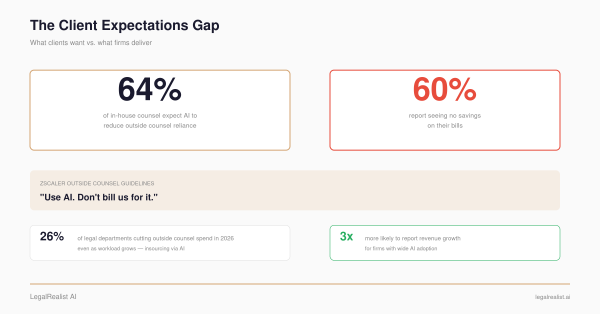
The survey data points in the same direction, though the numbers deserve caveats. AI adoption in corporate legal departments nearly doubled in a single year – from 44% to 87%, according to FTI Consulting and Relativity’s General Counsel Report. That headline figure depends on how “adoption” is defined; a team where one lawyer uses ChatGPT for research and a team with AI embedded in every workflow both count. Still, the direction is unambiguous. The ACC/Everlaw GenAI Survey found that 64% of in-house teams expect to depend less on outside counsel because of AI capabilities they’re building internally. A CLOC and Harbor survey found that 26% of in-house teams expect to cut law firm spending in 2026 – even as overall demand for legal services grows. Expectations aren’t actions; GCs have been promising to cut outside counsel spending for two decades. But the difference now is that they have the tools to actually do it.
The Lock-In Is Gone#
The commodity layer of legal work has always been fungible. An NDA review is an NDA review. A first-pass deposition summary is a first-pass deposition summary. The client doesn’t care whether the output was produced by a partner at a major firm, an associate at a regional firm, or the GC’s own team. The deliverable is functionally identical.
What kept fungible work at outside counsel wasn’t the quality of the output – it was switching costs. The partner who knew the client’s deal history. The associate who’d reviewed every version of the MSA. The clause preferences built from years of negotiations. That institutional knowledge created friction. Even when cheaper options existed, moving meant rebuilding context from scratch, so the client paid the premium.
AI eliminates that friction by making institutional knowledge portable. A GC who structures her playbook, clause library, and negotiation history into documents an AI tool can consume has extracted that knowledge from the law firm’s institutional memory and moved it into her own systems. The playbook is now a structured file – preferred positions, fallback language, deal-breaker terms, escalation triggers – that any AI-augmented provider can read. She can hand the same file to a new firm, an AI-native boutique, or her own team running Claude, and get competent output on day one.
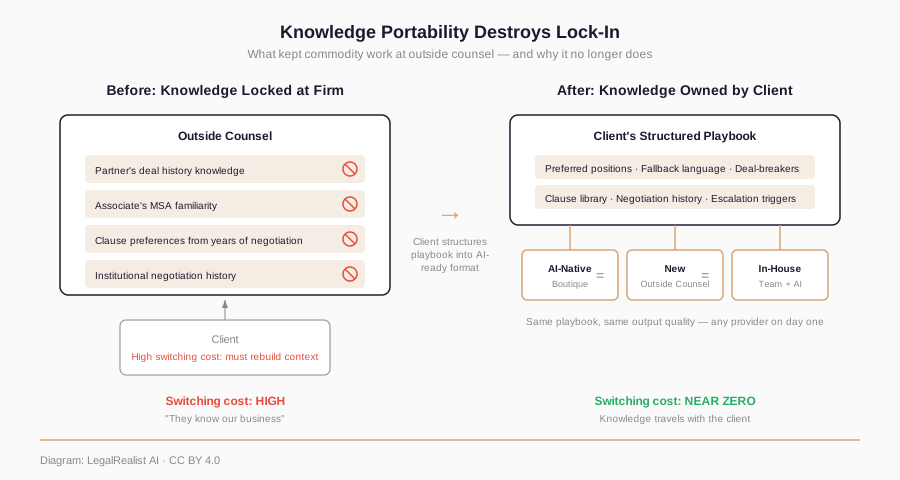
For commodity work, the switching cost that justified a premium – “they know our business” – drops to near zero when what they knew is now a client-owned asset that travels with the client. For high-stakes judgment work, the calculus is different: a GC’s trust in a litigator’s instincts, familiarity with a board’s risk appetite, years of shared context on ongoing matters – none of that fits in a playbook. The lock-in that’s disappearing is specific to the fungible layer. But the fungible layer is where firms bill the most associate hours.
This is the paradox of the knowledge management push happening across the industry. When firms help clients structure legal knowledge into AI-ready playbooks, they build better workflows for the current engagement – and simultaneously make it easier for the client to take that workflow to a competitor or bring it in-house entirely. The same KM work that makes AI useful inside a firm relationship makes the client less dependent on the firm.
The economic logic compounds: fungible service + scalable internal capacity + near-zero switching costs + misaligned incentives = the work moves to the lowest-cost provider with acceptable quality. No strategic decision required. No breakup call. The GC builds an AI-assisted contract review workflow, stops sending the NDAs, and the associate’s utilization drops by a few hours a month. The partner attributes it to a slow quarter. By the time the firm recognizes the pattern, the client has been handling that work internally for six months and the workflow is mature.
Why It Held – and Why It Breaks#
If the economics are this clear, why has the billable hour survived the fax machine, email, Westlaw, e-discovery platforms, and cloud computing? Because it has real virtues, and every previous technology left those virtues intact.
Information asymmetry. The client couldn’t see the efficiency gain. A lawyer who found a case on Westlaw in 10 minutes instead of spending 3 hours in the law library could still bill for the research, because the client had no way to benchmark the work. The efficiency surplus stayed with the firm, cycle after cycle.
Transparency and auditability. Hourly billing gives the client a line-item record of exactly what was done and how long it took. When something goes wrong, “we spent 40 hours researching this question” is a malpractice defense. “Our AI did it in 2 hours and we billed a fixed fee” is a harder story to tell a disciplinary committee. The billable hour creates a paper trail that protects both sides.
Risk allocation for unpredictable work. Complex litigation and novel regulatory matters genuinely resist scoping. A fixed fee on a matter that could take 200 hours or 2,000 puts ruinous risk on the firm. Hourly billing shifts scope-creep risk to the client – not out of greed, but because no one can predict how a bet-the-company case will unfold. This is why 72% of firms offer AFAs but apply them narrowly: both sides find hourly billing rational for genuinely unpredictable engagements.
Partner economics. The managing partner’s counterargument writes itself: AI frees me from supervising routine work, I handle more matters, my origination credits increase, my personal billings go up. If the partner’s judgment work is what clients actually value, AI might make the partner more profitable even as the firm’s per-matter revenue drops. This is real – but it only works if the firm restructures compensation around origination and judgment rather than total hours supervised. Most haven’t.
AI doesn’t invalidate all of these at once. It invalidates the first one decisively, and that’s enough. When a GC can paste a contract into Claude and get a competent risk summary in 90 seconds, she knows what that work costs to produce. The benchmarking problem that protected hourly billing for decades is solved – not by procurement consultants or legal ops teams, but by the same AI the firms are using. The transparency argument still holds for judgment work. The risk-allocation argument still holds for unpredictable matters. But for the commodity layer – summarization, first-draft research, standard contract review – the information asymmetry that kept hourly billing stable is gone, and clients are moving from bilateral rate negotiations to codifying the repricing in their standard terms.
Clients Are Codifying It#
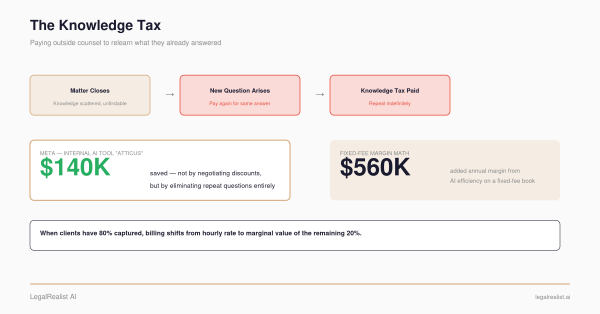
Zscaler’s published outside counsel billing guidelines state that “any time and cost associated with AI-generated work product shall not be passed on to Zscaler.” Meta has reportedly adopted similar provisions, flagging and declining to pay for work it believes could be handled with AI – summaries, first-pass research, routine drafting. UBS reportedly updated its guidelines with AI-specific provisions in early 2026.
Three companies don’t make a trend. But these are leading indicators, not outliers – they’re large, sophisticated legal consumers codifying what many GCs are already doing informally. And the provisions target the exact categories of work that generate the bulk of associate billing: document summarization, deposition digests, provision extraction, timeline construction, first-draft research. When clients systematically refuse to pay hourly rates for those line items, the economics of the associate pyramid shift underneath every firm that depends on it.
But the contract terms are the visible part. The larger shift is silent. The GC who discovers that Crosby reviews NDAs at a fixed fee with median turnaround under an hour doesn’t call her relationship partner to renegotiate. She runs a quiet pilot on 20 contracts and routes the next batch the same way. Avantia built a corporate law practice with no billable hours – fixed-price services powered by its proprietary AI platform, 100 employees, 90 clients. Tacit Legal offers SRA-regulated contract review starting at £95 per contract. These firms aren’t competing on reputation or relationships. They’re competing on the economics of fungible services – and on those economics, they win.
BigHand’s survey found that 100% of law firms say AI has impacted their pricing strategies. Only a third have updated their models to reflect it.
Three Layers#
The firms that are adapting aren’t eliminating the billable hour. They’re recognizing that legal work falls into three layers, each with different economics – and that only one supports hourly billing.
Commodity work gets fixed fees. NDAs, standard employment agreements, routine compliance filings, form motions – tasks where scope is predictable, AI handles the first draft, and the attorney’s value is quality control. Fixed fees reward efficiency: if AI cuts production cost by 60%, the firm keeps the margin. Most firms already offer AFAs for this work – the question is whether they treat fixed fees as a client accommodation or as the structural response this market demands.
Judgment work stays hourly or goes to value-based pricing. Complex litigation strategy, bet-the-company negotiations, novel regulatory questions – work where scope is unpredictable and the value is the lawyer’s expertise, not the document produced. Hourly billing works here because the client is buying judgment, and judgment isn’t fungible.
AI handles the production layer in between. First-pass research, document summarization, contract extraction – work now done faster and cheaper by the same associates using AI tools. The firm bills less for production and more for judgment, and if the pricing is right, total revenue holds or grows because the firm handles higher volume at better margins.
Bloomberg Law calls this “speciation” – the market splitting into fundamentally different forms. The split follows the economics: fungible work flows to the lowest-cost provider with acceptable quality; judgment work stays with the provider the client trusts most. The billable hour survives where expertise is the product. It fails where the output is standardized and the market has repriced around AI-augmented delivery.
The split won’t hit every practice area equally. Document review, contract abstraction, regulatory compliance filings, and standard research – heavily compressible. Trial strategy, appellate advocacy, bet-the-company M&A negotiations – not compressible in any meaningful sense, and not likely to be soon. A firm whose revenue is weighted toward judgment work may feel this pressure as a distant hum. A firm that bills thousands of associate hours for due diligence and deposition digests will feel it as a structural threat.
The three-layer split also creates a talent problem no one has solved. Associates learn by doing – reviewing thousands of contracts, drafting hundreds of motions, sitting through depositions that teach them what to listen for. If AI handles the production layer, the training ground shrinks. Fewer billable hours on routine work means fewer reps, and fewer reps means the pipeline that produces future partners narrows. Firms that embrace AI for efficiency may find they’ve optimized away the apprenticeship model that made their senior lawyers worth $1,500/hour. This tension doesn’t invalidate the market forces described above, but it’s a real cost the industry hasn’t reckoned with.
There is a real counterargument worth taking seriously: AI could expand the total market for legal services. Legal work is massively under-consumed – most small businesses and individuals can’t afford lawyers. If AI drops the cost of routine legal work by 70%, the addressable market may grow enough to offset per-matter revenue compression. ATMs didn’t reduce bank-teller employment; they made branches cheaper to operate and banks opened more of them. Something analogous could happen in law. But expansion takes years to materialize and requires firms to pursue market segments they’ve historically ignored. The repricing is happening now.
BigLaw has been “about to be disrupted” since Richard Susskind’s The End of Lawyers in 2008. Every wave – e-discovery, legal process outsourcing, cloud computing – was supposed to break the billable hour. None did. A healthy skepticism about timelines is warranted. But every previous wave gave firms an efficiency surplus they could keep because the client couldn’t see it. AI is different because the client has the same tool. The GC isn’t reading a McKinsey report about disruption; she’s using Claude on her laptop and watching it produce in 90 seconds what she used to pay $4,000 for. The information asymmetry that insulated every previous transition is gone.
How fast? Not overnight. Law is conservative, relationships are sticky, and institutional inertia is real. But the commodity layer will reprice within a few years, not a few decades – because the repricing doesn’t require industry consensus or regulatory change. It requires one GC to run a pilot and route the next batch of NDAs to a cheaper provider. That’s already happening. The firms that keep billing by the hour for commodity work aren’t losing a pricing argument. They’re selling a fungible service at a premium in a market where clients have scalable internal capacity, low switching costs, and AI-native competitors offering the same output faster and cheaper. The incentives, the market structure, and the technology all push in one direction.
Further Reading#
- 2026 Report on the State of the US Legal Market. Thomson Reuters and Georgetown Law’s annual analysis.
- The Gap Is Closing: Why AI Is Breaking the Billable Hour Model. Above the Law on the pricing disconnect.
- Legal AI’s Next Act Is In-House Productivity. LegalOn’s CEO on the incentive asymmetry.
- AI Adoption in Corporate Legal Departments Doubles. FTI Consulting and Relativity’s General Counsel Report.
- AI-Enabled Firms’ Unbundled Offerings to Split the Legal Market. Bloomberg Law on boutique formation and market speciation.
- 10 AI Law Firms to Watch in 2026. Lupl’s survey of AI-native legal service providers.
- Law Firms Embrace AFAs, But Clients Want More Flexibility. Best Law Firms survey on alternative fee adoption.
- Zscaler Outside Counsel Billing Guidelines. Published AI billing provisions.
- Ten AI Predictions for 2026. National Law Review analyst consensus.
This post is part of The Client Side series on LegalRealist AI. It is intended for informational and educational purposes only and does not constitute legal advice. AI capabilities, pricing, and market data described here reflect publicly available information as of the publication date and are subject to rapid change. Laws governing AI use vary by jurisdiction.