TL;DR
- Both companies abandoned proprietary models. Harvey built a custom LLM, tested it against frontier models on its own benchmark, and the frontier models won. Legora runs primarily on Claude. The AI is rented, not owned.
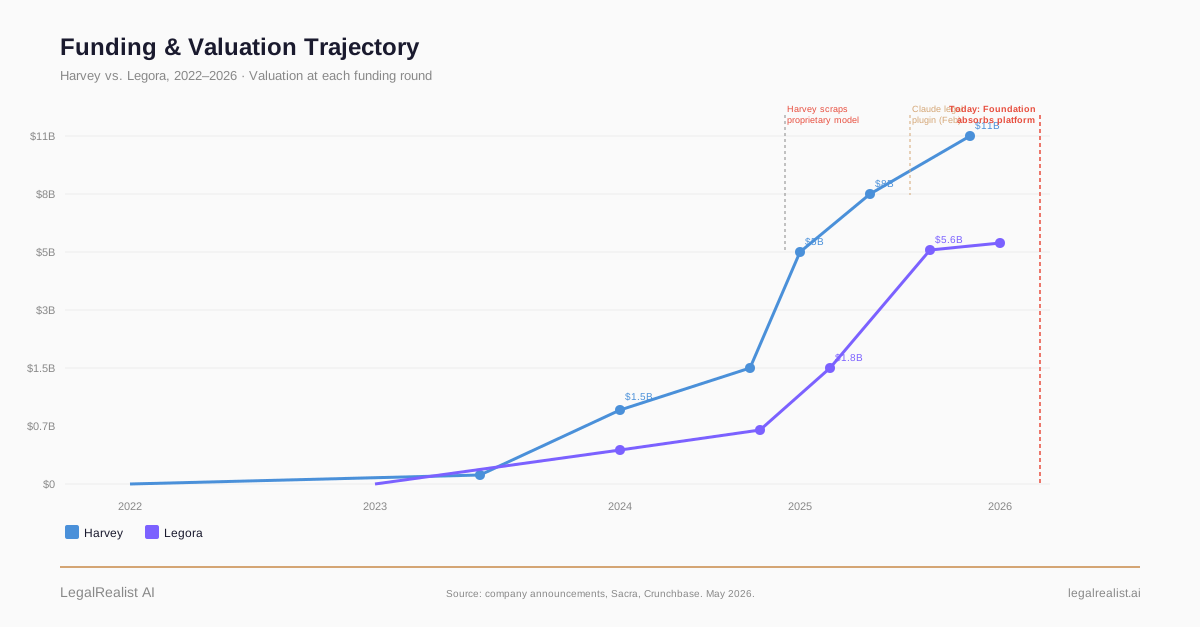
- $17B in combined valuation on ~$300M combined ARR. Harvey at ~57x revenue, Legora at ~56x. Those multiples price in a future where the platform layer stays independent – today’s announcement suggests it won’t.
- The foundation is absorbing the platform. Anthropic just launched 20+ connectors – including Harvey itself – and 12 practice-area plugins for Claude. The integration moat Harvey and Legora built is now a feature of the foundation model they run on.
- Celebrity marketing is a commoditization signal. Legora signed both a Law and a Judge in the same week. Harvey signed the fictional lawyer it was named after. When B2B software spends like consumer brands, product differentiation is no longer doing the work.
- Open source makes the platforms portable. Projects like Mike are building bridges between proprietary platforms – good for firms, bad for 57x revenue multiples.
Legora signed Jude Law. Then Aaron Judge. Then the New York Yankees. Harvey signed Gabriel Macht – the actor who played Harvey Specter in Suits, the character the company was literally named after – plus Paris Saint-Germain and Fulham FC. As one commentator observed, Legora managed to sign both a Law and a Judge in the span of a single week.
Two legal AI companies. Combined valuation approaching $17 billion. Spending on Oscar-winning cinematographers and MLB All-Stars like they’re selling sneakers. And as of this morning, both are built on top of a Foundation Model that just launched itself as a legal platform – with Harvey as a connector inside it.
The Contenders#
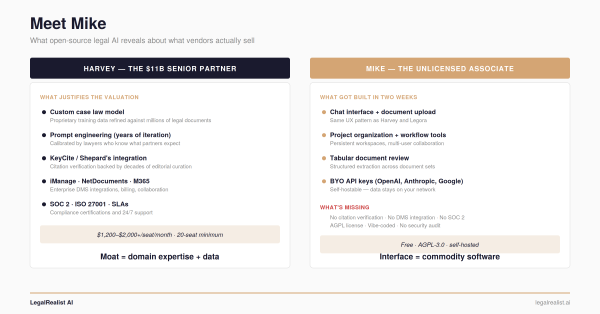
Harvey: founded 2022 by a former O’Melveny litigator and a former Google DeepMind research scientist. $11 billion valuation, $1.3 billion raised, ~$195 million ARR. More than 100,000 lawyers across 1,300 organizations, majority of the AmLaw 100. Pricing around $1,000–1,200 per user per month.
Legora: founded 2023 in Stockholm by a 26-year-old with no legal background. Y Combinator W24, fastest YC startup to unicorn. $5.6 billion valuation, $866 million raised, $100 million+ ARR – growing from 200 to over 1,000 customers in a single year. Pricing around $3,000 per user per year, 10-seat minimum.
Both sell the same three things. A managed prompt layer: legal-specific Prompt Engineering, structured outputs, and quality control between the Foundation Model and the lawyer. Harvey’s BigLaw Bench is the most rigorous legal AI evaluation framework in the industry. A workflow engine: Harvey runs 400,000+ agentic queries per day with 25,000 custom workflows; Legora’s Workflows chain drafting, review, extraction, and research into multi-step agents. Both let firms encode how this practice group reviews SPAs, which clauses trigger escalation, what this client’s preferred indemnification language looks like. An integration surface: Harvey connects to LexisNexis, iManage, NetDocuments, Intapp, and Microsoft 365 Copilot; Legora connects to iManage, SharePoint, Word, Outlook, and Docusign.
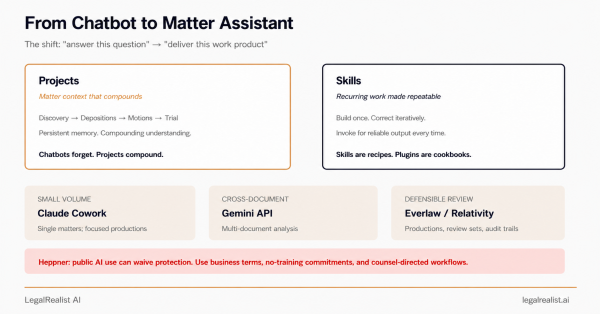
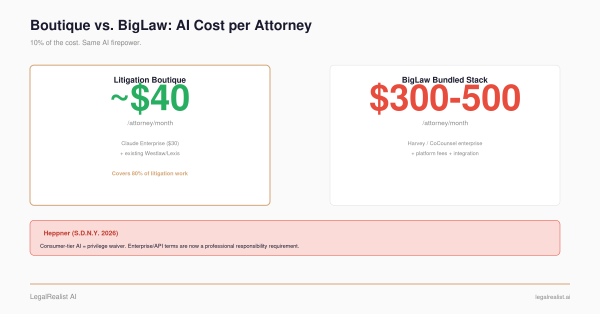
In our AI Use Spectrum framework, both operate at Level 5 (enterprise platform). But the tasks lawyers actually perform through them – research a question, review a contract against a playbook, extract terms from a document set – are increasingly achievable at Level 2 or 3. Our Cowork litigation guide walked through how a boutique can build deposition summaries, discovery triage, and brief finalization as Claude Skills – the same work Harvey and Legora sell at Level 5 pricing. Their value has to be what Level 5 adds that lower levels can’t: governance, consistency, compliance, integration. Not the AI itself.
The Model Underneath#
The first post in our Legal AI Landscape series opened with a claim that holds up: no legal tech vendor builds their own LLM.
Harvey built a proprietary legal LLM, tested it against frontier foundation models on BigLaw Bench, and the foundation models won. Seven models – from Google, OpenAI, Anthropic, and xAI – now outperform the original Harvey system on Harvey’s own benchmark. Harvey went multi-model, routing tasks to Claude, Gemini, and GPT by subtask. The right engineering call – but the most well-funded legal AI company in history tried to own its model and concluded that renting was better.
Legora is built primarily on Claude. When Anthropic launched a legal plugin for Claude Cowork in February 2026, the market erased $285 billion from legal tech stocks in five trading days. The stocks recovered – the market concluded the plugin targeted contract administration, not legal research. That was February.
Foundations Absorb Platforms#
On May 12, 2026, Anthropic went further: 20+ MCP connectors and 12 practice-area plugins for Claude Cowork. Connectors for iManage, NetDocuments, Docusign, Relativity, Everlaw, Datasite, Midpage, Thomson Reuters’ CoCounsel – covering contracts, e-discovery, deal rooms, and legal research.
And Harvey. Harvey is now an MCP connector inside Claude.
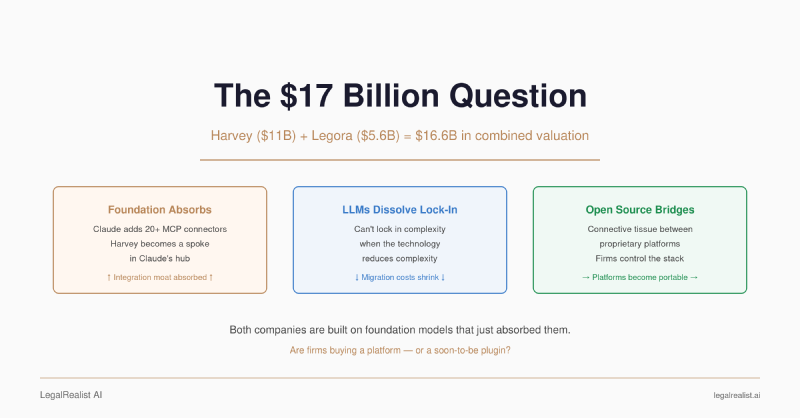
The platform that sold itself as the hub is now a spoke in Claude’s hub. A firm using Harvey through Claude’s connector can swap Harvey for a different connector – or for Claude’s own plugins – without changing anything else in its stack.
The 12 practice-area plugins cover commercial, corporate (M&A diligence, closing checklists), employment, privacy, regulatory, IP, and litigation. Each begins with what Anthropic describes as a setup interview that learns a team’s playbooks, escalation chains, and house style – the same onboarding Harvey and Legora charge five- and six-figure contracts to provide.
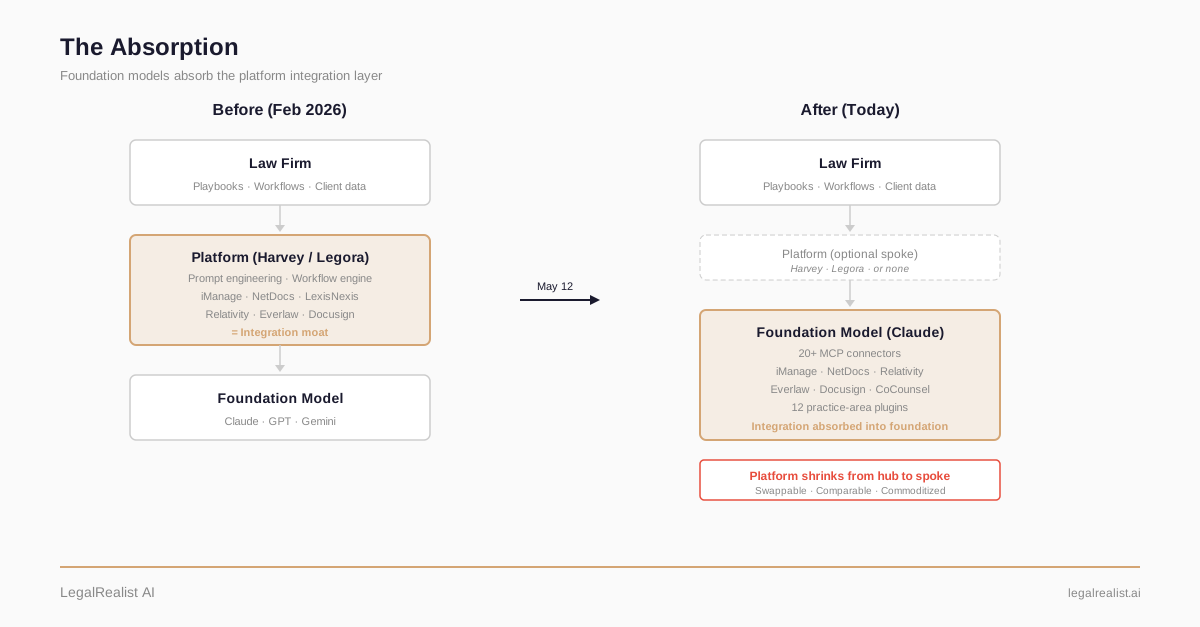
Our Cowork post described how three months ago DeepJudge, Midpage, and Pramata built early MCP connectors for Claude – first signals that the ecosystem was forming around the Foundation Model, not around the enterprise platforms. Today Anthropic added the platforms themselves as connectors. The discovery tiers we mapped – Cowork for hundreds of documents, Gemini for thousands, Everlaw or Relativity for tens of thousands – now all route through Claude.
Claude Opus 4.7 scored 90.9% on Harvey’s BigLaw Bench. A Quinn Emanuel partner built his firm’s litigation platform on Claude with no coding background. Legal is now the top power-user job function inside Cowork. As Fortune put it, Anthropic is now “not just a model provider” but “a direct participant in legal workflows.”
The Lock-In Question#
The standard defense: enterprise lock-in. Nobody stays on Oracle because it’s the best database. They stay because migrating 15 years of custom schemas is an 18-month project nobody wants to own. Harvey has 25,000 custom workflows. Legora has 1,000+ deployments with embedded Legal Engineers. Every workflow a firm builds is a brick in a wall around itself.
But legal AI lock-in has a structural weakness Oracle never faced: the same technology that powers the platform makes migration easier. A firm locked into Salesforce in 2015 couldn’t use Salesforce to rebuild its CRM on a competitor. A firm locked into Harvey in 2027 can use Claude to analyze its workflows, extract the logic, and reconstruct equivalents. Lock-in that depends on complexity is vulnerable to a technology whose purpose is reducing complexity.
Integration lock-in – historically the stickiest layer – is what Anthropic absorbed today. Claude now connects directly to the same DMS, research, and e-discovery tools that Harvey and Legora built their moats around.
What remains is data gravity: accumulated knowledge of how a firm works, which prompts lawyers accept, which workflow patterns correlate with faster turnaround. That’s real, but it’s a retention moat, not a growth moat. It keeps existing customers. It doesn’t explain how Harvey and Legora reach the revenue their valuations require – because the foundation models don’t need to break existing lock-in. They need to prevent it from forming.
Every firm that builds its own Skills library in Claude Cowork instead of signing a Harvey contract is a customer Harvey never gets and never has to lose. And the pressure isn’t only from Anthropic. Open-source legal AI is emerging as a third force – not just cheaper alternatives at the bottom of the market, but connective tissue between the proprietary platforms. Mike, built by a former Latham associate and named after the other half of the Suits duo, is open-source legal AI that a 40-attorney firm can run for $6,000–24,000 per year – roughly 2–4% of what the same firm pays Harvey. But the deeper threat to the $17 billion thesis isn’t Mike replacing Harvey. It’s open-source projects building bridges between Claude, Harvey, and Legora – making it possible to use each where it’s strongest without being locked into any of them. For the firms buying these tools, that’s the best possible outcome: platforms competing on quality and price inside a stack the firm controls. For the vendors, it’s the opposite – you can’t sustain 57x revenue multiples when your customers can fork the integration layer and swap you out.
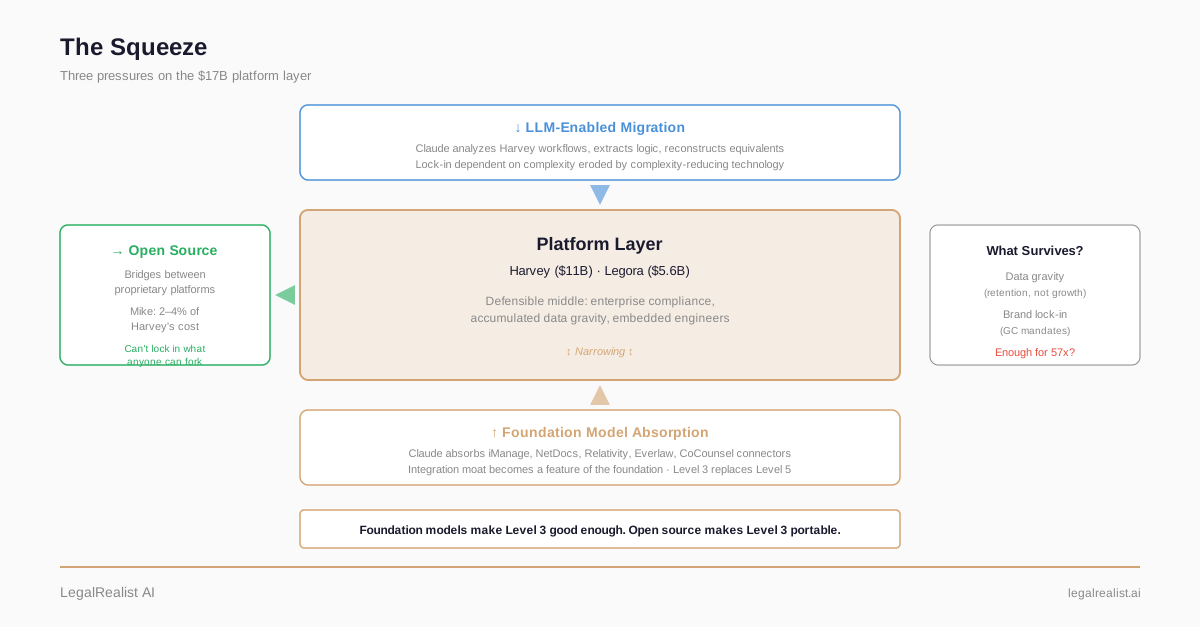
The foundation models aren’t climbing the AI Use Spectrum to compete at Level 5. They’re making Level 3 good enough that fewer firms need to climb there – and open source is making Level 3 portable.
The Marketing Arms Race#
Harvey signed Gabriel Macht – the actor who played Harvey Specter, the character the company was named after. “People prompt better when they act more human,” CEO Winston Weinberg told Non-Billable, explaining the name. Plus Paris Saint-Germain and Fulham FC.
Legora responded with Jude Law – tagline: “Law just got more attractive” – then Aaron Judge and the Yankees, then Swedish golfer Ludvig Åberg. A Law and a Judge in the same week.
Brand as distribution: both companies have saturated BigLaw and the next wave is mid-market firms and corporate legal departments. As Legal IT Insider noted, “They are using brand to break further into the FTSE 100. If the FTSE then says its panel law firms must use Harvey, it’s a game changer.” Brand creates organizational lock-in that survives technical commoditization. Differentiation anxiety: both companies are wrappers around the same foundation models, with converging features. As TechCrunch observed, “they are built on top of large language models made by AI giants that could well become their competitors.” The celebrity spend is the loudest acknowledgment that both companies know this.
Harvey at ~57x ARR. Legora at ~56x. Harvey alone valued at nearly twice the entire legal AI software market. Those multiples require the platform layer to remain independent and indispensable. Today, the Foundation Model absorbed the integration layer, LLMs made migration easier than any prior generation of enterprise software, and open source started making the platforms interchangeable. The firms writing six-figure checks aren’t buying AI capabilities – those are commoditizing. They’re making an ecosystem bet. Whether that ecosystem remains independent by the time the contract renews – or becomes a feature inside the Foundation Model they already subscribe to – is the $17 billion question.
Further Reading#
- Anthropic Goes All-In on Legal. Bob Ambrogi’s analysis of the May 12 announcement.
- Even as Hallucinations Show Up, Big Law Goes All In on AI. Fortune’s coverage of Anthropic’s legal expansion.
- Harvey Raises at $11 Billion Valuation. Harvey’s March 2026 funding announcement.
- Legora Extends Series D to $600M. Nvidia and Atlassian join Legora’s cap table.
- The Billion-Dollar Legal AI Arms Race. PlatinumIDS analysis of March 2026 funding and market context.
- Expanding Harvey’s Model Offerings. Harvey on scrapping its proprietary model.
- BigLaw Bench on GitHub. Harvey’s open-source legal AI evaluation framework.
- Inside Legora’s Celebrity Partnerships Playbook. Marketing Brew on the brand strategy.
- Legal AI Is Splitting in Two. Fortune on operational vs. authoritative AI.
- LegalTech: SaaSpocalypse Now. Law Gazette on the February market reaction.
This post is part of the Legal AI Arms Race series on LegalRealist AI. It is intended for informational and educational purposes only and does not constitute legal advice. AI capabilities, pricing, valuations, and product features described here reflect publicly available information as of the publication date and are subject to rapid change. Valuations and ARR figures are based on company announcements and third-party estimates; neither Harvey nor Legora has disclosed audited financials. Laws governing AI use vary by jurisdiction.