TL;DR
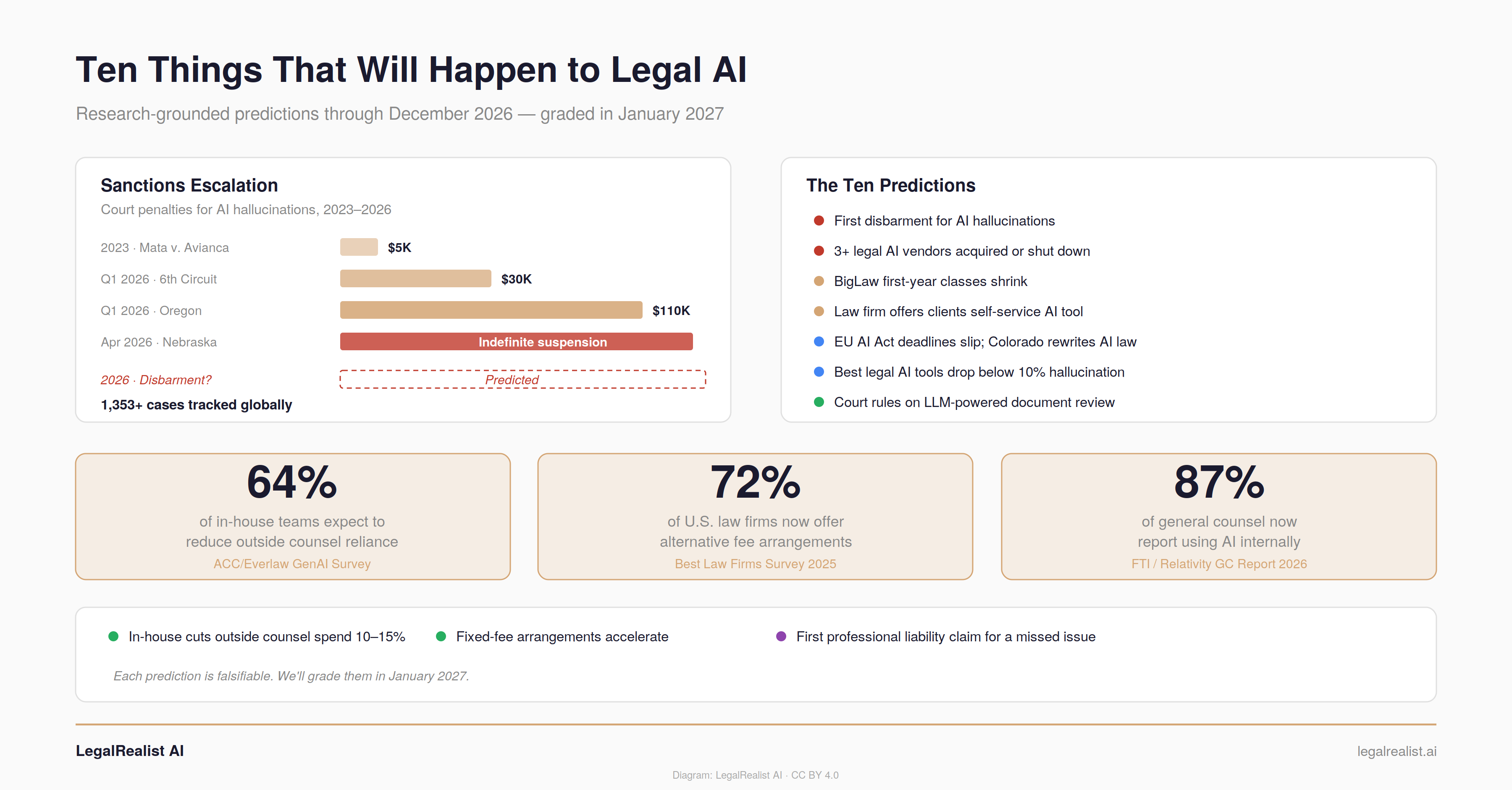
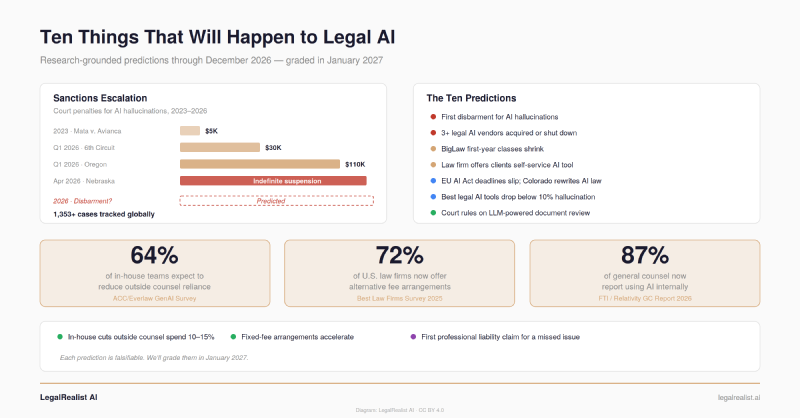
- Courts have sanctioned lawyers $145,000 for AI hallucinations in recent months alone. The escalation from fines to suspensions to disbarment is a matter of months, not years.
- At least three legal AI vendors will be acquired or shut down. Point solutions that raised seed rounds in 2023–2024 are hitting the wall between traction and runway.
- BigLaw will hire fewer first-years even as total associate headcount grows. Only 35% of large firms plan to increase first-year class sizes through 2027, while 86% plan to grow their overall associate ranks.
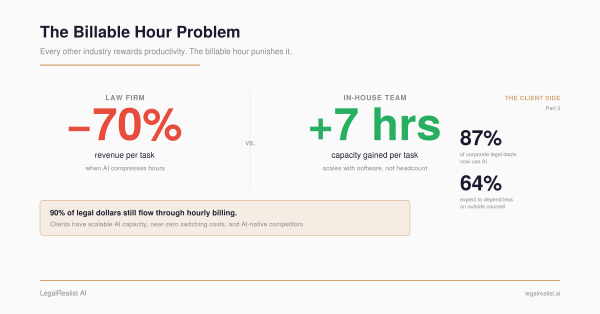
- In-house departments will cut outside counsel spend 10–15% through AI-powered insourcing. The ACC/Everlaw survey shows 64% of in-house teams expect to reduce reliance on outside counsel – and they’re building the tools to do it.
- Run your own benchmark before year-end. Most of these predictions will affect your practice. An hour of testing with your own documents tells you more than any forecast.
Most legal AI commentary hedges. “AI could transform the profession” – or it might not. “Firms may need to adapt” – but who knows when. Predictions framed as possibilities aren’t predictions. They’re atmosphere.
This post does something different: it commits ten specific, falsifiable predictions to paper. Not “AI will change things” – concrete claims about what will happen to courts, firms, vendors, clients, and regulators before the end of 2026. Each one is grounded in data that already exists: enforcement trends, hiring surveys, deal activity, regulatory timelines, and benchmark results. Each prediction carries a confidence level – high (already documented or in motion), medium (supported by clear incentives or trends), or low (speculative but worth watching) – so you can calibrate how much weight to give it. Some will be wrong. That’s the point. Vague predictions can’t be wrong, which means they can’t be useful either.
We’ll grade this post in January 2027 and publish the scorecard. In the meantime, here’s the case for each one.
Nebraska recently ordered the first indefinite license suspension for AI-hallucinated citations. Sullivan & Cromwell sent an emergency letter to a federal bankruptcy judge shortly after, attaching a chart of fabricated cases its lawyers had submitted. Damien Charlotin’s database now tracks over 1,353 court cases globally involving AI-generated hallucinations – up from under 200 eighteen months ago. The profession is reorganizing around this technology faster than most commentary acknowledges – and the changes coming before year-end are less about what AI can do and more about how institutions respond to what it’s already doing.
Mid-Year Scorecard: June 2026#
The full grade comes in January 2027. But the window is half over, so here’s where the ten predictions stand at the midpoint. Each prediction below carries a dated Update note with the supporting evidence; this table is the summary view.
| # | Prediction | Confidence | Status (June 13, 2026) |
|---|---|---|---|
| 1 | First disbarment for AI-hallucinated citations | High | On track – suspensions, not yet a disbarment |
| 2 | At least three legal AI vendors acquired or shut down | High | Realized |
| 3 | First-year associate classes shrink at BigLaw | High | On track |
| 4 | A major firm offers clients a self-service AI tool | Medium | Emerging |
| 5 | EU AI Act deadlines slip; Colorado rewrites its AI law | High | Realized |
| 6 | Best tools’ hallucination rates drop below 10% | Medium | Off track |
| 7 | Courts rule on LLM document-review defensibility | Medium | Not yet |
| 8 | In-house cuts outside counsel spend 10–15% | Medium | Partial |
| 9 | Fixed-fee arrangements accelerate | High | Mixed |
| 10 | First professional-liability claim for a missed issue | Low | Not yet |
Interim assessment as of June 13, 2026, based on publicly reported developments. Two predictions (vendor consolidation and the EU/Colorado regulatory retreat) are already realized; none has yet been falsified.
1. The First Disbarment for AI-Hallucinated Citations#
[High confidence] The sanctions escalation tells a clear story. In 2023, Mata v. Avianca produced a $5,000 fine. More recently, the Sixth Circuit imposed $30,000 in sanctions for fabricated citations. An Oregon court levied $110,000 – the largest single AI Hallucination penalty on record. Nebraska ordered an indefinite license suspension. Courts are now stacking remedies: Rule 11 sanctions, contempt findings, and bar referrals from a single incident.
The trajectory – warnings, fines, suspensions – has one destination left. A full disbarment will likely involve a repeat offender or an attorney who attempted to conceal the AI’s role, as in the Nebraska case where the lawyer initially denied using AI before admitting it was a “grave error of judgment.” The Fifth Circuit has already signaled that using enterprise legal AI tools doesn’t mitigate sanctions: an attorney sanctioned $2,500 had used vLex and CoCounsel.
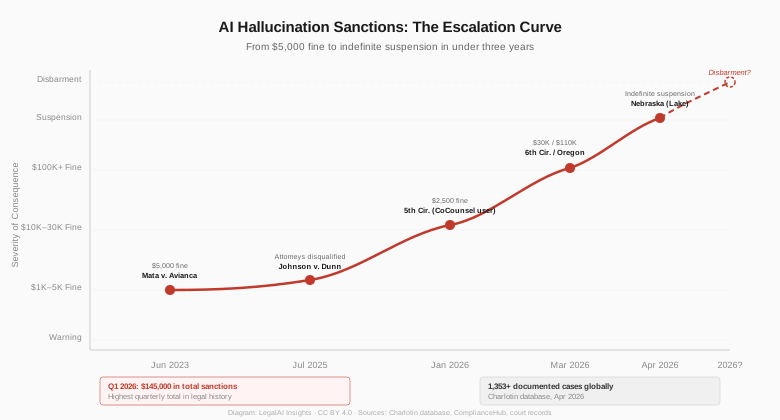
Update – June 13, 2026 (on track): Still suspensions, not yet a disbarment. The Nebraska Supreme Court suspended Omaha attorney Greg Lake on April 16 after 57 of 63 citations in an appellate brief were flagged defective, including 20 outright hallucinations and 3 fabricated cases. On June 3, the Ninth Circuit suspended two Orange County attorneys from practice before the court for six months. California’s State Bar has charged three more lawyers – a disciplinary track that can reach disbarment. The escalation toward the final rung is intact; no one has reached it.
2. At Least Three Legal AI Vendors Will Be Acquired or Shut Down#
[High confidence] The consolidation has already started. Legora acquired Walter shortly after raising $550 million. Thomson Reuters bought Noetica recently. Litera’s Dennis Garcia described the dynamic plainly: the legal technology market is crowded, competition is intense, and more M&A is inevitable.
The math driving consolidation is simple. Legal AI startups that raised seed or Series A rounds in 2023–2024 are 18–24 months in. The ones without meaningful revenue traction face a choice: find a buyer or shut down. Gartner predicts over 40% of agentic AI projects will be canceled by end of 2027 due to escalating costs or unclear business value. Forrester projects that enterprises will defer 25% of planned AI spend into 2027 due to ROI concerns.
Expect at least one acquisition above $500 million – likely a major publisher or enterprise software company buying a legal AI platform to add workflow capabilities. Point solutions that do one thing well but lack distribution or platform economics are the most vulnerable.
Update – June 13, 2026 (realized): Consolidation outran the forecast. On top of Legora–Walter and Thomson Reuters–Noetica, Harvey acquired Hexus and LawConnect acquired Finchly in early 2026, and Lexis+ AI was folded into Lexis+ with Protégé. Bloomberg Law and others document a broader wave of acquisitions and quiet shutdowns. Three-plus deals have cleared – prediction met. The one open piece is the predicted single acquisition above $500 million, which hasn’t been confirmed yet.
3. First-Year Associate Classes Will Shrink at BigLaw Firms#
[High confidence] Here’s the data point that hasn’t gotten enough attention. Law360 reported in December 2025 that 86% of large law firms plan to increase their total associate ranks through 2027 – but only 35% plan to increase the size of their first-year classes. That 51-percentage-point gap tells you exactly where the leverage model is heading: more senior associates, fewer juniors.
The logic is straightforward. AI absorbs the work that historically justified large first-year classes: document review, initial research, routine drafting. Harvard CLP documented one AmLaw 100 firm reducing complaint response time from 16 hours to 3–4 minutes. That’s not a task that needs a first-year anymore. Ropes & Gray now asks summer associate applicants to explain what they’re doing daily to keep up with AI development – a signal that AI fluency is becoming a hiring filter, not a nice-to-have.
This doesn’t mean fewer lawyers overall. It means fewer entry points into BigLaw, with the ones that remain demanding different skills. The NALP employment data for the class of 2024 showed record employment rates – but median law firm starting salaries dipped 3%, a subtle signal that the hiring market may already be softening at the entry level.
Update – June 13, 2026 (on track): The contraction is showing up in recruiting data. Law firms cut summer-associate hiring to record lows in the 2026 cycle, and firms like Cooley are filling only about half their summer class up front, leaving seats open to fill later. The summer class is the pipeline to the first-year class, so the leading indicator points the predicted way; definitive confirmation arrives with the class-of-2026 NALP numbers.
4. A Major Law Firm Will Offer Clients a Self-Service AI Tool#
[Medium confidence] The pieces are in place. Legora’s Portal already creates shared AI workspaces between firms and clients – Linklaters, Cleary Gottlieb, and Goodwin signed on as design partners. Wilson Sonsini’s Chief Innovation Officer predicted a proliferation of self-serve AI tools from law firms for narrow, repeatable use cases.
The business case is defensive. If a corporate client can use GC AI or a general-purpose LLM to handle NDA review internally, the firm loses that work entirely. If the firm builds a branded, playbook-constrained tool and offers it to the client directly – covering standard contract review, compliance checklists, or regulatory screening – the firm retains the relationship and the fees for anything the tool escalates. The first firm to do this credibly converts a cost center (routine advisory work clients are already insourcing) into a client retention mechanism.
Update – June 13, 2026 (emerging): The infrastructure is spreading. Legora’s client-facing Portal now reaches 800+ firms and in-house teams, giving firms a branded space to share AI outputs with clients, and Wilson Sonsini’s Neuron platform runs a fixed-fee commercial-contracting agent at 92% accuracy. Artificial Lawyer reports self-serve tooling is being offered to clients beyond simple chatbots. The pieces predicted are assembling, but no firm has yet made a true self-service product its headline client offering – consistent with the medium-confidence tag.
5. The EU AI Act’s High-Risk Deadlines Will Slip – and Colorado Will Rewrite Its AI Law#
[High confidence] Both were supposed to arrive this year. Neither will arrive as written.
The European Commission’s November 2025 “Digital Omnibus” proposal is pushing key AI Act compliance deadlines toward 2027–2028. The amendments must be adopted before August, or the original dates apply – but EU institutions are actively negotiating extensions. In the U.S., Colorado’s AI Policy Work Group released a recent proposal to repeal and replace much of SB 205, resetting the effective date to January 2027. The proposal narrows the law’s scope, replacing “high-risk AI systems” with “covered automated decision-making technology” and limiting what counts as a “consequential decision.”
The pattern is the same on both continents: comprehensive AI laws written in 2023–2024 are colliding with the reality that compliance regimes need standards that don’t exist yet, enforcement infrastructure that hasn’t been built, and categories that don’t map cleanly onto how AI is actually deployed. The regulatory trend for the rest of the year is delay-and-narrow, not repeal. Both laws will eventually take effect – but not on the timeline their drafters imagined.
Update – June 13, 2026 (realized): Both halves landed, almost to the letter. The EU’s Digital Omnibus deal, agreed in May 2026, defers high-risk obligations to December 2, 2027 for stand-alone Annex III systems and August 2, 2028 for AI embedded in regulated products. Colorado went further than a rewrite of timing: SB 189, signed May 14, 2026, repeals and reenacts SB 205 with a narrower, notice-based framework and resets the effective date to January 1, 2027. Delay-and-narrow on both continents, as predicted.
6. Hallucination Rates for the Best Legal AI Tools Will Drop Below 10%#
[Medium confidence] Stanford’s 2024 testing found Lexis+ AI hallucinated 17% of the time – the best rate among tools tested. Westlaw AI-Assisted Research hit 34%. Since then, foundation models have improved substantially, Graph RAG architectures have matured, and citation verification pipelines have tightened. A March 2025 randomized controlled trial found RAG-based tools achieving productivity gains of 38–115% while maintaining Hallucination rates comparable to non-AI human work.
The best publisher tools – CoCounsel with KeyCite, Protégé with Shepard’s – will push below 10% on citation accuracy by year-end. But the harder problem is mischaracterization: citing a real case while misstating its holding. Citation verification catches reversed or overruled cases. It doesn’t catch subtle misrepresentation – and that category of error will remain stubbornly high. This gap will become the primary quality differentiator between legal AI products, and the one most difficult for buyers to evaluate without hands-on testing.
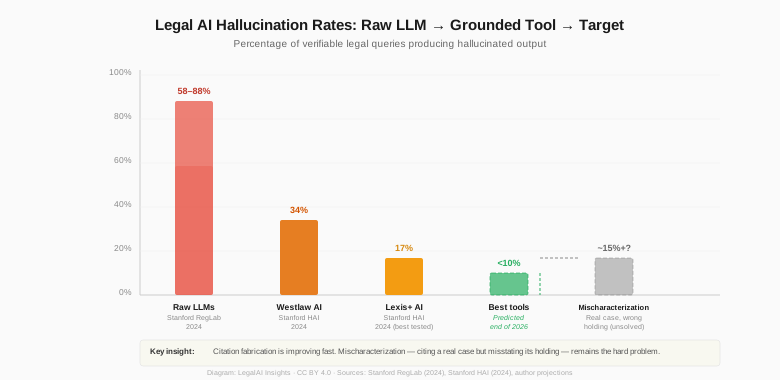
Update – June 13, 2026 (off track): No major tool is near the threshold at mid-year. Updated Stanford-based benchmarking put Lexis+ at 65% accuracy and Westlaw with CoCounsel at 42%, and researchers called Protégé’s “100% hallucination-free” marketing claim overstated. Citation-verification pipelines have improved, but sub-10% Hallucination on legal research remains out of reach. Six months of runway remain, yet this is the prediction most likely to miss.
7. Courts Will Rule on the Defensibility of LLM-Powered Document Review#
[Medium confidence] Courts accepted technology-assisted review in 2012 (Da Silva Moore) and 2015 (Rio Tinto). Those opinions addressed predictive coding – supervised machine learning trained on attorney seed sets. LLM-powered first-pass review is a different technology with different failure modes, and no published opinion has specifically addressed it.
With Relativity aiR now bundled into standard RelativityOne pricing (reaching 300,000+ users), Everlaw processing millions of documents per hour, and Syllo handling first-pass review on matters like the Desktop Metal trial, the volume of LLM-classified documents entering litigation is growing exponentially. A privilege blow – an inadvertent production of a privileged document flagged as non-privileged by an LLM – will force a court to address whether LLM-based classification meets the “reasonable inquiry” standard under the Federal Rules.
The ruling will likely be favorable. Courts have generally embraced technology-assisted review. But it will establish specific requirements: what validation protocols satisfy reasonableness, what disclosure is required about AI’s role in the review, and how error rates should be documented for defensibility.
Update – June 13, 2026 (not yet): Courts engaged AI and privilege in 2026, but not the question predicted here. United States v. Heppner (S.D.N.Y., Feb. 2026) held that prompts a client fed to a public AI tool and forwarded to counsel were not privileged – a waiver ruling, not a holding on whether LLM-based first-pass review satisfies the “reasonable inquiry” standard for production. No published opinion has yet addressed LLM document-review defensibility directly. Still open.
8. In-House Departments Will Cut Outside Counsel Spend 10–15%#
[Medium confidence] The ACC/Everlaw GenAI Survey found 64% of in-house teams expect to depend less on outside counsel because of AI capabilities they’re building internally. 87% of general counsel now report using AI within their departments, up from 44% in recent years. Meta saved $140,000 on a single category of repeat queries by building an internal AI assistant. GC AI reports a 14% average reduction in outside counsel spend among its customers – roughly $252,000 annually for a median legal department.
The reduction won’t come from rate negotiation. It will come from eliminating categories of work that go outside the building: standard contract review, routine regulatory questions, first-pass research, template drafting. As Google X’s Alex Ponce de Leon described it at the latest Legalweek, generative AI is enabling in-house teams to become augmented legal advisors, reserving outside counsel for truly complex, high-stakes work. Firms that don’t adapt their pricing models will see it in 2027 panel reviews.
Update – June 13, 2026 (partial): Real where AI is deeply adopted; invisible elsewhere. GC AI’s customer ROI study reports an average 14% reduction in outside-counsel spend – squarely inside the predicted band. But the broader market hasn’t caught up: the ACC/Everlaw survey found 59% of departments seeing “no noticeable savings yet” from their firms’ AI use, even as 87% of GCs now report using AI internally. The 10–15% cut is showing up in pockets of heavy adopters, not across the board.
9. Fixed-Fee Arrangements Will Accelerate – Driven by AI Economics#
[High confidence] 72% of U.S. law firms already offer some form of alternative fee arrangement, rising to 90% among firms with 50+ lawyers. 71% of legal consumers prefer flat fees. But most AFA usage is concentrated in routine transactional work – the billable hour still dominates high-value litigation and advisory.
AI is changing the arithmetic. Under hourly billing, a tool that reduces a task from eight hours to two costs the firm six hours of revenue. Under a fixed fee, the same tool converts those six hours into margin. Clio’s data shows firms with wide AI adoption are nearly three times more likely to report revenue growth. Duane Morris published a detailed argument for fixed fees in recurring securities law work – a practice area that historically billed hourly. The argument isn’t ideological; it’s that fixed fees align incentives with AI adoption while hourly billing fights it.
The prediction isn’t that hourly billing dies. It won’t – not for high-stakes, unpredictable litigation. The prediction is that fixed-fee arrangements expand from routine work into recurring advisory and compliance work that AI makes more predictable, and that this expansion accelerates as clients demand AI-driven pricing concessions in 2027 panel reviews.
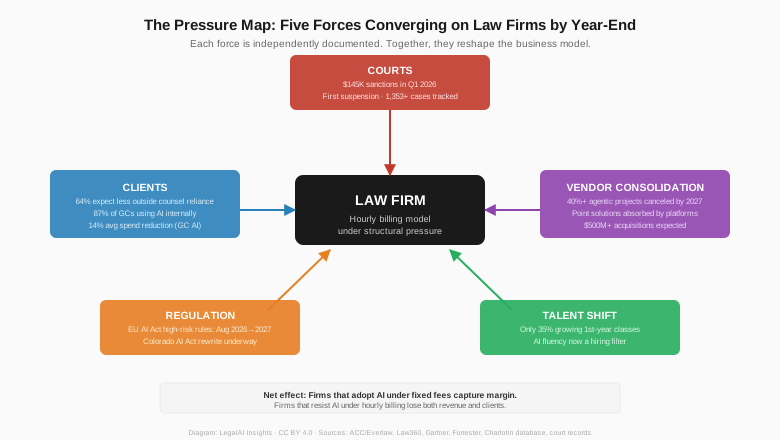
Update – June 13, 2026 (mixed): Pressure is mounting; the billing data lags. Commentators now argue AI makes fixed-fee billing inevitable and corporate clients are pushing hard for it, but survey data shows AI has done little to dent billable hours so far, and only about a third of firms with alternative fee arrangements use them heavily. The narrative and the incentives point the predicted way; measurable acceleration into recurring advisory work isn’t in the numbers yet.
10. A Legal AI Product Will Face Its First Professional Liability Claim for a Missed Issue#
[Low confidence] Everyone is watching for hallucinated citations. The higher-stakes failure mode is what the AI doesn’t flag: a buried change-of-control provision in a 200-page credit agreement, a regulatory deadline in a footnote, an indemnification cap that contradicts the term sheet.
As firms increase reliance on AI for first-pass review and reduce the human hours allocated to the same work, the probability of a consequential miss rises. The claim won’t target the model provider – it will target the firm that relied on the tool without adequate verification, and possibly the vendor under a breach-of-warranty or negligence theory. The Sullivan & Cromwell incident demonstrated that even firms with comprehensive AI policies, training requirements, and citation review procedures can fail to catch AI errors. Apply that dynamic to a transactional context – where a missed term doesn’t embarrass the firm in court but costs the client money – and the liability exposure is clear.
This is the risk that no Benchmark measures and no vendor addresses in their marketing materials. When a tool’s accuracy is 95%, the question is what’s in the other 5% – and whether anyone was assigned to look.
Update – June 13, 2026 (not yet): No such claim has surfaced. The action so far is on the insurance side – carriers and firms are scrambling over whether existing professional-liability policies even cover AI-assisted work, with a firm reviewing 500 contracts a month instead of 50 carrying roughly 10x the claim surface against unchanged aggregate limits. But no reported malpractice claim yet turns on an issue an AI tool failed to flag. Consistent with the low-confidence tag: the exposure is building faster than the case law.
Run Your Own Benchmark Before Year-End#
Most of these predictions will touch your practice before December. The firms and departments that navigate them well won’t be the ones who predicted the future correctly – they’ll be the ones who tested their tools against their own work.
Pick a task you’ve already completed. Pull your answer key. Give the same task to two or three models. Grade blind. Calculate whether the cost difference justifies the quality difference at your volume. An hour of testing with your own documents tells you more than any forecast – including this one.
Further Reading#
- AI Hallucination Cases Database. Damien Charlotin’s tracker of 1,353+ court filings with AI-generated fabrications.
- The 2026 Legal AI Reckoning. Case-by-case breakdown of every major 2026 hallucination sanction.
- Legal M&A Trends Q2 2026. AI consolidation and platform expansion in the legal industry.
- Law Firms’ Junior Roles At Risk From AI. Law360 survey on associate hiring plans through 2027.
- Hallucination-Free? (Stanford HAI). Independent testing of RAG-based legal AI tools (17–34% hallucination rates).
- State AI Laws – Where Are They Now?. Cooley’s tracker of the evolving U.S. AI regulatory landscape.
- 2026 Year in Preview: AI Regulatory Developments. Wilson Sonsini’s top 10 AI regulatory developments to watch.
- Law Firms Embrace AFAs, But Clients Want More Flexibility. Best Law Firms’ survey on alternative fee arrangement adoption.
- Google X’s Discovery Leader on Gen AI and Outside Counsel. How insourcing is reshaping the legal department relationship.
- 85 Predictions for AI and the Law in 2026. National Law Review’s expert survey.
This is a standalone post on LegalRealist AI. It is intended for informational and educational purposes only and does not constitute legal advice. Predictions reflect publicly available data and identified trends as of the publication date; outcomes are inherently uncertain. AI capabilities, regulatory timelines, and market conditions described here are subject to rapid change. Laws governing AI use vary by jurisdiction.