
The Bench Is Using It Too#
TL;DR
- The most-required disclosure in legal AI runs the wrong way. Three hundred-plus federal judges require lawyers to disclose AI use. The Northwestern survey is the first time anyone has asked the judges.
- 61.6% of federal judges use AI in their judicial work. Only 22.4% use it weekly or daily. The dominant tool is Westlaw AI-Assisted Research at 38.4% adoption — Harvey and Legora register zero.
- Two federal judges had to withdraw rulings in 2025 after their staff used ChatGPT and Perplexity for opinion drafting. Both wrote contrite letters to Senator Grassley. Neither chambers had a written AI policy at the time.
- 41.7% of federal chambers have no codified AI policy. That’s the practitioner’s real problem: you don’t know whether the judge reviewing your motion used AI, what tool, or under what controls.
- Treat every filing as if the judge might paste it into Westlaw AI. Build the record so an AI summary produces the same answer a careful clerk would.
When you file a motion in the U.S. District Court for the Western District of North Carolina, you must now certify on the first page that AI was not used to help prepare it. When you file in the Eleventh or Seventeenth Judicial Circuits of Florida — Miami-Dade and Broward — you must certify that all factual assertions, legal authority, and citations have been independently reviewed and verified. Three hundred-plus federal judges have now issued some form of AI disclosure or certification requirement, beginning with Judge Brantley Starr of the Northern District of Texas in 2023.
On March 30, 2026, Northwestern University and the New York City Bar Association published the first random-sample survey ever conducted on AI use by federal judges. It found that 61.6% of responding judges use at least one AI tool in their judicial work.
The asymmetry has been there all along. We just didn’t have the number.
The Asymmetry#
For two years the entire bar has watched the disclosure debate run in one direction. State bars issued opinions on whether lawyers must tell clients they’re using AI. Federal judges issued standing orders on whether lawyers must tell the court. The American Bar Association’s Formal Opinion 512 (July 2024) framed the obligation as a competence duty owed by attorneys to clients and tribunals.
None of these rules ran the other way. There is no national disclosure regime requiring a judge to tell parties when their motion was triaged by Claude, when their summary judgment record was summarized by Westlaw AI-Assisted Research, or when their hearing questions were drafted by ChatGPT. The Judicial Conference issued interim guidance in 2024 prohibiting judges from using AI to draft opinions, but most district courts left day-to-day chambers practice to individual judges.
Until the Northwestern study, no one had asked at scale how the bench was actually using these tools. The result was a one-way mirror: lawyers had to disclose; judges didn’t have to say.
The Northwestern Numbers#
The study, Artificial Intelligence in Federal Courts: A Random-Sample Survey of Judges, was led by Daniel W. Linna Jr. of Northwestern Pritzker Law and V.S. Subrahmanian of Northwestern’s McCormick School of Engineering, with U.S. District Judge Xavier Rodriguez of the Western District of Texas as a co-author. It was published in The Sedona Conference Journal, Volume 27, with the New York City Bar Association as co-publisher.
The sample is the methodologically careful part. Researchers drew a stratified random sample of 502 active federal judges — 92 bankruptcy, 177 magistrate, 182 district court, and 51 court of appeals — using the Federal Judicial Center’s Biographical Directory and other public sources. They asked about six general-purpose LLMs (ChatGPT, Claude, Copilot, Gemini, Grok, Perplexity) and six AI-for-law platforms (CoCounsel, Westlaw AI-Assisted Research, Protégé, Vincent AI, Harvey, and Legora). The response rate was 22.3% — 112 judges.
The headline number tells one story. The breakdown tells a different one.
| Frequency of AI use | % of responding judges |
|---|---|
| Daily | 5.4% |
| Weekly | 17.0% |
| Monthly | 19.6% |
| Rarely | 19.6% |
| Never | 38.4% |
Source: Jaitley et al., Artificial Intelligence in Federal Courts, Sedona Conference Journal Vol. 27 (March 2026). N=112.
Adoption is broad but shallow. The largest single group hasn’t used AI in their judicial work at all. Just under a quarter use it weekly or daily. The middle is a long tail of judges who have tried it and use it occasionally — the experimental phase, not the operational phase.
The tool preferences are more revealing than the frequency data. Westlaw AI-Assisted Research leads at 38.4% adoption. ChatGPT comes second at 28.6%. Harvey and Legora — the two best-funded standalone legal AI startups, with over $1 billion in combined raise — registered zero adoption. Not one responding judge reported using either.
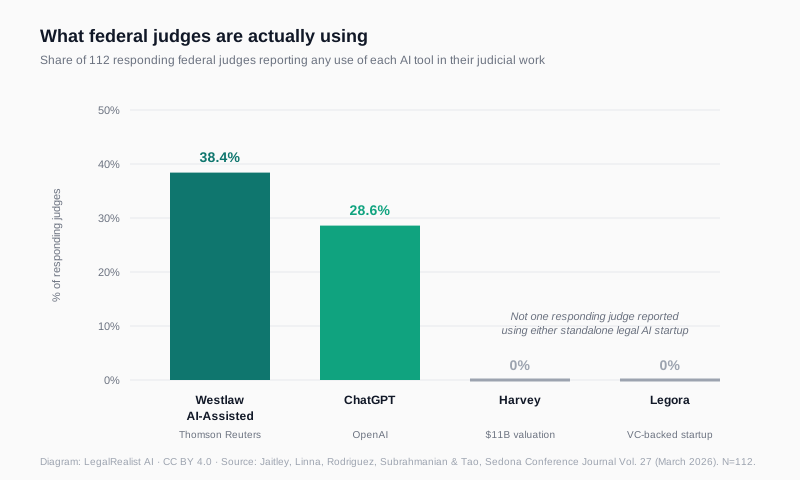
This makes sense the moment you think about who’s served by each product. Harvey and Legora were built for law firms. CoCounsel and Westlaw AI-Assisted Research were built around legal research databases that judges have used for decades. The path of least friction for a judge experimenting with AI is the search box that’s already on their screen — not a new platform requiring institutional procurement and a security review. Whatever AI vendor wins the chambers market will win it through the existing research subscription, not through a separate sale.
What Judges Are Actually Doing#
The most candid public account of judicial AI use comes from Judge Rodriguez himself. In interviews with the Washington Post and MIT Technology Review, and in his own writing for the Sedona Conference Journal, Rodriguez has described feeding case filings into AI tools to generate timelines, surface key actors, identify weaknesses in arguments, and draft questions for hearings. On a summary judgment motion in a hypothetical age discrimination case, he told the Post, “I’m uploading everything. And then I’ll ask, ‘Identify any potential statements made in this age discrimination case that appear discriminatory.’”
Federal Magistrate Judge Allison Goddard, who keeps an AI model open through the workday to search case records, co-authored Sedona Conference guidelines with Rodriguez and other judges in February 2025. The guidelines outline what they consider safe judicial uses — legal research, preliminary transcripts, brief search, draft routine orders — and warn that “no known GenAI tools have fully resolved the hallucination problem.”
Both judges draw the same line. AI is acceptable for triage, summarization, and template drafting. It is not acceptable for outcome-determinative reasoning: bail, custody, sentencing, the merits of a motion. This mirrors the four-tier risk framework developed by the National Center for State Courts, which sorts judicial AI uses by their potential to violate constitutional rights — from low-risk administrative work to high-stakes sentencing recommendations. California’s SB 574, which the state Senate passed in January 2026, formalizes the same line at the state level by barring judges from delegating decision-making authority to AI.
The careful version of judicial AI use has a structure: AI for inputs and templates, human for the decision and the reasoning that supports it. The problem is that the careful version isn’t the only version.
What Happens When It Goes Wrong#
In July 2025, U.S. District Judge Henry T. Wingate of the Southern District of Mississippi issued a temporary restraining order blocking enforcement of a Mississippi anti-DEI law. Within three days, Mississippi Attorney General Lynn Fitch’s office had identified errors throughout: misnamed parties, misquoted state law, references to declarations that weren’t in the record. Wingate withdrew the order. He later acknowledged in a letter to Senator Chuck Grassley that a law clerk had used Perplexity to draft the order, and that the docketed version was an early draft that “should have never been docketed.”
A month earlier, in In re CorMedix, U.S. District Judge Julien Xavier Neals of the District of New Jersey had issued an opinion on a motion to dismiss in a securities case that contained fabricated quotes attributed to litigants and misstated case outcomes. The errors were caught when attorneys tried to cite the opinion as precedent in another case and discovered the citations didn’t check out. Neals withdrew the opinion and reissued it. He later told Senator Grassley that a law school intern had used ChatGPT in violation of his chambers AI policy — and acknowledged that the policy had been communicated only verbally. He has since put it in writing.
Damien Charlotin’s hallucination cases database — which now exceeds 1,350 documented filings globally — currently logs four cases involving judicial rulings: Wingate, Neals, a state court matter in Georgia, and a case from India. The number is small. The pattern is not.
The Wingate and Neals withdrawals are the public version of a private problem. Both rulings were caught because opposing counsel read them carefully and pushed back. Most rulings don’t get that kind of scrutiny. A ruling on a motion to dismiss that quietly mischaracterizes a case in a paragraph of background reasoning is not going to be flagged unless someone specifically goes looking. The errors that get caught are the ones bad enough to surface; the ones that drift quietly into the case law are harder to count.
The Governance Vacuum#
The most uncomfortable finding in the Northwestern study isn’t the adoption rate. It’s the policy data. Among responding judges:
- 24.1% said their chambers have no official AI policy at all
- 17.6% said their chambers discourage AI use without formally prohibiting it
- The remaining 58% have some form of codified rule, but the survey didn’t probe the substance
Combined, more than 41% of federal chambers operate without a codified framework governing how AI may be used. This is the gap that produced both the Wingate and Neals incidents. Neals had a policy — he just hadn’t written it down, so a law school intern could violate it without realizing one existed.
The asymmetry sharpens here. A lawyer filing in the Western District of North Carolina or Miami-Dade County is operating under a written certification regime. The judge reviewing the filing may be operating under no policy at all. Whether the judge’s law clerks ran the motion through ChatGPT to produce a bench memo, or used Westlaw AI-Assisted Research to brief-search the cited authorities, is — in 41% of chambers — neither documented internally nor disclosed to parties.
Senator Grassley’s letters to Wingate and Neals signaled that the legislative branch is paying attention. The Administrative Office of the U.S. Courts told Grassley it does not keep statistics on judicial AI hallucinations. Pending mandatory reporting legislation proposed in early 2026 would require the AO to track AI-related sanctions and fee awards. Whether that reporting requirement will eventually run to judicial uses as well as attorney uses is the open question.
The Standing-Order Patchwork#
While the bench was quietly experimenting, individual judges were issuing inconsistent disclosure rules for everyone else. The result is a landscape where the rule depends on which judge draws your case.
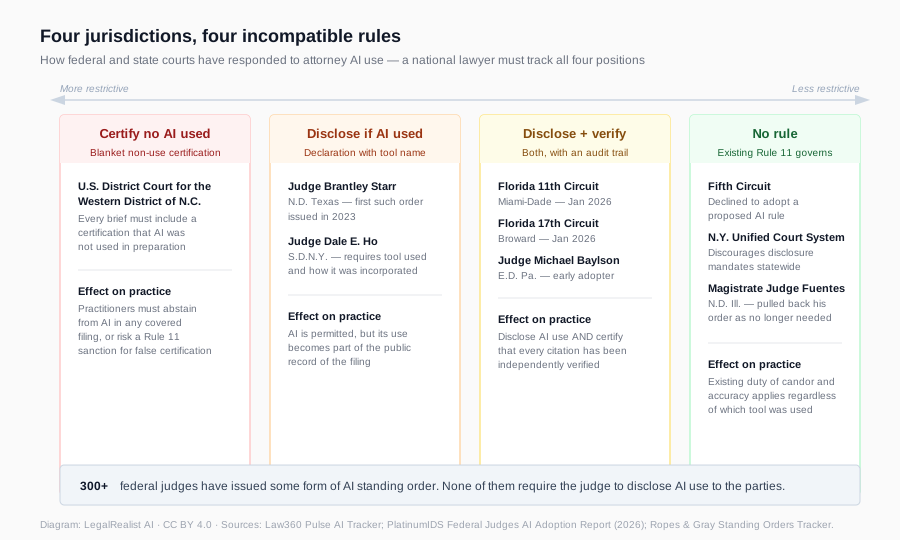
Some judges require certification that AI was not used. The U.S. District Court for the Western District of North Carolina now requires this on every brief. Some require disclosure when AI was used. U.S. District Judge Dale E. Ho of the Southern District of New York asks for declarations specifying the tool used and how its output was incorporated. Some — including the Northern District of Texas, the Eastern District of Pennsylvania, and Florida’s two largest judicial circuits — combine disclosure with affirmative certification that all citations have been independently verified.
Some have moved the other way. Illinois Magistrate Judge Gabriel A. Fuentes pulled back his AI standing order in 2025 after concluding it had become unnecessary and slightly burdensome. The Fifth Circuit declined to adopt a proposed AI rule entirely, with the panel reasoning that existing Rule 11 obligations already cover the duty to verify. The New York Unified Court System has discouraged disclosure mandates as a matter of statewide policy. The result: a national lawyer practicing across districts has to track which jurisdiction’s rule governs which filing — and the rules don’t agree on whether disclosure is required, prohibited, or beside the point.
The Seventh Circuit’s January 2026 decision on a pro se appeal points to a third position. The court declined to sanction a self-represented plaintiff suspected of submitting AI-hallucinated case law, while still vacating his appeal. “Accuracy and honesty matter,” the panel wrote — pinning responsibility for the filing on the litigant regardless of source. The same logic, applied consistently, suggests the disclosure question may be the wrong one. What matters is whether the citations check out, not which tool produced them.
What This Means for Litigators#
The Northwestern study doesn’t just describe the bench. It changes how careful litigators should write for it. Three working assumptions follow.
Treat every filing as if the judge might paste it into Westlaw AI-Assisted Research. The largest single tool-use cohort in the study isn’t ChatGPT — it’s the AI layer built into the research database the judge already pays for. That tool is good at extracting holdings, generating timelines, and answering “does this brief actually support its cited proposition?” Briefs that overstate authorities, cite cases for propositions they don’t squarely hold, or rely on string cites without engagement are likelier to get flagged in 2026 than they were in 2024 — not by a careful clerk, but by a tool the clerk runs first.
Assume the bench memo summarizing your motion was machine-generated. Judge Rodriguez has been candid that he uploads filings to generate timelines and summaries before hearings. That’s the careful version. The less careful version — a clerk feeding a 40-page motion into a general-purpose chatbot to produce a five-page summary — is happening in some unknown number of the 41% of chambers without policies. If your argument depends on a nuance buried on page 27, write the motion as if a summary will collapse that nuance unless you make it impossible to miss. Front-load the controlling facts. Repeat the operative holdings near each issue. Build the record so a summary produces the same answer a careful reading would.
Verify your own citations the way the Sedona Conference guidelines tell judges to verify theirs. The Wingate and Neals withdrawals happened to judges. They could have happened to anyone. The Sedona guidelines, the ABA’s Formal Opinion 512, and the Q1 2026 sanctions wave all converge on a single rule that applies regardless of which side of the bench you sit on: the human signing the document is responsible for the citations, and “my clerk used Perplexity” is not a defense.
The deeper issue is that two years of debate over lawyer disclosure left the harder question unasked. Lawyers using AI is a competence problem governed by Rules 1.1, 1.6, and 5.3. Judges using AI is something else — a question about the integrity of judicial reasoning, the role of clerks and interns as undisclosed AI operators, and what parties are entitled to know about how their cases are decided. The Northwestern study didn’t answer that question. It made it impossible to keep ignoring.
Further Reading#
- Artificial Intelligence in Federal Courts: A Random-Sample Survey of Judges (Jaitley, Linna, Rodriguez, Subrahmanian & Tao). Sedona Conference Journal Vol. 27 (March 2026). The primary source.
- Sedona Conference Working Group on AI and the Courts — Judicial Guidelines (February 2025). The first published framework for judicial AI use, co-authored by Judges Rodriguez and Goddard.
- Law360 Federal Judicial AI Standing Order Tracker. Live tracking of the patchwork of orders by jurisdiction.
- Damien Charlotin, AI Hallucination Cases Database. 1,350+ documented filings globally; four involve judicial rulings.
- ABA Formal Opinion 512. The lawyer-side disclosure framework that has no judicial counterpart.
- Senator Grassley letters to Judges Wingate and Neals (October 2025). Congressional response to the two withdrawn rulings.
- National Center for State Courts AI Risk Framework. The four-tier model that maps AI uses to constitutional risk.
- MIT Technology Review, Meet the early-adopter judges using AI (August 2025). Long-form profile of Rodriguez and Goddard.
This is a standalone post on LegalRealist AI. It is intended for informational and educational purposes only and does not constitute legal advice. The Northwestern survey data reflects 112 responding federal judges out of 502 sampled (22.3% response rate); inferences to the full federal judiciary are subject to the limitations of any survey. Court rules, standing orders, and bar opinions described here reflect publicly available information as of the publication date and are subject to change. Laws governing AI use vary by jurisdiction.