

The Knowledge Tax#
TL;DR
- Every legal department pays a knowledge tax — AI is making it visible and refusable. Meta saved $140,000 by eliminating repeat outside counsel questions, not by negotiating discounts. The same question billed twice, six months apart, is the tax.
- Clients are treating outside counsel work product as a permanent asset, not a one-time deliverable. Platforms like Legora’s Portal let firms index their memos directly into client knowledge systems. The next similar question costs a fraction of the first.
- When clients have 80% of the answer, they stop paying for 100%. AI-powered knowledge capture shifts billing conversations from “what’s your hourly rate?” to “what’s the marginal value of the 20% update we still need?”
- Fixed fees align incentives in a way hourly billing structurally cannot. Under a fixed fee, AI efficiency becomes firm margin — firms are incentivized to adopt and clients get cost certainty. 71% of legal consumers already prefer flat-fee billing.
- Ask your outside counsel where work product goes when a matter closes. If the answer is “into the associate’s files,” you’re paying the knowledge tax. If it’s “into a system your team can query,” you’re working with a firm that understands where the market is heading.
In Part 1 of this series, we mapped what corporate clients expect from AI-enabled law firms: lower costs, faster turnaround, governance transparency — and the survey data showing firms aren’t delivering. This post is about the specific mechanism clients are building to enforce those expectations: AI-powered knowledge management that captures everything outside counsel produces and turns it into a permanent asset.
Meta’s legal department built an AI assistant called Atticus to handle routine marketing legal queries internally. Within months of deployment, the tool had saved the company over $140,000 in outside counsel fees — not by negotiating discounts, but by eliminating the work entirely. As Jen Fryhling, Meta’s associate general counsel, told Law.com after winning the 2026 Legalweek Leaders in Tech Law Award for Best Custom Legal Technology Development: AI-powered tools are democratizing legal expertise, allowing in-house lawyers to access best practices that previously required outside consultation.
That $140,000 — a modest number against a legal budget of Meta’s scale — wasn’t spent on better AI. It was spent on the same questions Meta’s outside counsel had answered before, just asked again, by different people, at different times, with no system to retain the answers. The savings came from eliminating a single category of repeat queries, not from renegotiating rates or switching firms. It was a knowledge tax: the cost of institutional amnesia.
Every corporate legal department pays some version of this tax. An associate at your outside firm researches a regulatory question for one matter, produces a memo, and bills eight hours. Six months later, a different associate at the same firm researches the same question for a different matter and bills eight more hours. The first memo exists somewhere in the firm’s document management system. Nobody finds it. Your company pays twice for the same knowledge.
AI is making that tax visible — and corporate clients are refusing to keep paying it.
The Institutional Memory Problem#
Law firms have struggled with knowledge management for decades. Work product disappears into email threads, shared drives, and individual attorneys’ filing systems the moment a matter closes. When a new matter raises the same question, the firm starts from scratch.
For firms, this was an inconvenience. For clients, it’s a billing line item.
The In-House Connect CLE on modernizing legal knowledge management is now teaching in-house lawyers something that would make any outside counsel nervous: practical ways to reduce outside counsel spend by reusing institutional knowledge and standard guidance.
That’s the shift. Knowledge management used to be a law firm efficiency initiative. Now it’s a client procurement strategy.
How Clients Are Capturing the Knowledge#
The Internal Knowledge Layer#
In-house teams are using AI to build searchable repositories of their own accumulated guidance — contract playbooks, regulatory interpretations, standard positions on recurring issues. When a business unit asks a question the legal department answered two years ago, the AI surfaces the prior guidance instead of generating a new research request.
Tom Dunlop, CEO of legal tech company Summize, described where this is heading: empowering the wider business to be more self-sufficient by finding ways for technology and AI to use a lawyer’s knowledge to carry out tasks more autonomously. The immediate effect is fewer emails to the legal department. The downstream effect is fewer emails from the legal department to outside counsel.
A growing category of tools enables this. GC AI, built by a three-time former general counsel, reported that its customers saw a 14% average reduction in outside counsel spend — though that figure comes from the vendor’s own customer survey and should be read accordingly. Other platforms like Sandstone capture institutional memory in real time by observing how teams negotiate, though that approach raises its own questions about what data gets ingested and who controls it.
Capturing Outside Counsel Work Product#
The more consequential move is what happens to the work product that outside counsel does produce. Corporate departments are increasingly treating outside counsel memos, research, and analysis not as one-time deliverables but as inputs to their own knowledge systems.
Legora, an AI platform backed by Bessemer Venture Partners and General Catalyst, launched Portal specifically to address this. The tool creates a shared workspace where law firms can expose their knowledge — document libraries, playbooks, AI-driven research workflows — directly to their clients. Firms including Linklaters, Cleary Gottlieb, and Goodwin signed on as design partners. Kyle Poe, Legora’s VP of Legal Innovation and a former AmLaw 10 partner, described it as a fundamental shift in how legal services are delivered: firms scaling their expertise rather than just billing for it.
The client-side logic is simple. If your firm produced a 30-page memo on GDPR data transfer requirements for your European subsidiary last year, that memo should be instantly retrievable the next time the question arises — whether by the same firm, a different firm, or an in-house attorney handling it without outside help.
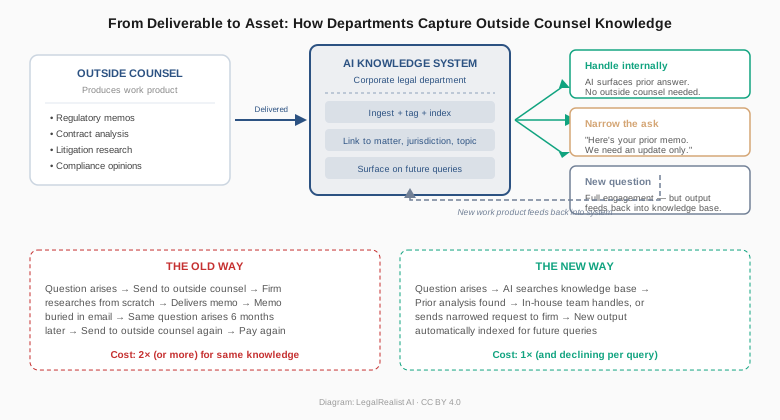
This changes the economics of the relationship. The first time a firm researches a question, the client pays full freight. Every subsequent time that question arises, the client’s AI pulls the prior analysis, and the work either doesn’t go to outside counsel at all or goes with a note: “Here’s what your firm told us last time. We need an update, not a fresh start.”
Eliminating Repeat Asks#
The ACC’s knowledge management maturity model defines the goal: capturing, distributing, and effectively using both structured and tacit knowledge assets, from work products like legal memos to understanding of an issue due to prior experience. AI makes the “distributing” and “using” parts scalable in ways that were previously impractical.
At the 2026 Legalweek conference, Alex Ponce de Leon, Google X’s discovery and litigation strategy leader and winner of the Innovator of the Year award, discussed how the move toward insourcing is forcing legal departments to reevaluate their outside counsel relationships entirely. Dan Fox, senior counsel at Kyndryl, argued that custom AI agents tailored to specific workflows — contract review, compliance checks, knowledge retrieval — will have the most transformative impact on legal departments, reducing reliance on manual processes and outside consultation.
Every question answered once should never need to be answered from scratch again.
The Pricing Collision#
Here’s what the knowledge shift looks like in a billing negotiation. Your outside firm billed 40 hours researching CFIUS review requirements for last year’s acquisition. This year, your department’s AI surfaces that memo in seconds. You still need a 4-hour update for the new regulations. The question is whether you accept 40 hours on the invoice again — and increasingly, clients aren’t.
As we covered in What Clients Actually Want from AI, over 60% of in-house counsel are pushing for pricing changes, and AI discounts are becoming a fixture in 2026 panel RFPs. Knowledge capture is the mechanism that makes those demands stick. When a department can prove it already has 80% of the answer, the pricing conversation shifts from “what’s your hourly rate?” to “what’s the marginal value of the 20% we still need?”
The Fixed-Fee Advantage#
The firms benefiting most from AI aren’t the ones cutting rates. They’re the ones decoupling revenue from hours.
Under hourly billing, an AI tool that reduces a task from eight hours to two costs the firm six hours of revenue. Under a fixed fee, the same tool converts six hours of freed capacity into margin — or into capacity to take on more work.
Walk the numbers on a concrete example. A firm prices a contract review package at $5,000 flat. Before AI, the work took 12 associate hours at an effective cost of $4,200 (at $350/hour loaded). After AI, it takes 4 hours at $1,400. The client pays the same $5,000. The firm’s margin jumps from $800 to $3,600. Now the firm is incentivized to adopt AI rather than fighting it — and the client gets faster turnaround without arguing over line items. Scale that across 200 matters a year and the firm has added $560,000 in margin without raising a single rate. As Kallam noted, a matter with a $200,000 fixed fee generates the same revenue whether it takes 400 hours or 250 hours, but the margin difference is substantial.
Clients should actually prefer fixed fees in this environment, even if the sticker price seems higher than an hourly estimate. A fixed fee aligns incentives: the firm wants to use AI because efficiency becomes profit, and the client gets cost certainty plus the speed gains that come from a firm that isn’t dragging its feet on adoption. Clio’s data supports this: firms with wide AI adoption are nearly three times more likely to report revenue growth. LeanLaw’s analysis found that 71% of legal consumers already prefer flat-fee billing.
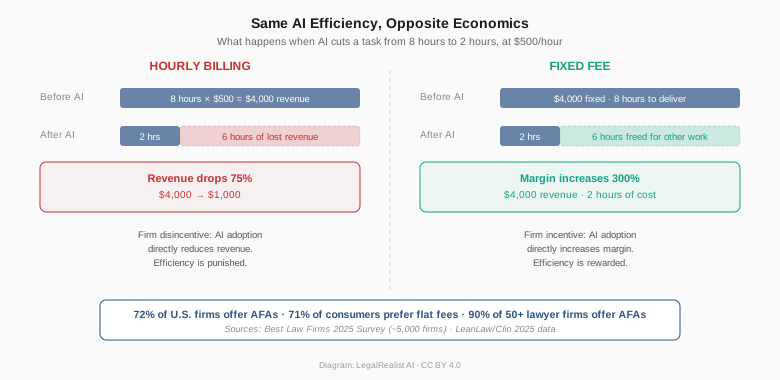
Clients expect to share in the efficiency gains. Firms that capture those gains as margin while billing the same hours are on borrowed time.
For clients, the question to bring to your next outside counsel review: When we pay you to research a question, where does that knowledge go? If the answer is “into the associate’s files,” you’re paying the knowledge tax. If the answer is “into a system your team can query next time,” you’re working with a firm that understands where the market is heading.
Further Reading#
- Meta AGC on AI and Outside Counsel. Jen Fryhling on how Atticus saved $140,000 by eliminating repeat outside counsel queries — and won the 2026 Legalweek Leaders in Tech Law Award for Best Custom Legal Technology.
- ACC Knowledge Management Maturity Model. The ACC’s framework for capturing, distributing, and reusing legal work product across the organization.
- Legora Portal Announcement. How law firms can expose their knowledge directly to clients through shared AI workspaces, with Linklaters, Cleary Gottlieb, and Goodwin as design partners.
- In-House Connect CLE: Modernizing Legal Knowledge Management. Practical guidance for in-house teams on reducing outside counsel spend through knowledge reuse.
- LeanLaw: Why AI May Make Fixed-Fee Billing Inevitable. Analysis of how AI efficiency is accelerating the shift to flat-fee arrangements and the economics that favor it.
- Clio Legal Knowledge Management Guide. Practical guide to building clause libraries and prompt systems that improve as lawyers correct AI outputs.
- Clio 2025 Legal Trends Report. Data on flat-fee adoption, AI revenue impact, and the 3x revenue growth advantage for firms with wide AI adoption.
- Google X Discovery Leader on the Outside Counsel Relationship. Alex Ponce de Leon on how insourcing is forcing legal departments to reevaluate outside counsel relationships entirely.
- Summize 2026 Legal Tech Trends. Perspective on AI-powered knowledge distribution and business unit self-sufficiency in legal departments.
This is part two of The Client Side, a two-part series on LegalRealist AI examining how corporate legal departments are reshaping the law firm relationship through AI. Read Part 1: What Clients Actually Want from AI. This post is intended for informational and educational purposes only and does not constitute legal advice. Product claims, pricing data, and survey results cited reflect publicly available information as of the publication date and are subject to change. Vendor references are for informational purposes; this post does not endorse any product or service.