

What Clients Actually Want from AI#
TL;DR
- Clients expect AI savings but almost none have seen them yet. 64% of in-house counsel expect AI to reduce outside counsel reliance, but 60% report no savings on their invoices — efficiency gains are landing in firm margins, not client bills.
- “Use AI. Don’t bill us for it” is becoming a contract clause. Zscaler’s public billing guidelines are a template: AI-related time and costs must not be passed to clients. Outside counsel guidelines are adding AI provisions alongside rate caps.
- 26% of legal departments plan to cut outside counsel spend in 2026 — even as workload surges. The math only works if departments are routing more work internally, which AI is enabling. BigLaw revenue records mask a squeeze on mid-tier and routine work.
- Firms with wide AI adoption are nearly 3x more likely to report revenue growth. The firms benefiting from AI redirect recaptured hours to higher-value work rather than hiding efficiency gains behind unchanged hourly invoices.
- Ask each outside firm what happens to the time AI saves their associates. If it becomes firm margin without appearing on your invoice, you have your answer about the relationship.
Zscaler’s outside counsel billing guidelines, published publicly on its website, contain a sentence that would have been unthinkable three years ago: “We encourage firms to use AI, including generative AI, where appropriate and practical to reduce administrative costs.” Two sentences later, the guardrail: “Any time and cost associated with AI-generated work product shall not be passed on to Zscaler.”
That’s the client expectation in two lines. Use AI. Don’t bill us for it.
Zscaler isn’t an outlier. The Association of Corporate Counsel (ACC) now publishes sample AI guidelines for outside counsel, complete with provisions on disclosure, data security, and accuracy. Corporate legal departments are embedding AI clauses into their outside counsel guidelines (OCGs) alongside the usual rules on block billing and rate caps. The question is no longer whether clients care about AI. It’s whether law firms understand how much — and how fast — those expectations are hardening into contractual requirements.
The Expectations Gap#
The clearest picture of the disconnect comes from the ACC/Everlaw 2025 Generative AI Survey, which surveyed roughly 650 in-house counsel and legal operations professionals.
Nearly two-thirds of in-house counsel (64%) expect generative AI to reduce their reliance on outside counsel — up from 58% the year before. Half expect lower outside counsel costs. But when asked whether they’ve seen savings yet, nearly 60% said no. Only 13% reported fewer billable hours from their firms’ use of AI; 20% saw faster turnaround times. The rest saw nothing.
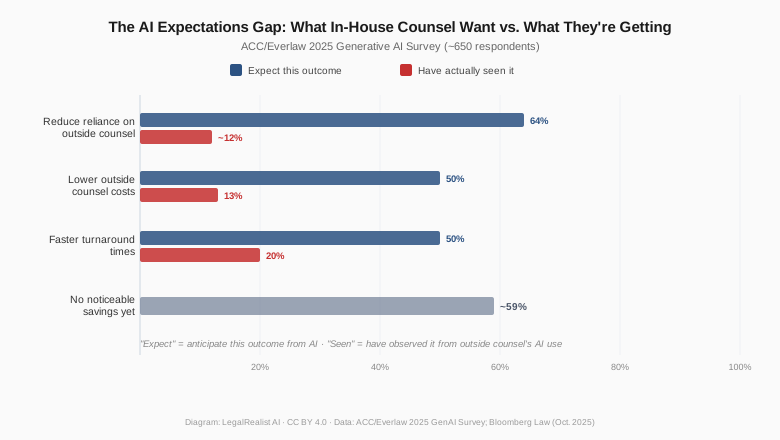
As Bloomberg Law reported, the problem isn’t that firms aren’t using AI — it’s that neither side knows how to price it. Firms don’t know how to adjust bills for AI-assisted work, and clients don’t know what discount to ask for. The result is a standoff where efficiency gains evaporate into the same hourly invoices.
ACC’s president and CEO, Veta T. Richardson, described AI in the survey’s release not as a productivity tool but as a strategic lever to “reduce reliance” on outside counsel. That language is a procurement signal, not a compliment.
What Clients Are Doing About It#
Rewriting the Rules#
Outside counsel guidelines have always governed billing behavior. Now they govern technology behavior too. Brightflag’s OCG best practices guide identifies AI as one of five core areas that modern guidelines must address, alongside resourcing, activities, commercial terms, and billing hygiene. Epiq’s analysis of OCG trends found that corporate legal departments are embedding AI provisions that cover disclosure requirements, data security standards, and expectations for how AI-driven efficiency should be reflected in pricing.
The Zscaler provisions are becoming a template. As more companies publish similar requirements, these expectations will become table stakes for panel selection.
A Sandpiper Partners OCG roundtable, sponsored by Williams Lea, captured the shift: OCGs are evolving from static billing documents into living agreements that address technology, risk, and operational alignment.
Cutting the Budget#
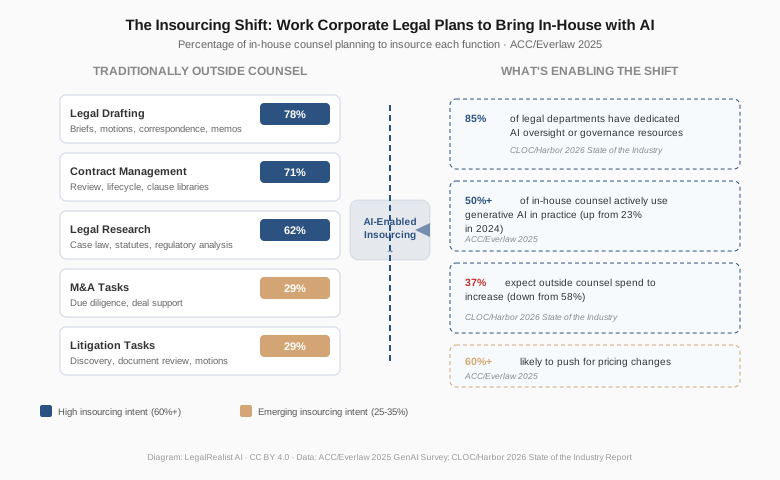
The CLOC 2026 State of the Industry Report, based on Harbor’s 22nd annual Law Department Survey of 135 corporate law departments, documents a sharp decline in outside counsel spend expectations. Only 37% of departments now expect their outside counsel spend to increase, down from 58% the previous year. Inside legal spend expectations fell nearly as steeply, from 65% to 47%.
This isn’t austerity for its own sake. Workload demand is rising — 63% of departments report surging regulatory compliance work, 58% cite growing cybersecurity demands. But legal departments are absorbing that demand through operational discipline and technology rather than throwing more money at outside firms. As Lauren Chung, the survey editor at Harbor, put it, departments are responding to constrained budgets by investing in smarter operating models and stronger AI governance. Outside counsel is no longer the default pressure valve.
The Harbor/CLOC data adds a sharper edge: 26% of departments actively expect to decrease spending on outside firms in 2026. That’s happening even as hourly rates continue climbing and overall demand for legal services grows. The math only works if departments are routing more work internally — and AI is how they plan to do it.
And yet — Am Law 100 firms posted record revenue in 2025. Hourly rates kept climbing. If clients are this unhappy, why do firms keep getting paid more? The likely answer is that bet-the-company litigation and complex M&A still command premium pricing regardless of AI. The squeeze is happening on routine and mid-tier work — exactly the categories clients are insourcing and demanding AFAs on. The top of the market is insulated. The middle is not.
Insourcing the Work#
The ACC/Everlaw survey quantifies the insourcing trend. In-house teams backed by AI efficiency gains plan to bring more work inside: 78% intend to insource drafting, 71% plan to insource contract management, and 62% will insource research. Even higher-stakes work isn’t immune — 29% of respondents plan to insource elements of M&A work, and another 29% plan the same for litigation tasks.
The Billing Collision#
AI makes legal work faster, but hourly billing rewards slowness. The 2025 Clio Legal Trends Report frames the problem directly — how can a lawyer charge for several hours when AI does the same work in minutes? The report found that 59% of firms now offer flat fees exclusively or alongside hourly rates, up from previous years. Clio’s mid-sized firm report found 64% of mid-sized firms offering flat fees, with 27% also offering subscription models.
The ACC/Everlaw survey adds the client perspective: over 60% of in-house counsel are likely to push for changes in how legal services are priced.
As Fennemore’s analysis of AI-ready billing noted, AI discounts are becoming a fixture in legal RFPs, particularly for 2026 panel reviews. Procurement teams now benchmark outside counsel against other AI-optimized providers. If the value isn’t visible in the invoice, clients will look elsewhere.
The firms seeing revenue growth from AI are the ones redirecting recaptured hours toward higher-value work — strategic counseling, complex problem-solving, business development — rather than trying to hide efficiency gains behind the same billing structure. Firms with wide AI adoption are nearly three times more likely to report revenue growth than firms that haven’t adopted AI, according to Clio’s data.
The Governance Layer#
Client expectations don’t stop at “use AI” and “charge less.” The CLOC 2026 report found that 85% of legal departments now have a dedicated resource or committee managing AI use — a decisive shift from experimentation to enterprise governance.
Clients increasingly expect their outside counsel to demonstrate not just AI capability but AI governance: documented policies, auditable workflows, data security protocols, and clear disclosure practices. As Emily Coghlan, a partner at Herbert Smith Freehills, wrote in the firm’s 2026 outlook: firms that combine robust guardrails with deep AI literacy will earn client trust and regulatory confidence.
The National Law Review’s 2026 predictions survey of 85 legal professionals captured this from the firm side. Anni Datesh, Chief Innovation Officer at Wilson Sonsini, predicted more focus on AI governance as firms reconcile an increasingly complex patchwork of client AI guidelines, audits, and compliance demands. Robert Klamser, Chief Innovation Officer at Stretto, was blunter: sophisticated clients will demand faster, more consistent work product and quietly reward firms that use AI to systematize quality.
The word “quietly” matters. Clients aren’t issuing press releases about which firms they’re rewarding. They’re routing work.
What Comes Next#
The pressure is directional. No survey in this data set shows clients becoming more comfortable with the status quo. OCG AI clauses are proliferating. Insourcing capabilities are compounding. Pricing expectations are hardening quarter by quarter.
The firms that will lose work aren’t the ones that fail to adopt AI. Most firms have adopted something by now. The firms that will lose work are the ones that adopted AI, captured the efficiency gains internally, and never changed what they charge. Clients can see that math — and they’re building the tools to do it themselves.
The question for your next outside counsel review: ask each firm on your panel what happens to the time AI saves their associates. If it shows up as margin on the firm’s books and nowhere on your invoice, you have your answer about the relationship.
Next in this series: the specific tools and strategies corporate legal departments are using to capture outside counsel knowledge, eliminate repeat questions, and turn institutional memory into a permanent cost advantage — in The Knowledge Tax.
Further Reading#
- ACC/Everlaw 2025 Generative AI Survey. Primary source: 650 in-house counsel on AI expectations versus realized savings from outside counsel.
- ACC Sample AI Guidelines for Outside Counsel. Model AI provisions that corporate departments are embedding in OCGs, covering disclosure, data security, and accuracy obligations.
- CLOC 2026 State of the Industry Report. Annual benchmark of corporate legal department budgets, staffing, and outside counsel spend expectations.
- Harbor 22nd Annual Law Department Survey. 135 corporate law departments on spend expectations and AI governance.
- Zscaler Outside Counsel Billing Guidelines. A publicly posted OCG template reflecting where client expectations are hardening.
- Bloomberg Law: AI Does Little to Reduce Law Firm Billable Hours. Analysis of the gap between firm AI adoption and change in client invoices.
- 2025 Clio Legal Trends Report. Data on flat-fee growth, AI adoption rates, and revenue impact across firm sizes.
- Brightflag OCG Best Practices Guide. Framework for modern OCGs covering AI alongside billing hygiene, resourcing, and commercial terms.
- Epiq: Outside Counsel Guidelines Built to Evolve. OCG trend analysis including AI provisions and data security requirements.
- National Law Review: 85 Predictions on AI and Law 2026. Legal professionals on AI governance expectations and outside counsel management in 2026.
This is part one of The Client Side, a two-part series on LegalRealist AI examining how corporate legal departments are reshaping the law firm relationship through AI. It is intended for informational and educational purposes only and does not constitute legal advice. Survey data cited reflects publicly available information as of the publication date. Survey methodologies, sample sizes, and respondent profiles vary across studies; readers should consult the original reports for full context. AI capabilities, adoption rates, and client expectations are subject to rapid change.