

Buy, Build, or Partner: Four BigLaw Bets on AI#
TL;DR
- Structure matters as much as the build-vs.-buy decision. S&C helped build a tool that worked, held a minority stake, and lost control when the startup was acquired. A minority investment gives you influence, not ownership.
- A&O Shearman turned institutional knowledge into recurring revenue. ContractMatrix and agentic tools built with Harvey are sold to other firms and clients on subscription — the first major firm to monetize its own practice expertise as a product line.
- Cleary acquired a team, not just a tool. Absorbing Springbok’s 10 AI engineers solved the talent problem that individual hiring can’t — but the acquisition is over a year old with no published adoption metrics.
- Freshfields diversified across Google, Anthropic, Microsoft, and Thomson Reuters — but can’t yet quantify firm-wide ROI. No single point of failure is the strategic upside; managing multiple strategic partnerships simultaneously is the risk.
- For firms below BigLaw scale, subscribe first and build on top. Latham and Macfarlanes show the pattern: an enterprise platform license for general capabilities, then internal tools built for firm-specific differentiation.
When Cleary Gottlieb acquired a London AI startup in March 2025, the ABA Journal called it an “extremely rare” move. Law firms license technology. They don’t buy technology companies. But across the Atlantic, A&O Shearman had already gone further — co-developing AI tools with Harvey and negotiating a revenue-sharing deal to sell those tools to other law firms. Sullivan & Cromwell had taken a lighter-touch approach: a minority investment in a Cornell Tech startup that built an e-discovery tool in S&C’s own offices — until the startup was acquired by someone else, and the IP walked out the door. And five days ago, Freshfields announced a multi-year co-development deal with Anthropic — its second strategic AI partnership in twelve months, after a similar arrangement with Google Cloud.
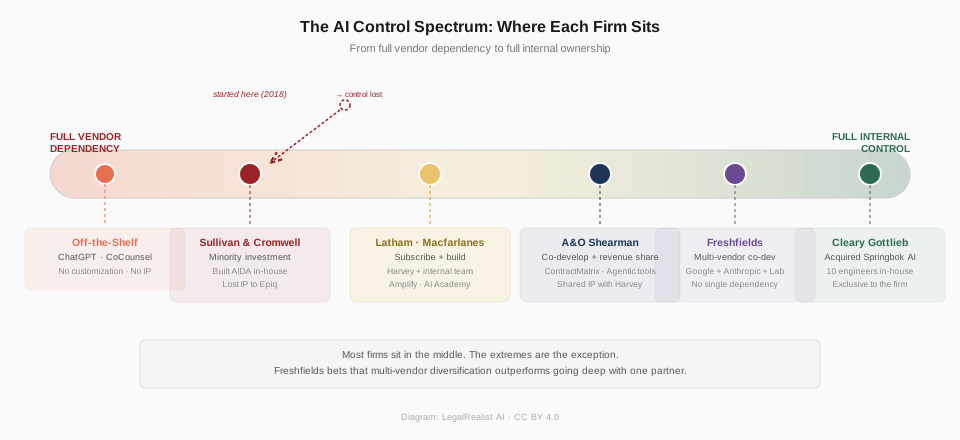
Four of the world’s most elite firms, four fundamentally different answers to the same question: who controls the AI your lawyers rely on?
What breaks when a model updates, what happens when a vendor gets acquired, and whether your firm captures the value of its own expertise or hands it to someone else — all of it depends on how you answer.
Cleary Gottlieb: Buy the Whole Company#
In March 2025, Cleary Gottlieb did something almost no BigLaw firm had done before: it acquired a technology company outright. Springbok AI, a London-based generative AI product development firm founded in 2017, had previously built tools for Dentons, Hogan Lovells, and EY. Cleary didn’t just license the product — it absorbed the entire operation: the proprietary SpringLaw platform, co-founder and CEO Victoria Albrecht, and a team of 10 data scientists and AI engineers.
The Springbok team became Cleary’s AI Acceleration team, embedded directly within the firm to build custom tools for practices that benefit from summarization, data extraction, and workflow automation. The group reports into Ilona Logvinova, Cleary’s Director of Practice Innovation, and works alongside two existing innovation arms: the e-Discovery and Litigation Technology (DLT) group and ClearyX, the firm’s alternative legal services operation launched in 2022.
Managing Partner Michael Gerstenzang has been one of the more vocal BigLaw leaders on the subject of AI adoption. He told Bloomberg Law that generative AI could help firms move away from the billable hour and reduce the structural advantage of brute-force staffing. The Springbok acquisition was the operational follow-through on that thesis.
What Cleary Gets — and What It Risks#
Control. The Springbok team works exclusively for Cleary. Its tools are purpose-built for the firm’s practice areas and clients. When a model provider ships an update that breaks a prompt, Cleary has in-house engineers who can fix it the same day — they don’t wait in a vendor’s support queue. SpringLaw is LLM-agnostic, meaning the firm isn’t locked into any single model provider.
Talent. Recruiting data scientists and AI engineers is brutally competitive. Acquiring a team of 10 with legal-domain experience is faster and more reliable than hiring them individually, especially when you’re competing against tech companies paying equity compensation that law firms can’t match.
But the acquisition carries real risks. Technologists and lawyers operate in different cultures with different incentive structures. If the AI Acceleration team can’t build tools lawyers actually use on live matters — not demos that impress at retreats — the acquisition becomes an expensive internal consultancy. A team of 10 is enough to build initial tools, but maintaining them across practice groups while keeping pace with competitors who have hundreds of engineers requires sustained investment. And Cleary’s tools are built for Cleary — they don’t have the feedback loop of a product company serving hundreds of firms. The acquisition is just over a year old, and the firm has not published adoption metrics or performance data for the tools the Springbok team has built — making this the hardest of the three strategies to evaluate on results rather than intent.
A&O Shearman: Partner and Share the Revenue#
A&O Shearman co-develops AI products with Harvey and shares in the subscription revenue when those products are sold to other law firms and corporations.
The partnership dates to November 2022, when the legacy Allen & Overy became the first major law firm to deploy Harvey at an enterprise level. By the time the partnership was announced publicly in early 2023, roughly 3,500 lawyers had already submitted around 40,000 queries. Today, Harvey supports 4,000 staff across 43 jurisdictions. The firm and Harvey report that staff save an average of 2–3 hours per week on routine tasks like summarization, analysis, and translation. (These figures are self-reported by A&O Shearman and Harvey; no independent evaluation has been published.)
The collaboration has also produced ContractMatrix, a generative AI platform for contract drafting, review, and negotiation, built with Harvey and Microsoft and launched in 2023. Around 2,000 of A&O Shearman’s lawyers use ContractMatrix daily. The firm reports it cuts contract review time by roughly 30%, saving an estimated seven hours per review on average. Clients — including life sciences companies, financial institutions, sovereign wealth funds, and tech companies — are licensing the tool for their own operations. In July 2025, the firm launched ContractMatrix Analyze, a module that reviews contracts against client-specific playbooks, with early adopters reporting accuracy levels exceeding 95% on expert-developed playbooks. Most recently, the firm developed ContractMatrix Vantage, which applies generative AI to complex analysis across large document portfolios — including a module for CRD VI loan transfer reviews that the firm proactively built ahead of the regulation’s January 2027 effective date.
The latest phase of the collaboration, announced in February 2026, produced a suite of agentic AI tools that handle multi-step reasoning tasks: antitrust filing analysis, cybersecurity assessments, fund formation reviews, and leveraged loan documentation analysis. These aren’t chatbots answering single prompts. They break complex legal problems into sub-tasks, execute them in sequence, and synthesize the results into work product that a lawyer can review and edit. These tools will be sold to other law firms and corporate clients on a subscription or usage-fee basis, with A&O Shearman sharing in the revenue. One secondary source estimated additional revenue potential of around £200 million by 2026, though that figure has not been confirmed by the firm.
The firm posted USD $3.7 billion in revenue for its first year as a combined firm (FY25). David Wakeling, who leads the 30-person Markets Innovation Group, has described the strategy as prioritizing “strategic partnerships with technology companies” over hiring engineers and data scientists internally — the opposite of Cleary’s approach. The Financial Times named A&O Shearman the “World’s Most Innovative Law Firm” in 2025.
What A&O Shearman Gets — and What It Risks#
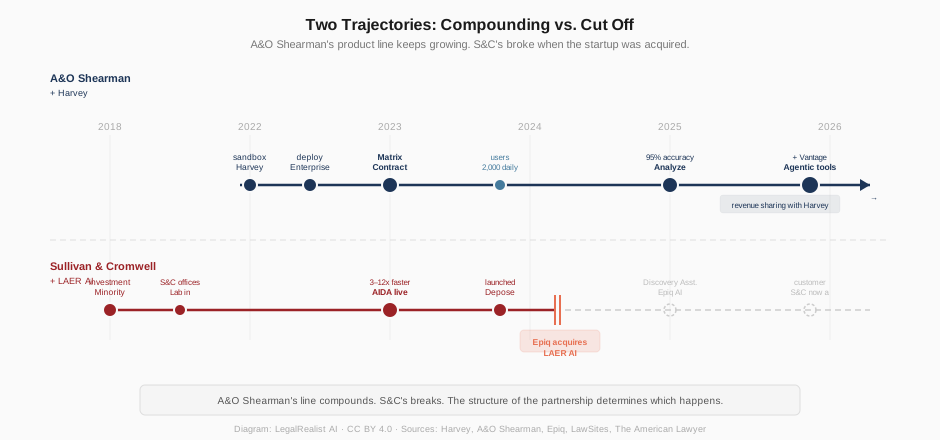
A proven product line. The progression from sandbox (2022) to enterprise Harvey deployment to ContractMatrix to Analyze to agentic tools shows a compounding strategy: each product builds on the institutional knowledge embedded in the last.
A new economic model. ContractMatrix licensing and the agentic tools’ subscription fees mean A&O Shearman earns revenue from other firms’ and clients’ use of tools built on its own lawyers’ knowledge — a fundamentally different model from hourly billing.
The risks are real, though. The partnership’s value is inseparable from Harvey, which has raised over $960 million through early 2026 at an $11 billion valuation — but remains a startup subject to acquisition, strategy pivots, or execution failures. Selling tools built on A&O Shearman’s practice expertise to competing firms is a bet that the firm’s judgment and client relationships are more durable advantages than the specific tools it sells. And a revenue-sharing arrangement between a law firm and a tech company creates novel questions about conflicts, data segregation, and regulatory compliance that don’t arise with standard vendor contracts. Paul Weiss, another Harvey client, has noted that it’s not using hard metrics like time saved to assess productivity gains because careful review of AI output makes efficiency measurement difficult — a reminder that published time savings may not translate cleanly into profit gains.
Sullivan & Cromwell: Invest and License#
S&C’s AI tools story started earlier than either Cleary’s or A&O Shearman’s — and initially looked like the most ambitious of the three.
In 2018, the firm made a minority investment in LAER AI, a startup founded at Cornell Tech by machine learning researchers Igor Labutov and Bishan Yang. The founders didn’t just receive funding — they set up a lab inside S&C’s offices, working directly alongside the firm’s litigation teams to develop AIDA (AI Discovery Assistant). Senior Chair Joe Shenker personally championed the investment.
AIDA was purpose-built for first-level document review. Unlike tools that rely on a single large language model, it used multiple specialized ML models — selecting the right model for each sub-task in the review process. It ran on-premises at S&C, meaning client documents never left the firm’s network. S&C trained it on dozens of past cases, and according to Relativity’s App Hub listing, AIDA delivered 3x to 12x speed increases over traditional TAR methods. It learned directly from natural language instructions, letting lawyers customize its behavior without writing code. Shenker told The American Lawyer the tool had “sped up the discovery process dramatically and freed up people.”
The ambitions extended beyond document review. LAER AI was developing a deposition assistant — Depose, launched in August 2024 — that could flag inconsistencies in live testimony, generate witness fact sheets, and correlate facts across depositions and documents. An AI litigation assistant for early case assessment and drafting was also in development. S&C had a roadmap for a full AI-powered litigation toolkit, built in-house.
Then, in 2024, Epiq acquired LAER AI. The founders joined Epiq as vice presidents. The technology S&C helped develop became the Epiq AI Discovery Assistant — which Epiq claims automates over 80% of traditional e-discovery processes and completes reviews up to 90% faster than traditional TAR, with the ability to analyze up to 500,000 documents per hour. S&C remains a customer: partner Matthew Schwartz said the tool “significantly reduces the volume of documents we need to have first-level reviewed,” citing high confidence scores and fast information extraction. But the firm no longer controls the technology, the roadmap, or the team that built it. The deposition assistant and litigation assistant S&C helped conceive are now Epiq products.
For general-purpose AI, S&C reportedly holds an enterprise license for OpenAI’s ChatGPT.
What S&C’s Strategy Reveals#
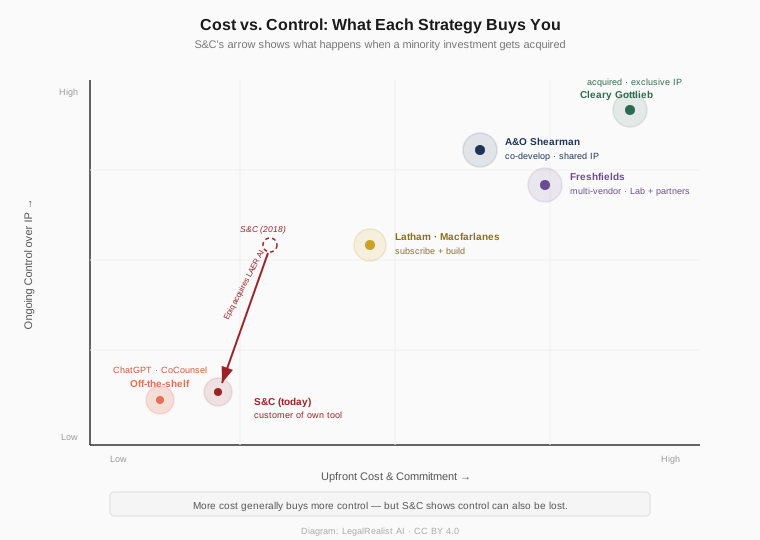
S&C’s LAER AI investment produced a tool that worked — on-premises, fast, trained on the firm’s own cases, with a product roadmap that could have given S&C a proprietary litigation AI stack. But a minority stake didn’t give the firm control over the company’s corporate trajectory. When Epiq made an acquisition offer, S&C couldn’t block the deal. The IP, the team, and the roadmap all transferred to a third party. Cleary avoided this by acquiring Springbok outright. A&O Shearman avoided it by structuring a revenue-sharing arrangement that keeps both sides financially aligned. S&C’s approach cost the least upfront but delivered the least durable advantage.
Freshfields: Multi-Vendor Co-Development#
On April 23, 2026 — five days before this post — Freshfields announced a multi-year co-development agreement with Anthropic. It was the firm’s second strategic AI partnership in twelve months. In April 2025, Freshfields had partnered with Google Cloud to roll out Gemini firmwide, build AI agents on Google’s Vertex AI platform, and power its proprietary Dynamic Due Diligence tool. Now it was doing the same thing with a second model provider — deploying Claude to all 5,700 employees across 33 offices, co-developing agentic legal workflows, and planning to expand into Cowork, Anthropic’s agentic AI platform. Within the first six weeks of Claude access, adoption increased by approximately 500%.
Freshfields’ approach is structurally different from the other three. Where A&O Shearman went deep with a single partner (Harvey), Freshfields went wide with multiple model providers — Google, Anthropic, Microsoft, Thomson Reuters, and Germany’s Beck-Noxtua — while building proprietary tools in-house through the Freshfields Lab, co-led by partner Gerrit Beckhaus and staffed by legal professionals, software developers, and project managers. The Lab develops the firm’s proprietary platforms — including Dynamic Due Diligence, a Case Management Platform, and a Multi-jurisdictional Insights Platform — that integrate whichever model performs best for the task. Chief Innovation Officer Gil Perez, who joined from Deutsche Bank in early 2024, described the approach as “tech-agnostic” — using the right model from the right provider for the right client need.
The Anthropic partnership goes beyond licensing. Freshfields will serve as outside counsel for Anthropic, collaborating with Anthropic’s in-house legal team to define new AI-native workflows for delivering legal services. In parallel, the firms are co-developing legal-focused AI applications — a similar model to A&O Shearman’s arrangement with Harvey, but with the firm maintaining relationships with multiple providers simultaneously. Freshfields is also an early adopter and tester of Thomson Reuters’ next-generation CoCounsel Legal, which is being fully rebuilt using Anthropic’s technology with Westlaw and Practical Law natively embedded.
One year into the Google partnership, over 5,000 professionals use AI tools built with Gemini. Over 2,100 regularly use Google’s NotebookLM Enterprise — with custom-managed encryption keys — to synthesize complex material and navigate large document sets. Google Workspace has been rolled out to 2,800 users. Beckhaus told Law.com that Claude is “really good at nuanced reasoning” and “really good at drafting,” while Gemini excels in other areas — making the multi-model approach more than theoretical.
What Freshfields Gets — and What It Risks#
No single point of failure. If Anthropic raises prices, pivots strategy, or gets acquired, Freshfields still has Google (and vice versa). If Harvey stumbles, A&O Shearman has a problem. If Springbok’s team leaves, Cleary has a problem. Freshfields has diversified its dependency across providers — the same principle as diversifying outside counsel across firms.
Best model for each task. Different models outperform on different tasks. Claude for nuanced reasoning and drafting, Gemini for long-context document analysis, CoCounsel for citation-verified research. Freshfields’ internal platforms route to the right model rather than forcing everything through one.
The risks are equally distinctive. Managing multiple strategic partnerships — each with its own integration requirements, security frameworks, data policies, and product roadmaps — is operationally complex. Perez acknowledged to the Global Legal Post that measuring overall return on AI investment remains “an industry challenge” and that Freshfields could not yet estimate firm-wide ROI despite seeing significant benefits. The multi-vendor approach also risks breadth without depth — a firm co-developing with everyone may advance more slowly with each partner than a firm that goes all-in with one.
The Trade-Off Matrix#
| Cleary: Acquire | A&O Shearman: Co-Develop | S&C: Invest + License | Freshfields: Multi-Vendor | |
|---|---|---|---|---|
| Control over IP | Full — team works exclusively in-house | Shared — co-owned with Harvey | Minimal — lost when LAER AI was acquired | Partial — proprietary Lab tools, shared co-dev |
| Upfront cost | Highest (acquisition + salaries) | Moderate (time + integration) | Lowest (minority stake + license fees) | High (multiple partnerships + internal Lab) |
| Dependency risk | Low — but team is small | High — tied to Harvey’s trajectory | High — vendor can change terms at will | Diversified — no single point of failure |
| Revenue potential | None beyond efficiency gains | Subscription revenue from tool sales | Equity return on exit only | Potential via CoCounsel/co-dev products |
| Model flexibility | High — SpringLaw is LLM-agnostic | Moderate — tied to Harvey’s stack | Low — tied to vendor’s model choices | Highest — Google, Anthropic, Microsoft, TR |
| Talent retention | Risk — engineers may leave for tech co. | Moderate — talent sits at Harvey | N/A — talent left with Epiq | Moderate — Lab team is internal |
The question isn’t which strategy is “best.” It’s which failure mode your firm can tolerate. Can you absorb the cost of maintaining an internal team? Can you accept dependency on a startup’s roadmap? Can you live with losing control of the IP you helped build?
The Build vs. Buy Calculus#
The buy case is straightforward — and A&O Shearman’s Harvey deployment is the strongest proof. Platforms like Harvey, CoCounsel, and Lexis+ AI deliver working AI tools within weeks. They come with compliance certifications, customer support, and ongoing updates as underlying models improve — all without hiring a single engineer. The 2026 Thomson Reuters/Georgetown State of the Legal Market report found that legal tech spending grew 9.7% in 2025, the fastest rate ever recorded, and most of that spending went to vendor subscriptions, not internal development.
The build case is harder to justify on cost alone — but Cleary’s acquisition of 10 engineers through a single deal, rather than competing for them individually against tech companies offering equity, shows one way to solve the talent problem. A Harvard Law School Center on the Legal Profession study found that about one third of firms have practice-specific methodologies — how your M&A team structures due diligence, how your regulatory practice tracks enforcement trends — that are competitive differentiators no vendor product can access.
Build when you have a high-volume, narrow task that no vendor serves well, and you have the engineering talent to maintain it. Buy when the task is well-served by existing products. But the four case studies above add a critical nuance: the structure of the buy matters as much as the decision to buy. A minority investment (S&C) gives you influence but not control. An acquisition (Cleary) gives you control but not scale. A co-development partnership (A&O Shearman) gives you both — if the partner stays aligned. Multi-vendor co-development (Freshfields) diversifies the risk — if you can manage the complexity.
The Mixed Approach: Subscribe and Build#
For firms below the scale of a Freshfields or A&O Shearman, the realistic strategy is a hybrid model — and two firms already demonstrate what it looks like. Latham & Watkins signed an enterprise Harvey license in August 2025 and simultaneously runs a mandatory AI Academy training over 400 associates per year, with billable credit for training time, while its internal AI strategy team led by Adam Ziegler builds practice-specific workflows on top. Macfarlanes achieved 80% internal adoption of Harvey, then had its internal Lawtech team build Amplify, a client-facing AI platform powered by Harvey’s API — clients use it without needing a Harvey license themselves.
The pattern: subscribe to a commercial platform for general capabilities, build internally for firm-specific differentiation. The commercial platform handles research, drafting, and document review — workflows that are largely the same across firms. The internal layer turns the firm’s own institutional knowledge — playbooks, precedent libraries, partner expertise — into a searchable system via a RAG pipeline connected to the firm’s document management system. A team of 2–5 engineers can stand up this kind of system. The risk is the gap between the two layers: if the commercial platform and internal tools don’t share context, lawyers toggle between systems and the value drops.
What to Watch#
These four firms are outliers. But the strategies they’ve chosen map to decisions every firm faces, and four questions will determine which approach ages best.
Does Cleary’s team ship? The Springbok acquisition is over a year old with no public results. If the AI Acceleration team produces tools that measurably change how Cleary’s lawyers work — and the firm can retain the engineers who built them — the acquisition model becomes a template. If the tools stay internal demos, the model becomes a cautionary tale about culture clashes between technologists and lawyers.
Do A&O Shearman’s agentic tools find paying customers? ContractMatrix has 2,000 internal daily users and external licensees. The agentic tools announced in February 2026 are the next test — they need to prove that other firms and corporations will pay subscription fees for AI agents built on A&O Shearman’s practice expertise. If they do, the revenue-sharing model with Harvey reshapes how law firms think about monetizing institutional knowledge.
Does anyone replicate S&C’s mistake — or learn from it? S&C invested early, co-developed a useful tool, and lost control when the startup was acquired. Firms currently making minority investments in legal AI startups should study that arc. The question isn’t whether the tool works — AIDA worked. The question is whether you’ll still own it in two years.
Can Freshfields manage the complexity? Two strategic AI partnerships, an internal Lab, CoCounsel, Microsoft — and still no firm-wide ROI figure. If Freshfields can demonstrate that multi-vendor co-development delivers better outcomes than going deep with one partner, it becomes the template for large global firms. If the complexity slows execution, it becomes a cautionary tale about spreading too thin.
Further Reading#
- Cleary Gottlieb Acquires Springbok AI. Cleary’s acquisition announcement (March 2025).
- A&O Shearman and Harvey Agentic AI Agents. The co-development and revenue-sharing announcement.
- Epiq AI Discovery Assistant. How S&C’s LAER AI investment became Epiq’s product (LawSites coverage).
- Freshfields and Anthropic Co-Build AI Legal Workflows. The multi-year partnership announcement (April 2026).
- Freshfields and Google Cloud Strategic Collaboration. The Google partnership (April 2025).
- Inside Freshfields’ Partnership With Anthropic. Law.com Q&A with Perez and Beckhaus.
- The Impact of AI on Law Firms’ Business Models. Harvard Law School Center on the Legal Profession (February 2025).
- Legal Tech Spending Surges 9.7%. 2026 Report on the State of the US Legal Market.
- A&O Shearman AI Strategy Analysis. Klover.ai deep dive on the Harvey partnership.
- ABA Journal: Cleary’s “Extremely Rare” Move. ABA coverage of the Springbok deal.
- AI × KM 2026: Knowledge Management as Infrastructure. InsidePractice on the knowledge backbone.
This post is part of the Law Firm AI Positioning series on LegalRealist AI. It is intended for informational and educational purposes only and does not constitute legal advice. AI capabilities, strategies, and market conditions described here reflect publicly available information as of the publication date and are subject to rapid change.